MiraLAX dosage reference for dogs (Polyethylene glycol 3350)
This medication is presented with its per-animal reference amount instead of a weight-based calculator. Confirm the current weight, exact product strength and schedule with your veterinarian.
This information is for educational purposes only. Always consult your veterinarian before giving medication to your pet. Do not use this reference for emergencies, overdoses, pregnancy, very young animals, very old animals, pets with liver/kidney disease, or pets taking multiple medications.
Sources and review process
Each medication page lists the references recorded for its data. The reference content and editorial presentation are maintained by PetDosageChart; a page is independently DVM-reviewed only when a named reviewer byline appears. See our methodology and limitations.
Some straining is an emergency. See a vet first.
Do not give a laxative if your dog is vomiting, will not eat, is lethargic or has a painful belly, or may have swallowed bones or other material that could block the bowel. A dog that keeps trying to urinate and passes little or nothing may have a urinary blockage, which the Merck Veterinary Manual (opens in a new tab) calls an emergency. In any of these cases, contact your veterinarian or an emergency clinic now.
MiraLAX is a brand of polyethylene glycol 3350 (PEG 3350), an osmotic laxative sold over the counter for people. It is not approved for dogs; veterinarians use it off-label to keep water in the colon and soften stool. The unflavored powder contains PEG 3350 and nothing else, and it is mixed into food rather than given as a pill.
No dose chart by weight on this page: The veterinary references checked for this page do not publish a MiraLAX dosage for dogs by weight. The Merck Veterinary Manual gives a single amount for dogs and cats, 1/8 to 1/4 teaspoon of PEG 3350 by mouth or in food every 12 hours, adjusted until stools are soft, and its laxative table lists a PEG 3350 dose for cats only. Your veterinarian sets the amount for your dog.
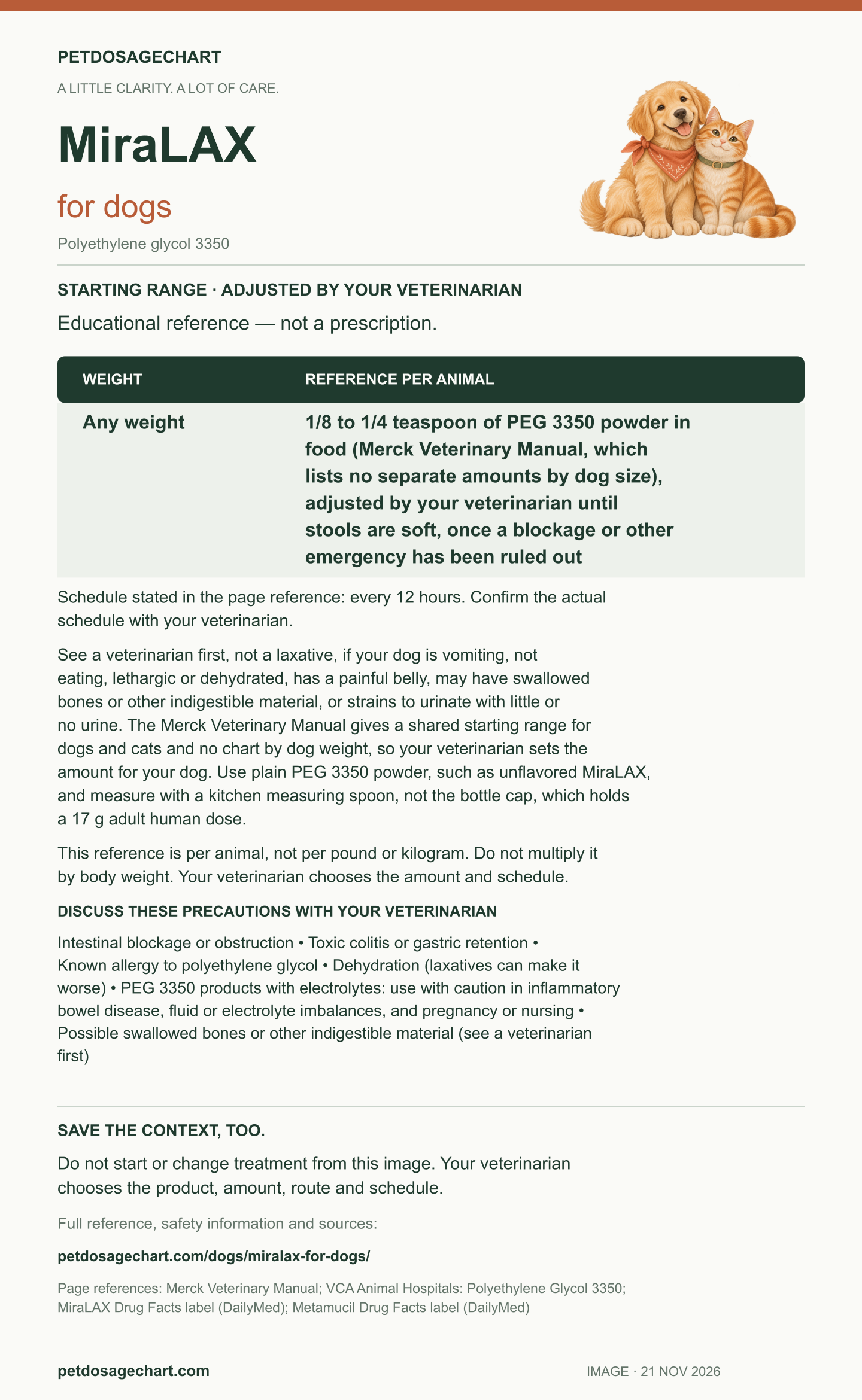
MiraLAX Reference Amount for Dogs
See a veterinarian first, not a laxative, if your dog is vomiting, not eating, lethargic or dehydrated, has a painful belly, may have swallowed bones or other indigestible material, or strains to urinate with little or no urine. The Merck Veterinary Manual gives a shared starting range for dogs and cats and no chart by dog weight, so your veterinarian sets the amount for your dog. Use plain PEG 3350 powder, such as unflavored MiraLAX, and measure with a kitchen measuring spoon, not the bottle cap, which holds a 17 g adult human dose.
| Dog weight | Reference amount (every 12 hours) |
|---|---|
| Any weight | 1/8 to 1/4 teaspoon of PEG 3350 powder in food (Merck Veterinary Manual, which lists no separate amounts by dog size), adjusted by your veterinarian until stools are soft, once a blockage or other emergency has been ruled out |
The cited source reports amounts per dog. Give only the amount and schedule your veterinarian prescribes.
Keep a copy of the reference chart
Educational reference, not a prescription. Your veterinarian sets the actual dose, product and schedule.
Why there is no MiraLAX dosage chart for dogs by weight
A dose chart would need a per-pound or per-kilogram figure, and the references checked for this page do not give one for PEG 3350 in dogs:
- The Merck Veterinary Manual constipation chapter, which covers dogs and cats together, lists 1/8 to 1/4 teaspoon every 12 hours, adjusted to soft stool, with no separate amounts for small and large dogs.
- The Merck laxative drug table lists PEG 3350 for cats (0.3 to 0.6 g every 12 hours) and gives no dog dose. Merck also notes that laxative dosages are generally empirical and extrapolated from human doses.
- The only published PEG 3350 dosing study found for this page was in six healthy cats, described on the MiraLAX for cats reference.
Scaling a teaspoon amount up by body weight, or using a human 17 g capful, would produce numbers these sources do not support. That is why this page shows the published amount as text instead of a calculator.
How to Give MiraLAX to Your Dog
Give it only after your veterinarian has agreed that a laxative is appropriate and told you how much to use.
- Use plain, unflavored PEG 3350 powder. Check Drug Facts for polyethylene glycol 3350 as the only active ingredient. Unflavored MiraLAX lists no inactive ingredients. Do not substitute electrolyte bowel preparations, combination laxatives or sweetened products.
- Measure with a kitchen measuring spoon, not the bottle cap. The cap is marked for 17 g, the once-daily dose for an adult person.
- Mix it into a small portion of wet food your dog will finish, so the whole dose is eaten, then offer the rest of the meal. Merck notes the powder can be added to a dog’s regular food.
- Keep fresh water available at all times. Laxatives should not be given to a dehydrated dog because they can make dehydration worse.
- Watch the stool. Tell your veterinarian if stools turn watery or if constipation does not improve. The human powder label says a bowel movement generally takes 1 to 3 days. Timing in pets varies. Do not repeat or increase a dose early while waiting. Call your veterinarian for continued straining or watery stools.
- If you miss a dose, give it when you remember unless the next one is nearly due. Never give two doses at once.
Tell your veterinarian about every other medicine your dog takes. Diuretics, opioids, other laxatives, tricyclic antidepressants and extended-release oral drugs can interact with PEG 3350.
What the source establishes
Lists polyethylene glycol 3350 at 1/8 to 1/4 teaspoonful by mouth or in food every 12 hours, adjusted to achieve soft stool, without separate amounts by species or dog size, and says laxatives should be avoided in dehydrated animals. It lists psyllium at 1 to 4 teaspoons per meal depending on size (cats and small dogs need less) or pumpkin at 1 to 4 tablespoons per meal added to canned food, with the animal well hydrated first, and calls dietary fiber preferable to other laxatives because it is well tolerated; lactulose liquid at 0.5 mL/kg every 8 to 12 hours; and docusate sodium at one to four 50 mg capsules every 24 hours for dogs. It limits mineral oil to rectal use because of the risk of aspiration pneumonia, names bones among material that can obstruct the colon and opioids among drugs that promote constipation, and describes lethargy, anorexia, vomiting and abdominal discomfort in severely affected animals.
A veterinary reference chapter covering dogs and cats together. It gives no PEG 3350 chart by dog weight, and none of these amounts replaces an examination.
Merck Veterinary Manual: Constipation, Obstipation, and Megacolon in Small Animals — Etiology; Clinical Findings; Treatment and Control (full review June 2025).
The laxative table lists a polyethylene glycol 3350 dose for cats only (0.3 to 0.6 g every 12 hours) and none for dogs. The text says PEG 3350 is generally free of adverse effects, that the powder can be added to a dog's or cat's regular food and does not produce bloating or gas, and that docusate should not be given with mineral oil. It notes that laxative dosages are generally empirical and usually extrapolated from human doses.
A pharmacology overview. It supplies no PEG 3350 dose by dog weight and sets no dose for an individual dog.
Merck Veterinary Manual: Cathartic and Laxative Drugs Used in Monogastric Animals — Table: Cathartic and Laxative Drugs; Hyperosmotic Cathartics; Fecal Softeners (full review May 2023).
Calls urethral obstruction a common urinary emergency in small animals. Obstructed animals make frequent nonproductive attempts to urinate, and complete obstruction causes uremia within 36 to 48 hours.
A professional reference. It supports seeing a veterinarian promptly when a dog strains to urinate; it does not let an owner tell the two problems apart at home.
Merck Veterinary Manual: Urethral Obstruction in Small Animals — Clinical Findings; Treatment (full review May 2025).
Says use in cats and dogs is off-label, that the powder may be mixed with food as long as the whole dose is swallowed, that pets need plenty of fresh water, and that stool consistency should be monitored. The handout discusses several formulations and does not establish time to a bowel movement with plain powder. It lists vomiting, diarrhea, nausea, flatulence and abdominal cramping, says not to use it with intestinal blockage, toxic colitis, gastric retention or allergy, urges caution with electrolyte-containing products in inflammatory bowel disease, fluid or electrolyte imbalance and pregnancy or nursing, and names diuretics, extended-release oral drugs, opioids, other laxatives and tricyclic antidepressants as interactions.
An owner handout written by a pharmacist and a veterinarian. It gives no dose.
VCA Animal Hospitals: Polyethylene Glycol 3350 — How do I give my pet PEG 3350?; side effects; risk factors; drug interactions; monitoring.
The active ingredient is polyethylene glycol 3350, 17 g per dose when the bottle cap is filled to the line, which is the once-daily adult human dose. The unflavored product lists no inactive ingredients and generally produces a bowel movement in 1 to 3 days in humans.
A human product label. It does not give a dose for dogs.
MiraLAX (polyethylene glycol 3350) Drug Facts label (DailyMed) — Drug Facts: Active ingredient; Directions; Inactive ingredients.
The active ingredient is psyllium husk, about 3.4 g in each 12 g packet of the orange powder, whose inactive ingredients include sucrose, flavor and a dye.
A human product label. It shows that a flavored Metamucil packet is mostly not psyllium; it does not give a dose for dogs.
Metamucil (psyllium husk) Drug Facts label (DailyMed) — Drug Facts: Active ingredient; Inactive ingredients.
Severe diarrhea can cause dehydration and electrolyte imbalance.
This is a consequence of fluid loss, independent of whether a powder contains electrolytes.
Merck Veterinary Manual: The Digestive System in Animals — Fluid losses in gastrointestinal disease.
Choose plain pumpkin without added sugar or spices. Avoid pumpkin pie filling.
Product selection only. Merck discusses fiber and hydration in constipated small animals.
Pet Poison Helpline: Pumpkins, a Safe and Nutritious Treat — Pumpkin preparation.
A dachshund died after a sodium phosphate enema despite intensive treatment.
The series documents serious risk in small dogs and cats; it does not establish a safe weight cutoff.
Tomsa et al.: Life-threatening metabolic disorders following sodium phosphate enemas — Case series, abstract.
Other Constipation Options for Dogs: Stool Softeners, Metamucil, Lactulose and Pumpkin
The Merck Veterinary Manual describes several other approaches. Each is a question for your veterinarian, not a home treatment to stack with MiraLAX.
- Fiber: pumpkin and psyllium (Metamucil). Merck calls dietary fiber preferable to other laxatives because it is well tolerated. Use plain, unsweetened 100% canned pumpkin, never pumpkin pie filling. Choose plain psyllium without added sweeteners. Merck gives a combined range for dogs and cats. Ask your veterinarian for an amount appropriate to your dog’s size. Small dogs need smaller amounts. Check sugar-free fiber products for xylitol, which is poisonous to dogs. Your dog should be well hydrated before fiber is added. A flavored Metamucil packet is mostly not psyllium: the orange powder lists about 3.4 g of psyllium husk in a 12 g packet, plus sugar, flavoring and dye.
- Stool softeners (docusate). Merck lists docusate sodium for dogs at one to four 50 mg capsules every 24 hours. Docusate should not be given together with mineral oil.
- Lactulose. A liquid that holds water in the bowel to soften stool. Merck lists 0.5 mL per kg every 8 to 12 hours.
- Enemas. Never give a human phosphate enema to your dog. It can cause life-threatening electrolyte changes, especially in small dogs. Ask your veterinarian before using any rectal treatment.
- Mineral oil. Merck limits it to rectal use, because a dog can inhale oil given by mouth and develop aspiration pneumonia.
Some medicines make constipation more likely: Merck lists opioids, diuretics, antihistamines, sucralfate and several others. Constipation is a recorded side effect of loperamide, an opioid sold as Imodium. MiraLAX treats the opposite problem from the antidiarrheals on this site, the Imodium (loperamide) reference for dogs and the Pepto-Bismol (bismuth subsalicylate) reference for dogs, and none of these is a substitute for a diagnosis when your dog’s stool changes.
Side Effects and Safety
Persistent watery diarrhea can cause dehydration and electrolyte losses even with plain powder. Call your veterinarian if it occurs.
Common side effects include diarrhea or overly loose stool, vomiting, nausea, flatulence, and abdominal cramping. VCA Animal Hospitals lists flatulence among the possible side effects, while the Merck Veterinary Manual describes PEG 3350 as generally free of adverse effects and says that, unlike fiber laxatives, it does not produce bloating or gas. Tell your veterinarian about any side effect that persists.
When MiraLAX should be used with caution or avoided
Some dogs should not take MiraLAX, or need a different dose and closer monitoring. Tell your veterinarian about your pet's full health history and every other medication or supplement they take before giving MiraLAX.
- Intestinal blockage or obstruction
- Toxic colitis or gastric retention
- Known allergy to polyethylene glycol
- Dehydration (laxatives can make it worse)
- PEG 3350 products with electrolytes: use with caution in inflammatory bowel disease, fluid or electrolyte imbalances, and pregnancy or nursing
- Possible swallowed bones or other indigestible material (see a veterinarian first)
MiraLAX drug interactions
MiraLAX can interact with other drugs. This list is not complete — always give your veterinarian a full list of your dog's medications and supplements.
When this reference is not enough
A reference table cannot decide whether a product or treatment is appropriate for an individual animal. Do not rely on it in these situations — talk to your veterinarian instead:
- In an emergency, or after accidental ingestion or a suspected overdose
- For pregnant or nursing pets
- For very young or very old dogs
- For pets with liver disease, kidney disease, or another chronic illness
- For pets taking several medications at once
- When you are not sure of your dog's current, accurate weight
- For combination products that contain additional active ingredients
Suspected overdose: what to do
If you think your dog had too much MiraLAX, or swallowed any medication by accident, act right away. Do not wait for symptoms to appear.
- Call your veterinarian or the nearest emergency animal hospital.
- ASPCA Animal Poison Control Center: (888) 426-4435
- Pet Poison Helpline: (855) 764-7661
A consultation fee may apply to the poison hotlines. Have the medication packaging ready, and note how much your pet may have taken and when. Do not try to make your pet vomit unless a veterinarian tells you to.
When to Call the Vet
If your dog shows any of the following, contact your veterinarian or an emergency clinic immediately:
- Vomiting, not eating, lethargy, or a painful belly
- Your dog may have swallowed bones or other indigestible material that could block the bowel
- Straining to urinate with little or no urine (possible urinary blockage, an emergency)
- Constipation that does not improve, or straining that continues, on your veterinarian’s plan
- Watery diarrhea after starting it (the amount may need lowering)
- Any sign of an allergic reaction
Frequently Asked Questions
Questions about this medication
How much MiraLAX can I give my dog by weight?
Is MiraLAX safe for dogs?
When is constipation in a dog an emergency?
How do I mix MiraLAX into my dog's food?
What other stool softeners can a dog take?
About this reference
- Onset
- Variable in pets; the human powder label says 1 to 3 days
- Duration
- Variable; no fixed duration established in pets
- Class
- Osmotic laxative
For Cats
Looking for MiraLAX dosage for cats?
View the MiraLAX reference amount for cats.
Sources & references
The structured medication record behind this page names the references below. The links open the publisher or official resource; they do not turn this page into a prescription for an individual animal.
- Merck Veterinary Manual: Constipation, Obstipation, and Megacolon in Small Animals
Etiology; Clinical Findings; Treatment and Control (full review June 2025). Supports the specific claim described above; it is not a review of the entire page.
- Merck Veterinary Manual: Cathartic and Laxative Drugs Used in Monogastric Animals
Table: Cathartic and Laxative Drugs; Hyperosmotic Cathartics; Fecal Softeners (full review May 2023). Supports the specific claim described above; it is not a review of the entire page.
- Merck Veterinary Manual: Urethral Obstruction in Small Animals
Clinical Findings; Treatment (full review May 2025). Supports the specific claim described above; it is not a review of the entire page.
- VCA Animal Hospitals: Polyethylene Glycol 3350
How do I give my pet PEG 3350?; side effects; risk factors; drug interactions; monitoring. Supports the specific claim described above; it is not a review of the entire page.
- MiraLAX (polyethylene glycol 3350) Drug Facts label (DailyMed)
Drug Facts: Active ingredient; Directions; Inactive ingredients. Supports the specific claim described above; it is not a review of the entire page.
- Metamucil (psyllium husk) Drug Facts label (DailyMed)
Drug Facts: Active ingredient; Inactive ingredients. Supports the specific claim described above; it is not a review of the entire page.
- Merck Veterinary Manual: The Digestive System in Animals
Fluid losses in gastrointestinal disease. Supports the specific claim described above; it is not a review of the entire page.
- Pet Poison Helpline: Pumpkins, a Safe and Nutritious Treat
Pumpkin preparation. Supports the specific claim described above; it is not a review of the entire page.
- Tomsa et al.: Life-threatening metabolic disorders following sodium phosphate enemas
Case series, abstract. Supports the specific claim described above; it is not a review of the entire page.
- Merck Veterinary Manual — listed in this medication's source record.
- VCA Animal Hospitals: Polyethylene Glycol 3350 — listed in this medication's source record.
- MiraLAX Drug Facts label (DailyMed) — listed in this medication's source record.
- Metamucil Drug Facts label (DailyMed) — listed in this medication's source record.
- DailyMed label search for Polyethylene glycol 3350 — check current product and formulation labels; some veterinary uses may be off-label.
Specific citations above support the identified claims. Other source names remain record-level references; further claim review is still needed. Read our methodology and limitations.
How this page was made
This page's structured medication record lists the source names below. This medication is presented with its per-animal reference amount instead of a weight-based calculator. A source record is not the same as an individualized prescription or an independent clinical review.
- Sources cited
-
- Merck Veterinary Manual
- VCA Animal Hospitals: Polyethylene Glycol 3350
- MiraLAX Drug Facts label (DailyMed)
- Metamucil Drug Facts label (DailyMed)
- Calculator formula
- No weight-based calculator is shown because the source reports amounts per animal rather than per kilogram. Use the exact amount directed by the veterinarian.
- Editorial owner
- Prepared and maintained by the PetDosageChart editorial team, a software-led publisher and not a veterinary practice.
- DVM review status
- Not independently DVM-reviewed. A named reviewer and review date appear here only after a confirmed review.
More on our methodology and editorial process — how we source, calculate, and review dogs dosage data.
More resources
- Pet Medication Safety Hub — What's safe, what's dangerous, and emergency signs
- How we calculate dosages — Our sources, math, and review process
- Printable emergency checklist — One-page reference for your fridge or first aid kit