Albon dosage reference for dogs (Sulfadimethoxine)
The table shows example weights and doses from the product label. Confirm the current weight, exact product strength and schedule with your veterinarian.
This information is for educational purposes only. Always consult your veterinarian before giving medication to your pet. Do not use this reference for emergencies, overdoses, pregnancy, very young animals, very old animals, pets with liver/kidney disease, or pets taking multiple medications.
Sources and review process
Each medication page lists the references recorded for its data. The reference content and editorial presentation are maintained by PetDosageChart; a page is independently DVM-reviewed only when a named reviewer byline appears. See our methodology and limitations.
Albon (sulfadimethoxine) is an FDA-approved prescription sulfonamide for susceptible bacterial infections in dogs. The oral label starts with one larger dose on day 1. From day 2 onward, each dose is half the initial amount, given every 24 hours. If the clinic already gave a first dose, confirm what is due next before giving any at home.
Albon dosage chart for dogs
| Treatment day | Labeled oral amount |
|---|---|
| Day 1 only | 55 mg/kg (25 mg/lb), once |
| Day 2 and following days | 27.5 mg/kg (12.5 mg/lb), every 24 hours as prescribed |
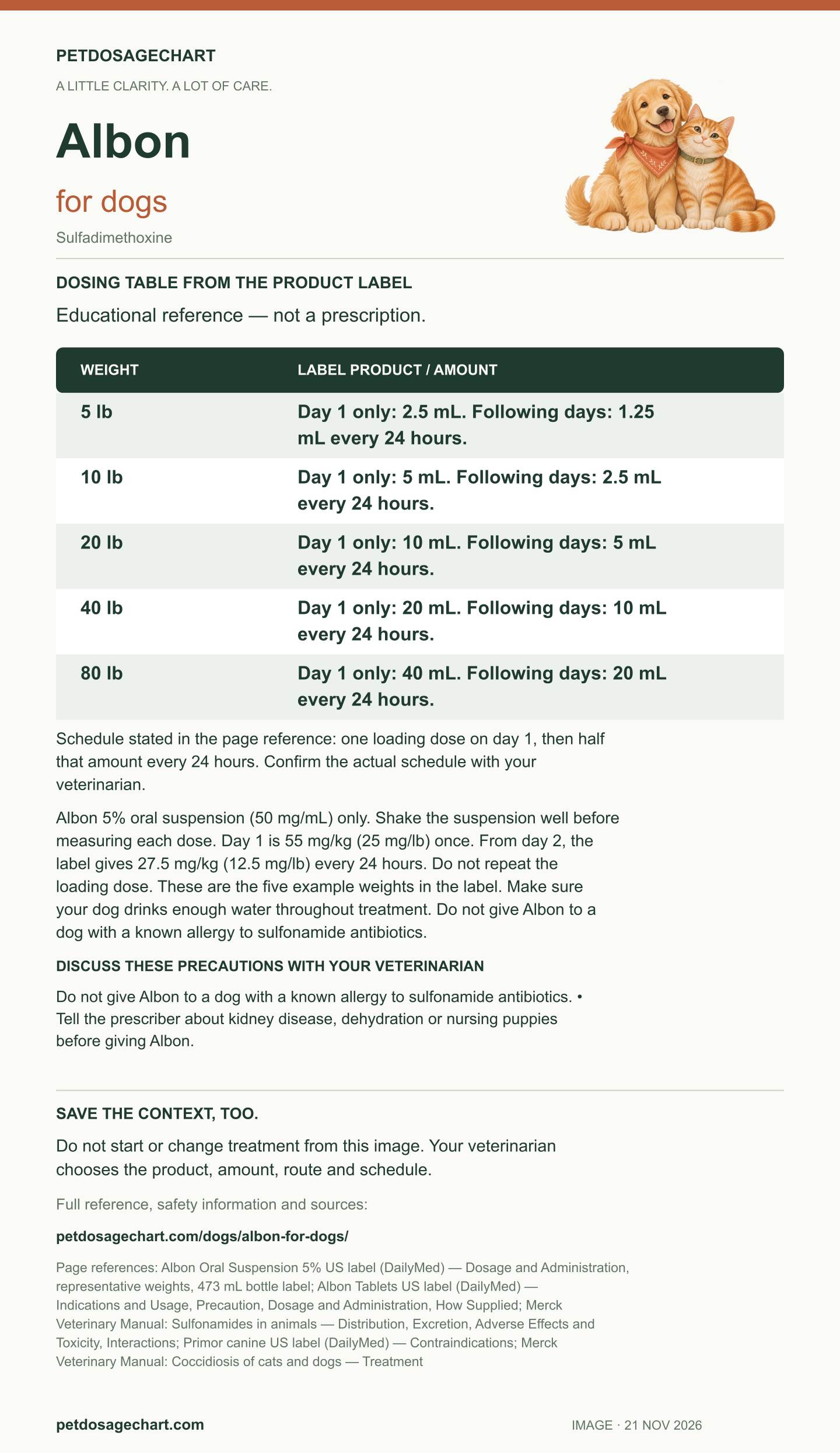
The table below reproduces the 5% oral suspension label’s examples. Check for 250 mg per 5 mL, equivalent to 50 mg/mL, before reading a volume. A 10 lb dog illustrates the difference. Its printed first dose is 5 mL, followed by 2.5 mL every 24 hours. Do not repeat the 5 mL loading dose on later days.
Albon 5% oral suspension (50 mg/mL) only. Shake the suspension well before measuring each dose. Day 1 is 55 mg/kg (25 mg/lb) once. From day 2, the label gives 27.5 mg/kg (12.5 mg/lb) every 24 hours. Do not repeat the loading dose. These are the five example weights in the label. Make sure your dog drinks enough water throughout treatment. Do not give Albon to a dog with a known allergy to sulfonamide antibiotics.
| Dog weight | Label dose (one loading dose on day 1, then half that amount every 24 hours) |
|---|---|
| 5 lb | Day 1 only: 2.5 mL. Following days: 1.25 mL every 24 hours. |
| 10 lb | Day 1 only: 5 mL. Following days: 2.5 mL every 24 hours. |
| 20 lb | Day 1 only: 10 mL. Following days: 5 mL every 24 hours. |
| 40 lb | Day 1 only: 20 mL. Following days: 10 mL every 24 hours. |
| 80 lb | Day 1 only: 40 mL. Following days: 20 mL every 24 hours. |
Source: Albon Oral Suspension 5% US label (DailyMed) — Dosage and Administration, representative weights, 473 mL bottle label.
Confirm the formulation and the amount prescribed for the current treatment day with your veterinarian.
Keep a copy of the reference chart
Educational reference, not a prescription. Your veterinarian sets the actual dose, product and schedule.
What Albon is approved to treat
The US oral labels list specified respiratory, urinary and reproductive tract, intestinal and soft tissue infections caused by susceptible bacteria. Examples include bronchitis, cystitis, bacterial enteritis and wound infections. The canine label specifically includes bacterial enteritis associated with coccidiosis.
Coccidia are protozoa. The Merck Veterinary Manual discusses sulfadimethoxine for severe clinical coccidiosis. Prescribing it specifically against the protozoa in a dog without the labeled bacterial enteritis is extra-label under the US Albon wording. A different dose or schedule also falls outside these oral label directions. Ask the prescriber which condition they are treating and which written schedule applies.
How to Give Albon to Your Dog
Confirm the first dose and the subsequent dose separately on the prescription. Tablets contain 125, 250 or 500 mg and follow the same two-phase schedule. The liquid table is only for the 5% oral suspension. Shake the suspension well before measuring each dose. Ask the clinic to mark both volumes on the measuring syringe.
Keep drinking water available throughout treatment and check that your dog is drinking adequately. The label says 3–5 days is often adequate and directs continuing until the dog has been free of signs for 48 hours. Your veterinarian sets the course based on the response.
Side Effects and Safety
Do not give Albon to a dog with a known allergy to sulfonamide antibiotics. Tell the prescriber if your dog has kidney disease, is dehydrated or is nursing puppies. The kidneys clear sulfadimethoxine, and sulfonamides can pass into milk.
The Merck Veterinary Manual lists nausea and vomiting as possible sulfonamide effects. It also describes hives, facial swelling, fever and dry eye (keratoconjunctivitis sicca). Liver inflammation and blood cell disorders have occurred with prolonged treatment. The Albon labels do not say how often these reactions occur in dogs taking the prescribed dose.
Ask the prescriber about antacids, which can reduce sulfonamide absorption, and products that acidify urine. Merck describes a higher risk of urinary crystals with acidic urine for the drug class. The Albon label describes sulfadimethoxine as soluble at normal kidney pH and calls for adequate water intake.
When to Call the Vet
Seek urgent care for facial swelling or a suspected serious allergic reaction. Call the clinic if your dog is not drinking, develops eye irritation or shows no improvement within 2–3 days. The label calls for reassessing the diagnosis at that point.
When Albon should be used with caution or avoided
Some dogs should not take Albon, or need a different dose and closer monitoring. Tell your veterinarian about your pet's full health history and every other medication or supplement they take before giving Albon.
- Do not give Albon to a dog with a known allergy to sulfonamide antibiotics.
- Tell the prescriber about kidney disease, dehydration or nursing puppies before giving Albon.
Albon drug interactions
Albon can interact with other drugs. This list is not complete — always give your veterinarian a full list of your dog's medications and supplements.
When this reference is not enough
A reference table cannot decide whether a product or treatment is appropriate for an individual animal. Do not rely on it in these situations — talk to your veterinarian instead:
- In an emergency, or after accidental ingestion or a suspected overdose
- For pregnant or nursing pets
- For very young or very old dogs
- For pets with liver disease, kidney disease, or another chronic illness
- For pets taking several medications at once
- When you are not sure of your dog's current, accurate weight
- For combination products that contain additional active ingredients
Suspected overdose: what to do
If you think your dog had too much Albon, or swallowed any medication by accident, act right away. Do not wait for symptoms to appear.
- Call your veterinarian or the nearest emergency animal hospital.
- ASPCA Animal Poison Control Center: (888) 426-4435
- Pet Poison Helpline: (855) 764-7661
A consultation fee may apply to the poison hotlines. Have the medication packaging ready, and note how much your pet may have taken and when. Do not try to make your pet vomit unless a veterinarian tells you to.
If you have a separate prescription for urine leakage, check the formulation in the Proin guide. For a wound prescription labeled cefpodoxime, use the Simplicef guide.
What the source establishes
Day 1 is 55 mg/kg (25 mg/lb) once. Subsequent doses are 27.5 mg/kg (12.5 mg/lb) every 24 hours. The five pairs of volumes are for the suspension containing 250 mg in 5 mL, equivalent to 50 mg/mL. The bottle label directs shaking well before use and maintaining adequate water intake.
Prescription oral suspension. The two columns in the source are successive phases. Each printed weight is an example, not a weight band.
Albon Oral Suspension 5% US label (DailyMed) — Dosage and Administration, representative weights, 473 mL bottle label.
The 125, 250 and 500 mg tablets have the same two-phase oral regimen. Maintain adequate water intake. If there is no improvement within 2–3 days the diagnosis should be reassessed. The label describes 3–5 days as often adequate and directs continuing until free of signs for 48 hours. Indications include susceptible bacterial infections and bacterial enteritis associated with coccidiosis in dogs.
The FDA-approved indication names bacterial enteritis. It does not list coccidial infection alone.
Albon Tablets US label (DailyMed) — Indications and Usage, Precaution, Dosage and Administration, How Supplied.
Sulfonamides can pass into milk. Kidney function matters for their elimination. Reported class effects include nausea, vomiting, hypersensitivity (hives, facial swelling and fever), dry eye, hepatitis and blood disorders. Antacids can reduce absorption, and acidifying urine increases the class risk of urinary crystals.
Class precautions. The oral Albon labels give no frequency for these reactions at prescribed doses and describe sulfadimethoxine as soluble at normal kidney pH.
Merck Veterinary Manual: Sulfonamides in animals — Distribution, Excretion, Adverse Effects and Toxicity, Interactions.
The canine label for sulfadimethoxine with ormetoprim explicitly excludes dogs with prior sulfonamide hypersensitivity. This supports avoiding re-exposure to a sulfonamide antibiotic in an allergic dog.
Evidence for the class allergy precaution only. Primor is a combination product with its own prescribing instructions.
Primor canine US label (DailyMed) — Contraindications.
Merck discusses sulfadimethoxine for clinical coccidiosis in severe cases. Its clinical discussion includes regimens different from the US Albon label.
Use directed at the protozoa themselves or a different prescribed regimen is distinguished from the specific bacterial indication on the US oral labels.
Merck Veterinary Manual: Coccidiosis of cats and dogs — Treatment.
Questions about this medication
Should I give the larger Albon dose every day?
Does the Albon label cover coccidia in dogs?
About this reference
- Onset
- The label calls for reassessment if there is no improvement in 2–3 days
- Duration
- Often 3–5 days, continuing until free of signs for 48 hours as directed
- Class
- Sulfonamide antibacterial
Sources & references
The structured medication record behind this page names the references below. The links open the publisher or official resource; they do not turn this page into a prescription for an individual animal.
- Albon Oral Suspension 5% US label (DailyMed)
Dosage and Administration, representative weights, 473 mL bottle label. Supports the specific claim described above; it is not a review of the entire page.
- Albon Tablets US label (DailyMed)
Indications and Usage, Precaution, Dosage and Administration, How Supplied. Supports the specific claim described above; it is not a review of the entire page.
- Merck Veterinary Manual: Sulfonamides in animals
Distribution, Excretion, Adverse Effects and Toxicity, Interactions. Supports the specific claim described above; it is not a review of the entire page.
- Primor canine US label (DailyMed)
Contraindications. Supports the specific claim described above; it is not a review of the entire page.
- Merck Veterinary Manual: Coccidiosis of cats and dogs
Treatment. Supports the specific claim described above; it is not a review of the entire page.
- Albon Oral Suspension 5% US label (NADA 043-785) — listed in this medication's source record.
- Albon Tablets US label (NADA 015-102) — listed in this medication's source record.
- Merck Veterinary Manual — listed in this medication's source record.
- DailyMed label search for Sulfadimethoxine — check current product and formulation labels; some veterinary uses may be off-label.
Specific citations above support the identified claims. Other source names remain record-level references; further claim review is still needed. Read our methodology and limitations.
How this page was made
This page's structured medication record lists the source names below. The table shows example weights and doses from the product label. A source record is not the same as an individualized prescription or an independent clinical review.
- Sources cited
-
- Albon Oral Suspension 5% US label (NADA 043-785)
- Albon Tablets US label (NADA 015-102)
- Merck Veterinary Manual
- Calculator formula
- Use the exact amount prescribed for each treatment day. Ask your veterinarian if the label has no example for your pet’s weight.
- Editorial owner
- Prepared and maintained by the PetDosageChart editorial team, a software-led publisher and not a veterinary practice.
- DVM review status
- Not independently DVM-reviewed. A named reviewer and review date appear here only after a confirmed review.
More on our methodology and editorial process — how we source, calculate, and review dogs dosage data.
More resources
- Pet Medication Safety Hub — What's safe, what's dangerous, and emergency signs
- How we calculate dosages — Our sources, math, and review process
- Printable emergency checklist — One-page reference for your fridge or first aid kit
More tools: common weights and embed code
By Weight
Albon reference by dog weight
Choose a common weight to open its optional reference page. Return to the main guide for the label's dosing table.
Common-weight pages are convenience views of the same educational reference, not separate medical recommendations.