Dramamine dosage reference for dogs (Dimenhydrinate)
This page's standard weight-based reference is 4 mg per kg (1.81 mg per lb), with every 8 hours recorded as the reference frequency. Use the calculator to see the arithmetic for your dog's weight, then confirm the indication, product, and actual dose with a veterinarian.
This information is for educational purposes only. Always consult your veterinarian before giving medication to your pet. Do not use this calculator for emergencies, overdoses, pregnancy, very young animals, very old animals, pets with liver/kidney disease, or pets taking multiple medications.
Sources and review process
Each medication page lists the references recorded for its data. The calculator math and editorial presentation are maintained by PetDosageChart; a page is independently DVM-reviewed only when a named reviewer byline appears. See our methodology and limitations.
Dramamine is a human over-the-counter motion sickness brand, and the name covers two different drugs. Dramamine Original Formula (50 mg tablets) and Dramamine for Kids (25 mg chewables) contain dimenhydrinate. Dramamine Less Drowsy, All Day Less Drowsy and some other chewables contain meclizine (25 mg). Veterinary references dose the two differently, so check the active ingredient on the box before you use any number on this page.
For dimenhydrinate, the Merck Veterinary Manual lists 4–8 mg per kg (about 1.8–3.6 mg per lb) by mouth every 8 hours for dogs. The calculator and chart below use 4 mg/kg as the standard reference and 8 mg/kg as the upper reference. For meclizine, Merck gives an amount per dog rather than a weight-based dose, which is covered in the Less Drowsy section below. VCA Animal Hospitals describes both drugs as off-label for motion sickness in dogs, so ask your veterinarian before giving either one.
| Product | Active ingredient | On this page |
|---|---|---|
| Dramamine Original Formula tablet | Dimenhydrinate 50 mg | Calculator and chart |
| Dramamine for Kids chewable | Dimenhydrinate 25 mg | Calculator and chart |
| Dramamine Less Drowsy tablet | Meclizine HCl 25 mg | Per-dog references in text, no calculator |
| Dramamine All Day Less Drowsy chewable | Meclizine HCl 25 mg | Per-dog references in text, no calculator |
| Advanced Herbals Non-Drowsy (ginger) | Ginger root 500 mg; no dimenhydrinate or meclizine | Not covered; ask your vet |
Calculator Warning: Use this only as an educational estimate. Your veterinarian may prescribe a different dose based on your pet’s condition, age, weight, other medications, and medical history.
Dramamine (Dimenhydrinate) Dosage Calculator for Dogs
Enter your dog’s weight below to estimate a dimenhydrinate amount from the 4 mg/kg standard reference, with the 8 mg/kg upper reference shown alongside. The result is for one dose of Dramamine Original Formula or another dimenhydrinate-only product. It does not apply to Less Drowsy or other meclizine products. Treat it as an educational starting point for a conversation with your veterinarian, not a prescription.

Which product this applies to: This reference is for dimenhydrinate only (Dramamine Original Formula 50 mg tablets, Dramamine for Kids 25 mg chewables, or another product whose only active ingredient is dimenhydrinate). It does not apply to Dramamine Less Drowsy, All Day or other meclizine products, which veterinary references give per dog rather than by weight, or to ginger and herbal products. Check the active ingredient on the box.
This Dramamine dosage chart for dogs shows the dimenhydrinate reference amounts recorded on this page for common weights, in pounds and kilograms. For a weight between rows, use the calculator above.
Dramamine (dimenhydrinate) dosage chart for dogs by weight
Which product this applies to: This reference is for dimenhydrinate only (Dramamine Original Formula 50 mg tablets, Dramamine for Kids 25 mg chewables, or another product whose only active ingredient is dimenhydrinate). It does not apply to Dramamine Less Drowsy, All Day or other meclizine products, which veterinary references give per dog rather than by weight, or to ginger and herbal products. Check the active ingredient on the box.
Both units describe the same weight. Switching the display does not change the amounts. For an exact weight, use the calculator.
Scroll sideways to compare references. The weight column stays visible.
| Weight | Lower Reference | Standard Reference | Upper Reference | Frequency |
|---|---|---|---|---|
| 5 lbs (2.3 kg) | 9.1 mg | 9.1 mg | 18.1 mg | every 8 hours |
| 10 lbs (4.5 kg) | 18.1 mg (0.75 × 25mg) | 18.1 mg (0.75 × 25mg) | 36.3 mg | every 8 hours |
| 15 lbs (6.8 kg) | 27.2 mg (0.5 × 50mg) | 27.2 mg (0.5 × 50mg) | 54.4 mg (50mg tablet) | every 8 hours |
| 20 lbs (9.1 kg) | 36.3 mg (0.75 × 50mg) | 36.3 mg (0.75 × 50mg) | 72.6 mg | every 8 hours |
| 25 lbs (11.3 kg) | 45.4 mg (1.75 × 25mg) | 45.4 mg (1.75 × 25mg) | 90.7 mg (1.75 × 50mg) | every 8 hours |
| 30 lbs (13.6 kg) | 54.4 mg (50mg tablet) | 54.4 mg (50mg tablet) | 108.8 mg | every 8 hours |
| 40 lbs (18.1 kg) | 72.6 mg (1.5 × 50mg) | 72.6 mg (1.5 × 50mg) | 145.1 mg | every 8 hours |
| 50 lbs (22.7 kg) | 90.7 mg (1.75 × 50mg) | 90.7 mg (1.75 × 50mg) | 181.4 mg | every 8 hours |
| 60 lbs (27.2 kg) | 108.8 mg (4.5 × 25mg) | 108.8 mg (4.5 × 25mg) | 217.7 mg (8.5 × 25mg) | every 8 hours |
| 70 lbs (31.7 kg) | 127.0 mg (2.5 × 50mg) | 127.0 mg (2.5 × 50mg) | 254.0 mg (5 × 50mg) | every 8 hours |
| 80 lbs (36.3 kg) | 145.1 mg (3 × 50mg) | 145.1 mg (3 × 50mg) | 290.2 mg (11.5 × 25mg) | every 8 hours |
| 90 lbs (40.8 kg) | 163.3 mg (6.5 × 25mg) | 163.3 mg (6.5 × 25mg) | 326.5 mg (6.5 × 50mg) | every 8 hours |
| 100 lbs (45.4 kg) | 181.4 mg (7.5 × 25mg) | 181.4 mg (7.5 × 25mg) | 362.8 mg (14.5 × 25mg) | every 8 hours |
| 120 lbs (54.4 kg) | 217.7 mg (8.5 × 25mg) | 217.7 mg (8.5 × 25mg) | 435.4 mg | every 8 hours |
| 150 lbs (68 kg) | 272.1 mg (5.5 × 50mg) | 272.1 mg (5.5 × 50mg) | 544.2 mg | every 8 hours |
Parenthetical tablet amounts are arithmetic comparisons only. They do not account for scoring, release type, concentration, product labeling, or whether this medication is appropriate for an individual animal.
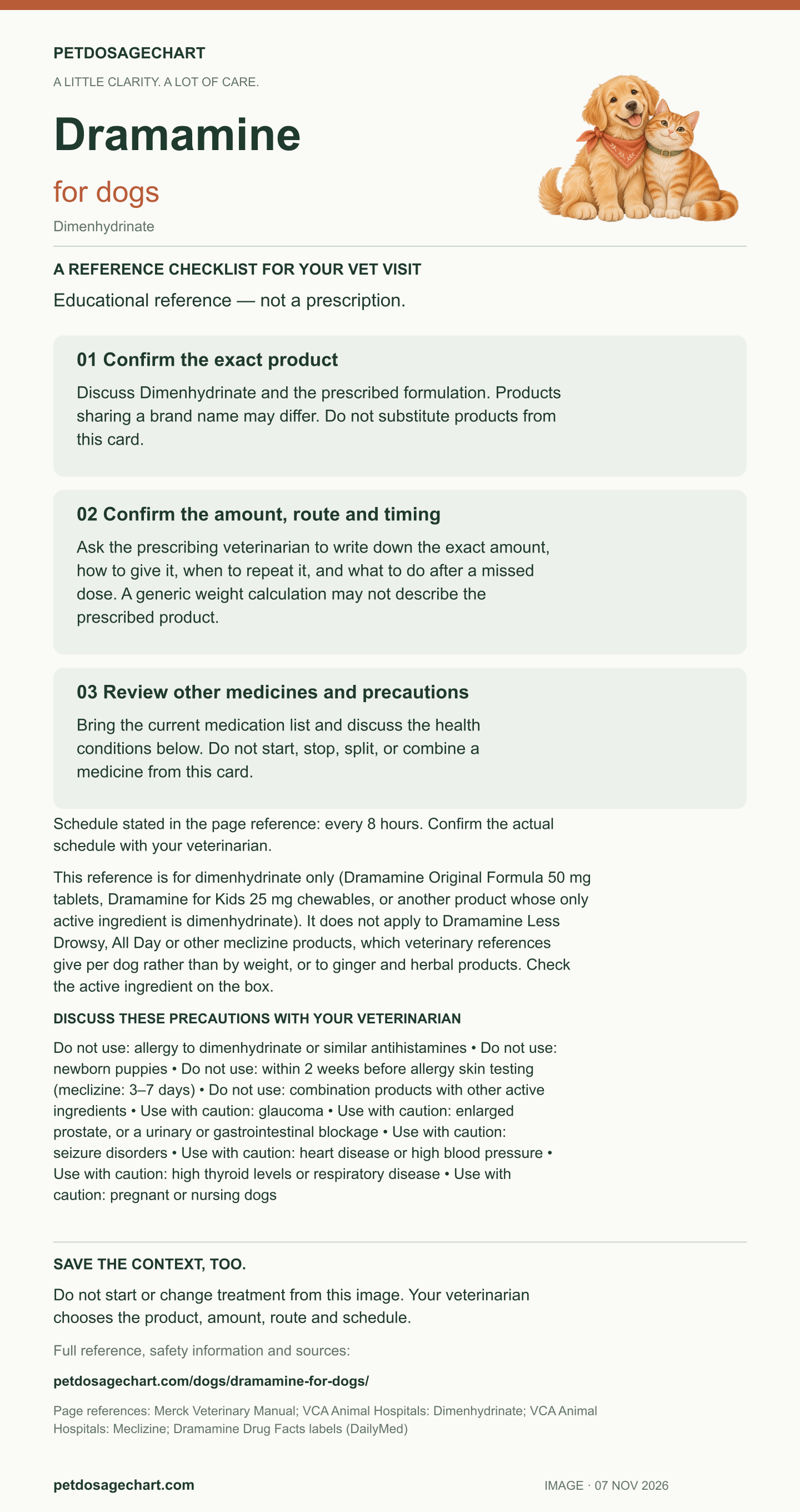
Keep a copy of the reference checklist
Educational reference, not a prescription. Your veterinarian sets the actual dose, product and schedule.
Dramamine Less Drowsy (Meclizine) for Dogs
Dramamine Less Drowsy and All Day Less Drowsy contain 25 mg of meclizine per tablet, not dimenhydrinate, so the calculator above does not apply to them. The Merck Veterinary Manual gives meclizine for dogs as an amount per dog, not per kilogram, and its two tables differ:
| Merck table | Meclizine reference for dogs |
|---|---|
| First-Generation Antihistamines | 12.5–50 mg per dog by mouth, every 24 hours |
| Motion Sickness in Animals | 12.5 mg per dog by mouth, every 12 hours; give 1 hour before travel |
Neither table says which size of dog gets the smaller or larger amount, so this page does not turn them into a weight chart. Your veterinarian decides whether meclizine suits your dog and how much to give. VCA Animal Hospitals notes that meclizine works in about 1 to 2 hours and that its effects can last longer in dogs with liver or kidney disease. Merck notes that mild signs of meclizine poisoning can occur below 33 mg/kg in dogs, so keep the package out of reach.
Meclizine has its own cautions in VCA’s handout. Sedation is common; dry gums and eyes, a fast heart rate, or excitement instead of sleepiness can also occur. VCA advises caution in dogs with an enlarged prostate, a bladder neck obstruction, severe heart failure, angle-closure glaucoma or a blockage between the stomach and small intestine, and in pregnant or nursing dogs. It lists other sedating (central nervous system depressant) and anticholinergic medicines as interactions, and says to stop meclizine 3–7 days before allergy skin testing.
When to Give Dramamine Before Travel
VCA Animal Hospitals advises giving dimenhydrinate 30–60 minutes before travel, and meclizine at least 30–60 minutes before. The Merck Veterinary Manual’s motion sickness table gives meclizine 1 hour before travel. VCA notes that both start working in about 1 to 2 hours. The human Dramamine labels also time the first dose ½ to 1 hour before the trip starts. For a repeat dose on a long drive, Merck’s antihistamine table uses an interval of every 8 hours and its antiemetic table every 6–8 hours; this page uses the 8-hour interval. Ask your veterinarian before giving a second dose, and never give two doses at once.
Planning holiday travel with a car-sick dog
If you are planning a road trip for the holidays, ask your veterinarian before the travel day rather than on the morning you leave. They can confirm whether a dimenhydrinate or meclizine product suits your dog, or whether to use Cerenia instead, and check the other medicines your dog takes. The Merck Veterinary Manual notes that conditioning a dog to travel can overcome motion sickness, and that a dog that has learned to fear the car may show signs before it even moves, so calm, short practice trips can help as well.
Other Motion Sickness Medicines Your Vet May Discuss
Cerenia (maropitant) for dogs is FDA-approved for dogs, and the Merck Veterinary Manual calls it the preferred drug to treat motion sickness in dogs. Merck lists it as given 2 hours before travel.
Benadryl (diphenhydramine) for dogs is closely related: Merck describes dimenhydrinate as diphenhydramine combined with 8-chlorotheophylline. Do not give Benadryl and Dramamine together unless your veterinarian tells you to, because that adds the same antihistamine twice.
Ondansetron for dogs and metoclopramide for dogs are general anti-vomiting medicines your veterinarian may prescribe for other causes of vomiting. Both appear in Merck’s motion sickness drug table, but Merck’s pharmacology chapter says serotonin (5-HT3) blockers such as ondansetron are not effective for vomiting caused by motion sickness, so ondansetron is not a stand-in for a travel medicine. Each has its own cautions: ondansetron needs care in dogs with the MDR1 gene mutation, and metoclopramide is avoided when a gut blockage is possible.
None of these links is a recommendation to switch or combine medicines. Ask your veterinarian which one fits your dog.
How to Give Dramamine to Your Dog
Ask your veterinarian before the trip which product and amount to use, then check the active ingredient on the box. Give only a product whose only active ingredient is the one your vet chose, never a combination product; VCA Animal Hospitals advises against giving dogs combination products. Dimenhydrinate can be given with or without food, and if your dog vomits when it is given on an empty stomach, give later doses with a little food. Chewables contain sweeteners (Dramamine for Kids lists aspartame and sorbitol), so read the inactive ingredients as well as the active one.
Expect drowsiness. Tell your veterinarian about every other medicine your dog takes, especially sedatives or tranquilizers, tricyclic antidepressants, other anticholinergic drugs and Benadryl. Stop dimenhydrinate at least 2 weeks before allergy skin testing.
Side Effects and Safety
Sleepiness is the most common effect. Dry mouth and difficulty urinating can also occur, and vomiting, diarrhea or a poor appetite are less common. Some dogs become excited or agitated instead of sleepy. Stop giving it and call your veterinarian immediately if your dog has a seizure or becomes unresponsive.
Both Dramamine labels tell people to ask a doctor first if they have glaucoma or trouble urinating due to an enlarged prostate, and VCA Animal Hospitals lists the same kinds of conditions as cautions in pets. Ask your veterinarian before giving dimenhydrinate to a dog with glaucoma, an enlarged prostate, a urinary or gastrointestinal blockage, seizures, heart disease, high blood pressure, high thyroid levels or respiratory disease, or to a pregnant or nursing dog, and do not give it to newborn puppies. The cautions and interactions listed below are for dimenhydrinate; meclizine’s are in the Less Drowsy section.
When Dramamine should be used with caution or avoided
Some dogs should not take Dramamine, or need a different dose and closer monitoring. Tell your veterinarian about your pet's full health history and every other medication or supplement they take before giving Dramamine.
- Do not use: allergy to dimenhydrinate or similar antihistamines
- Do not use: newborn puppies
- Do not use: within 2 weeks before allergy skin testing (meclizine: 3–7 days)
- Do not use: combination products with other active ingredients
- Use with caution: glaucoma
- Use with caution: enlarged prostate, or a urinary or gastrointestinal blockage
- Use with caution: seizure disorders
- Use with caution: heart disease or high blood pressure
- Use with caution: high thyroid levels or respiratory disease
- Use with caution: pregnant or nursing dogs
Dramamine drug interactions
Dramamine can interact with other drugs. This list is not complete — always give your veterinarian a full list of your dog's medications and supplements.
When not to use this calculator
This calculator gives a general educational estimate for a healthy adult dog at a known weight. Do not rely on it in these situations — talk to your veterinarian instead:
- In an emergency, or after accidental ingestion or a suspected overdose
- For pregnant or nursing pets
- For very young or very old dogs
- For pets with liver disease, kidney disease, or another chronic illness
- For pets taking several medications at once
- When you are not sure of your dog's current, accurate weight
- For combination products that contain additional active ingredients
Suspected overdose: what to do
If you think your dog had too much Dramamine, or swallowed any medication by accident, act right away. Do not wait for symptoms to appear.
- Call your veterinarian or the nearest emergency animal hospital.
- ASPCA Animal Poison Control Center: (888) 426-4435
- Pet Poison Helpline: (855) 764-7661
A consultation fee may apply to the poison hotlines. Have the medication packaging ready, and note how much your pet may have taken and when. Do not try to make your pet vomit unless a veterinarian tells you to.
When to Call the Vet
If your dog experiences any of the following, contact your veterinarian or an emergency clinic immediately:
- Seizures, collapse or unresponsiveness
- Agitation, tremors, a racing heart or very large pupils (possible overdose)
- Straining to urinate or not passing urine
- Vomiting that continues despite the medicine, or vomiting with weakness
- Facial swelling, hives or trouble breathing (possible allergic reaction)
- Your dog ate extra tablets or got into the package
If your dog may have eaten too much, do not try to make it vomit: the Merck Veterinary Manual says inducing vomiting is not appropriate for most animals that ate these antihistamines. Call your veterinarian, the ASPCA Animal Poison Control Center (888-426-4435) or Pet Poison Helpline (855-764-7661).
What the source establishes
Lists dimenhydrinate for dogs at 4–8 mg/kg by mouth, IM or IV every 8 hours: the calculator’s 4 mg/kg standard and 8 mg/kg upper reference. The record’s 24 mg/kg daily figure is arithmetic from this schedule (three doses at 8 mg/kg), not a separately stated maximum. Lists meclizine for dogs as 12.5–50 mg per dog by mouth every 24 hours and notes mild signs can occur below 33 mg/kg. Toxic signs begin within 30–60 minutes of dimenhydrinate and within 9 hours of meclizine.
A toxicology table that also gives therapeutic ranges. It does not set the dose or schedule for an individual dog, and its meclizine amounts are per dog, not by weight.
Merck Veterinary Manual: First-Generation Antihistamines table — Dimenhydrinate/diphenhydramine row and meclizine row; from Toxicoses in Animals From Human Cold and Allergy Medications (reviewed May 2025).
Calls maropitant (Cerenia) FDA-approved and the preferred drug to treat motion sickness in dogs, given 2 hours before travel. Lists meclizine at 12.5 mg per dog by mouth every 12 hours, given 1 hour before travel, and says antihistamines prevent motion sickness and also sedate. The same table lists diphenhydramine, ondansetron and metoclopramide with their own cautions. Notes that conditioning a dog to travel can overcome motion sickness and that fear can cause signs even in a parked car.
A veterinary overview of motion sickness. It names dimenhydrinate among the antihistamines but gives no dimenhydrinate dose in its table.
Merck Veterinary Manual: Motion Sickness in Animals — Treatment text and drug table (meclizine, diphenhydramine, ondansetron, metoclopramide and maropitant rows); full review July 2026.
Lists dimenhydrinate at 4–8 mg/kg by mouth every 6–8 hours as an antiemetic: the same per-dose range, with a shorter interval than the antihistamine table’s every 8 hours, which this page uses.
The table does not separate species or address travel timing. Repeat dosing for an individual dog is a veterinary decision.
Merck Veterinary Manual: Antiemetic Drugs table — Dimenhydrinate row; from Drugs Used to Control or Stimulate Vomiting in Monogastric Animals.
Describes dimenhydrinate as diphenhydramine plus 8-chlorotheophylline. Says antihistamines block the vestibular signals behind motion sickness and are useful for motion sickness in dogs (but ineffective in cats), and that they can cause mild sedation or paradoxical excitement. Says serotonin (5-HT3) receptor antagonists such as ondansetron are not effective for vomiting caused by motion sickness.
A pharmacology overview. It does not give a product-specific dose.
Merck Veterinary Manual: Drugs Used to Control or Stimulate Vomiting in Monogastric Animals — Antiemetics: antihistamines; last updated June 2025.
Lists lethargy, sedation, agitation, a fast heart rate, vomiting, low blood pressure, dilated pupils, tremors and possibly seizures as signs of first-generation antihistamine poisoning. Says treatment is supportive and inducing vomiting is not appropriate for most animals that ate these drugs, and notes that human cold and allergy products often combine antihistamines with decongestants or pain relievers.
Poison-control guidance for overdoses. It does not set a therapeutic dose.
Merck Veterinary Manual: Toxicoses in Animals From Human Cold and Allergy Medications — First-generation antihistamines: clinical signs and treatment; full review May 2025.
Describes dimenhydrinate for motion sickness and nausea in dogs as off-label, given 30–60 minutes before travel, with or without food, and working in about 1 to 2 hours. Calls it short-acting and says it should stop working within 24 hours, although effects can be longer in pets with liver or kidney disease. Lists sleepiness, dry mouth and difficulty urinating as side effects and seizures or coma as reasons to stop and call. Says not to use it in neonates, in pets allergic to it, or within 2 weeks before allergy skin testing, and to watch for allergic reactions throughout treatment. Advises caution with glaucoma, seizures, high thyroid levels, heart disease, high blood pressure, an enlarged prostate, a gastrointestinal or urinary blockage, respiratory disease, and pregnancy or nursing (likely safe). Lists anticholinergic drugs, central nervous system depressants and tricyclic antidepressants as interactions, and says to give only single-ingredient dimenhydrinate products, never combination products.
An owner-facing hospital handout. It gives no dose; the dose range comes from the Merck tables.
VCA Animal Hospitals: Dimenhydrinate — How is it given?; side effects; risk factors; drug interactions.
Describes meclizine as an off-label antihistamine to prevent motion sickness and the vomiting it causes, given at least 30–60 minutes before travel and working in about 1 to 2 hours, with longer effects in pets with liver or kidney disease. Lists sedation, dry gums and eyes, a fast heart rate and excitement as possible effects, and advises caution with an enlarged prostate, bladder neck obstruction, severe heart failure, angle-closure glaucoma, pyeloduodenal obstruction, and pregnancy or nursing. Lists central nervous system depressants and anticholinergic drugs as interactions and says to stop it 3–7 days before skin testing.
An owner-facing hospital handout. It gives no dose.
VCA Animal Hospitals: Meclizine — How is it given?; side effects; risk factors.
Each tablet contains 50 mg dimenhydrinate. The label warns that marked drowsiness may occur and says to ask a doctor first with glaucoma or trouble urinating due to an enlarged prostate. It times the first dose ½ to 1 hour before starting activity.
A human Drug Facts label. Its directions are for people and do not give a dog dose.
Dramamine Original Formula (dimenhydrinate) Drug Facts label, DailyMed — Drug Facts: active ingredient; warnings; directions.
Each chewable tablet contains 25 mg dimenhydrinate. Inactive ingredients include aspartame and sorbitol.
A human Drug Facts label. It does not give a dog dose.
Dramamine for Kids (dimenhydrinate) chewable Drug Facts label, DailyMed — Drug Facts: active ingredient; inactive ingredients.
Each tablet contains 25 mg meclizine HCl, not dimenhydrinate. The label carries the same glaucoma and enlarged-prostate warnings and says drowsiness may occur.
A human Drug Facts label. It does not give a dog dose.
Dramamine Less Drowsy (meclizine) Drug Facts label, DailyMed — Drug Facts: active ingredient; warnings.
The All Day Less Drowsy chewable contains 25 mg meclizine HCl per tablet, not dimenhydrinate.
A human Drug Facts label. It does not give a dog dose.
Dramamine All Day Less Drowsy chewable (meclizine) Drug Facts label, DailyMed — Principal display panel; active ingredient.
Lists 500 mg ginger root as the active ingredient; the ingredient list contains no dimenhydrinate or meclizine.
A manufacturer product page for people. It does not give a dog dose.
Dramamine: Advanced Herbals Non-Drowsy (product page) — Ingredients.
The lozenges combine ginger root extract with ashwagandha root extract; the ingredient list contains no dimenhydrinate or meclizine.
A manufacturer product page for people. It does not give a dog dose.
Dramamine: Advanced Herbals Nausea + Stress Support lozenges (product page) — Ingredients.
Frequently Asked Questions
Questions about this medication
Can I give my dog Dramamine?
How much Dramamine can I give my dog?
What is the difference between Dramamine Original and Dramamine Less Drowsy for dogs?
How long before a car ride should I give my dog Dramamine?
Can I give my dog Dramamine and Benadryl together?
Is Dramamine Non-Drowsy or a ginger product the same thing?
What are the signs of too much Dramamine in a dog?
What weight alone cannot tell you
The calculator performs one narrow job: it multiplies your dog's weight by the lower, standard, and upper mg/kg values recorded for Dramamine. It cannot decide whether this drug, indication, formulation, or schedule is appropriate for an individual animal.
Context in this medication record
- Commonly listed uses
- motion sickness (car sickness), nausea and vomiting with travel, nausea from vestibular disease
- Recorded forms
- tablet (50 mg), chewable tablet (25 mg)
- Reference timing
- every 8 hours; onset 1-2 hours; duration Short-acting (under 24 hours)
Individual checks a calculator cannot perform
- Confirm the diagnosis and the reason this medication is being considered.
- Match the exact product, concentration, route, and whether a tablet may be split.
- Account for age, pregnancy, organ function, genetics, allergies, and prior reactions.
- Review every prescription, over-the-counter product, and supplement your pet takes.
Recorded cautions
Do not use: allergy to dimenhydrinate or similar antihistamines; Do not use: newborn puppies; Do not use: within 2 weeks before allergy skin testing (meclizine: 3–7 days); Do not use: combination products with other active ingredients; Use with caution: glaucoma; Use with caution: enlarged prostate, or a urinary or gastrointestinal blockage; Use with caution: seizure disorders; Use with caution: heart disease or high blood pressure; Use with caution: high thyroid levels or respiratory disease; Use with caution: pregnant or nursing dogs.
Recorded interactions
Sedatives, tranquilizers and other central nervous system depressants; Anticholinergic drugs; Tricyclic antidepressants; Diphenhydramine (Benadryl), which dimenhydrinate already contains; Allergy skin testing (stop dimenhydrinate at least 2 weeks before; meclizine 3–7 days before).
These lists reproduce the structured record used by this page and may not be exhaustive. Show your veterinarian the product label and your dog's complete medication list before acting on a number.
About this reference
- Onset
- 1-2 hours
- Duration
- Short-acting (under 24 hours)
- Class
- Antihistamine
Related medications for dogs
These references share a recorded drug class. They are not interchangeable treatments or instructions to combine medications.
Sources & references
The structured medication record behind this page names the references below. The links open the publisher or official resource; they do not turn this page into a prescription for an individual animal.
- Merck Veterinary Manual: First-Generation Antihistamines table
Dimenhydrinate/diphenhydramine row and meclizine row; from Toxicoses in Animals From Human Cold and Allergy Medications (reviewed May 2025). Supports the specific claim described above; it is not a review of the entire page.
- Merck Veterinary Manual: Motion Sickness in Animals
Treatment text and drug table (meclizine, diphenhydramine, ondansetron, metoclopramide and maropitant rows); full review July 2026. Supports the specific claim described above; it is not a review of the entire page.
- Merck Veterinary Manual: Antiemetic Drugs table
Dimenhydrinate row; from Drugs Used to Control or Stimulate Vomiting in Monogastric Animals. Supports the specific claim described above; it is not a review of the entire page.
- Merck Veterinary Manual: Drugs Used to Control or Stimulate Vomiting in Monogastric Animals
Antiemetics: antihistamines; last updated June 2025. Supports the specific claim described above; it is not a review of the entire page.
- Merck Veterinary Manual: Toxicoses in Animals From Human Cold and Allergy Medications
First-generation antihistamines: clinical signs and treatment; full review May 2025. Supports the specific claim described above; it is not a review of the entire page.
- VCA Animal Hospitals: Dimenhydrinate
How is it given?; side effects; risk factors; drug interactions. Supports the specific claim described above; it is not a review of the entire page.
- VCA Animal Hospitals: Meclizine
How is it given?; side effects; risk factors. Supports the specific claim described above; it is not a review of the entire page.
- Dramamine Original Formula (dimenhydrinate) Drug Facts label, DailyMed
Drug Facts: active ingredient; warnings; directions. Supports the specific claim described above; it is not a review of the entire page.
- Dramamine for Kids (dimenhydrinate) chewable Drug Facts label, DailyMed
Drug Facts: active ingredient; inactive ingredients. Supports the specific claim described above; it is not a review of the entire page.
- Dramamine Less Drowsy (meclizine) Drug Facts label, DailyMed
Drug Facts: active ingredient; warnings. Supports the specific claim described above; it is not a review of the entire page.
- Dramamine All Day Less Drowsy chewable (meclizine) Drug Facts label, DailyMed
Principal display panel; active ingredient. Supports the specific claim described above; it is not a review of the entire page.
- Dramamine: Advanced Herbals Non-Drowsy (product page)
Ingredients. Supports the specific claim described above; it is not a review of the entire page.
- Dramamine: Advanced Herbals Nausea + Stress Support lozenges (product page)
Ingredients. Supports the specific claim described above; it is not a review of the entire page.
- Merck Veterinary Manual — listed in this medication's source record.
- VCA Animal Hospitals: Dimenhydrinate — listed in this medication's source record.
- VCA Animal Hospitals: Meclizine — listed in this medication's source record.
- Dramamine Drug Facts labels (DailyMed) — listed in this medication's source record.
- DailyMed label search for Dimenhydrinate — check current product and formulation labels; some veterinary uses may be off-label.
Specific citations above support the identified claims. Other source names remain record-level references; further claim review is still needed. Read our methodology and limitations.
How this page was made
This page's structured medication record lists the source names below. PetDosageChart applies the record's mg/kg values to the entered weight and presents the arithmetic result. A source record is not the same as an individualized prescription or an independent clinical review.
- Sources cited
-
- Merck Veterinary Manual
- VCA Animal Hospitals: Dimenhydrinate
- VCA Animal Hospitals: Meclizine
- Dramamine Drug Facts labels (DailyMed)
- Calculator formula
- Doses scale linearly from a standard basis of 4 mg per kg (1.81 mg per lb) of body weight, given every 8 hours. The calculator multiplies that basis by your dog's weight and shows an arithmetic comparison with recorded tablet sizes. That comparison does not determine whether a tablet is scored, splittable, or appropriate for your pet.
- Editorial owner
- Prepared and maintained by the PetDosageChart editorial team, a software-led publisher and not a veterinary practice.
- DVM review status
- Not independently DVM-reviewed. A named reviewer and review date appear here only after a confirmed review.
More on our methodology and editorial process — how we source, calculate, and review dogs dosage data.
More resources
- Pet Medication Safety Hub — What's safe, what's dangerous, and emergency signs
- How we calculate dosages — Our sources, math, and review process
- Printable emergency checklist — One-page reference for your fridge or first aid kit
More tools: common weights and embed code
By Weight
Dramamine reference by dog weight
Choose a common weight to open its optional reference page. Use the main medication calculator for a different exact weight.
Common-weight pages are convenience views of the same educational reference, not separate medical recommendations.
Embed this calculator on your site
Get a free Dramamine dosage widget
Get embed code
Embed this calculator on your site
Get a free Dramamine dosage widget
Free forever. Works in any blog post or article. Adds a small "Powered by petdosagechart.com" credit and a one-line text link below the widget.