Entyce dosage reference for dogs (Capromorelin)
This page's standard weight-based reference is 3 mg per kg (1.36 mg per lb), with once daily recorded as the reference frequency. Use the calculator to see the arithmetic for your dog's weight, then confirm the indication, product, and actual dose with a veterinarian.
This information is for educational purposes only. Always consult your veterinarian before giving medication to your pet. Do not use this calculator for emergencies, overdoses, pregnancy, very young animals, very old animals, pets with liver/kidney disease, or pets taking multiple medications.
Sources and review process
Each medication page lists the references recorded for its data. The calculator math and editorial presentation are maintained by PetDosageChart; a page is independently DVM-reviewed only when a named reviewer byline appears. See our methodology and limitations.
Entyce (capromorelin oral solution) is an FDA-approved, prescription-only appetite stimulant for dogs. Capromorelin is a selective ghrelin receptor agonist: it acts on receptors in the brain’s hypothalamus to stimulate appetite. Entyce comes as a flavored 30 mg/mL liquid in 10, 15 and 30 mL bottles, each with a measuring syringe.
The Entyce dosage for dogs on the FDA-approved label is 3 mg/kg (1.4 mg/lb) of body weight, given by mouth once daily. Because each mL holds 30 mg, that works out to 0.1 mL of Entyce per kg: about 0.45 mL for a 10 lb dog, 2.27 mL for a 50 lb dog and 4.54 mL for a 100 lb dog. The Merck Veterinary Manual lists the same 3 mg/kg once-daily dose for dogs. Entyce is labeled for dogs only; Elura is a separate capromorelin product for cats.
Calculator Warning: Use this only as an educational estimate. Your veterinarian may prescribe a different dose based on your pet’s condition, age, weight, other medications, and medical history.
What the source establishes
Entyce is indicated for appetite stimulation in dogs. The label dose is 3 mg/kg (1.4 mg/lb) by mouth once daily, drawn up with the supplied syringe from a 30 mg/mL flavored solution sold in 10, 15 and 30 mL bottles. It is contraindicated in dogs with hypersensitivity to capromorelin and advises caution in dogs with liver dysfunction or kidney insufficiency, dogs that may have heart disease or severe dehydration (transient decreases in heart rate and blood pressure), and dogs with diabetes (hyperglycemia has been reported). Safe use in breeding, pregnant or lactating dogs has not been evaluated. Owners should wash their hands after use because the product may be absorbed through skin, keep it out of reach of children and animals, and store it at or below 86°F (30°C).
One product label. Its field study treated dogs for 4 days. The mL amounts on this page are arithmetic from the label dose and strength (mg divided by 30), not volumes printed on the label.
Entyce (capromorelin oral solution) FDA-approved label, NADA 141-457 (revised August 2025) — Indication; Dosage and Administration; Contraindications; Warnings; Precautions; Storage; How Supplied.
In the 4-day field study the most frequent reactions were diarrhea (7.0% on Entyce vs 6.8% on vehicle control), vomiting (6.4% vs 5.5%), polydipsia (4.1% vs 1.4%), elevated BUN (4.1% vs 2.7%) and hypersalivation (2.3% vs 0%). Post-approval reports include vomiting, hypersalivation, diarrhea, lethargy, weakness, hyperglycemia, ataxia, loss of consciousness, disorientation, panting, dyspnea, bradycardia and hypotension. In 12 Beagles, plasma levels peaked about 0.83 hours after 3 mg/kg, with a half-life of about 1.19 hours; drugs that inhibit CYP3A4 and CYP3A5 may affect its metabolism. Owners rated appetite as increased on day 3 (plus or minus 1) in 68.6% of Entyce dogs versus 44.6% of vehicle-control dogs. A 12-month study in healthy Beagles at up to 40 mg/kg/day found salivation, red or swollen paws, liver changes and, at 40 mg/kg, lower red blood cell counts.
Post-approval reports cannot show how often an event happens or prove that Entyce caused it. Field study dogs had various medical conditions and were treated for only 4 days.
Entyce label: adverse reactions, post-approval reports, pharmacology and effectiveness — Adverse Reactions (Table 1); Post-Approval Experience (2025); Clinical Pharmacology; Effectiveness; Target Animal Safety.
Lists capromorelin for dogs at 3 mg/kg by mouth every 24 hours. Describes it as a selective ghrelin receptor agonist that stimulates appetite and increases body weight in dogs with inappetence from many causes, with vomiting and diarrhea as the most common adverse effects and polydipsia and hypersalivation also reported, and states it has no treatment duration, age or weight restrictions. Notes that anorexia is a common sign of many systemic diseases, and describes oral mirtazapine as an effective appetite stimulant and antiemetic for cats with chronic kidney disease.
A veterinary reference overview. It does not explain why an individual dog has stopped eating, which needs a veterinary exam.
Merck Veterinary Manual: Drugs That Affect Appetite in Monogastric Animals — Appetite Stimulation in Monogastric Animals; table “Drugs Used to Stimulate Appetite”.
Lists maropitant, ondansetron and metoclopramide among antiemetic drugs. Capromorelin is not in this table.
Cited only to identify those medicines as antiemetics on this page. It gives no Entyce dose, and their doses appear on their own pages.
Merck Veterinary Manual: Antiemetic Drugs (table) — Table “Antiemetic Drugs” (Drugs Used to Control or Stimulate Vomiting in Monogastric Animals).
Elura is a 20 mg/mL capromorelin oral solution for oral use in cats only, indicated for the management of weight loss in cats with chronic kidney disease, with its own once-daily cat dose.
A cat product label, cited only to show that Elura and Entyce are different products with different strengths and labeled species. It supports no dose for dogs.
Elura (capromorelin oral solution) FDA-approved label for cats — Indication; Dosage and Administration; product heading.
Names ketoconazole and itraconazole among medicines to discuss with the prescribing veterinarian.
Examples only; the label cautions about drugs that inhibit capromorelin metabolism.
VCA Animal Hospitals: Capromorelin — Drug interactions.
The oral solution may be given with or without food.
Owner administration guidance for the dog product.
JAM Veterinary Services: Entyce — Administration.
Entyce Dosage Calculator for Dogs
Enter your dog’s weight to see the label amount in mg for one daily dose. To turn the result into mL of Entyce, divide the mg by 30, or multiply your dog’s weight in kg by 0.1. The calculator does not know your dog’s condition, other medicines or the volume your veterinarian prescribed, so treat the result as an educational check, not a prescription.

Which product this applies to: This is the Entyce label amount for dogs: 3 mg/kg (1.4 mg/lb) by mouth once daily, using the 30 mg/mL oral solution. To turn the mg result into mL, divide by 30 (0.1 mL of Entyce per kg of body weight). Give the volume your veterinarian prescribes with the supplied syringe. Elura is a different capromorelin product for cats (20 mg/mL); never use these numbers for a cat or to measure Elura.
The chart below shows the same label amount for common weights, with the matching volume of the 30 mg/mL solution.
Entyce dosage chart for dogs by weight (mg and mL)
Which product this applies to: This is the Entyce label amount for dogs: 3 mg/kg (1.4 mg/lb) by mouth once daily, using the 30 mg/mL oral solution. To turn the mg result into mL, divide by 30 (0.1 mL of Entyce per kg of body weight). Give the volume your veterinarian prescribes with the supplied syringe. Elura is a different capromorelin product for cats (20 mg/mL); never use these numbers for a cat or to measure Elura.
Both units describe the same weight. Switching the display does not change the amounts. For an exact weight, use the calculator.
| Weight | Label amount (3 mg/kg, once daily) | Volume of Entyce 30 mg/mL |
|---|---|---|
| 5 lbs (2.3 kg) | 6.8 mg | 0.23 mL |
| 10 lbs (4.5 kg) | 13.6 mg | 0.45 mL |
| 15 lbs (6.8 kg) | 20.4 mg | 0.68 mL |
| 20 lbs (9.1 kg) | 27.2 mg | 0.91 mL |
| 25 lbs (11.3 kg) | 34.0 mg | 1.13 mL |
| 30 lbs (13.6 kg) | 40.8 mg | 1.36 mL |
| 40 lbs (18.1 kg) | 54.4 mg | 1.81 mL |
| 50 lbs (22.7 kg) | 68.0 mg | 2.27 mL |
| 60 lbs (27.2 kg) | 81.6 mg | 2.72 mL |
| 70 lbs (31.7 kg) | 95.2 mg | 3.17 mL |
| 80 lbs (36.3 kg) | 108.8 mg | 3.63 mL |
| 90 lbs (40.8 kg) | 122.4 mg | 4.08 mL |
| 100 lbs (45.4 kg) | 136.1 mg | 4.54 mL |
| 120 lbs (54.4 kg) | 163.3 mg | 5.44 mL |
| 150 lbs (68 kg) | 204.1 mg | 6.80 mL |
mL = mg ÷ 30. Amounts use the weight shown (2.205 lb per kg) and are rounded to two decimals. They are arithmetic from the label dose and strength, not volumes printed on the label. Give only the volume your veterinarian prescribes, measured with the syringe supplied with the bottle.
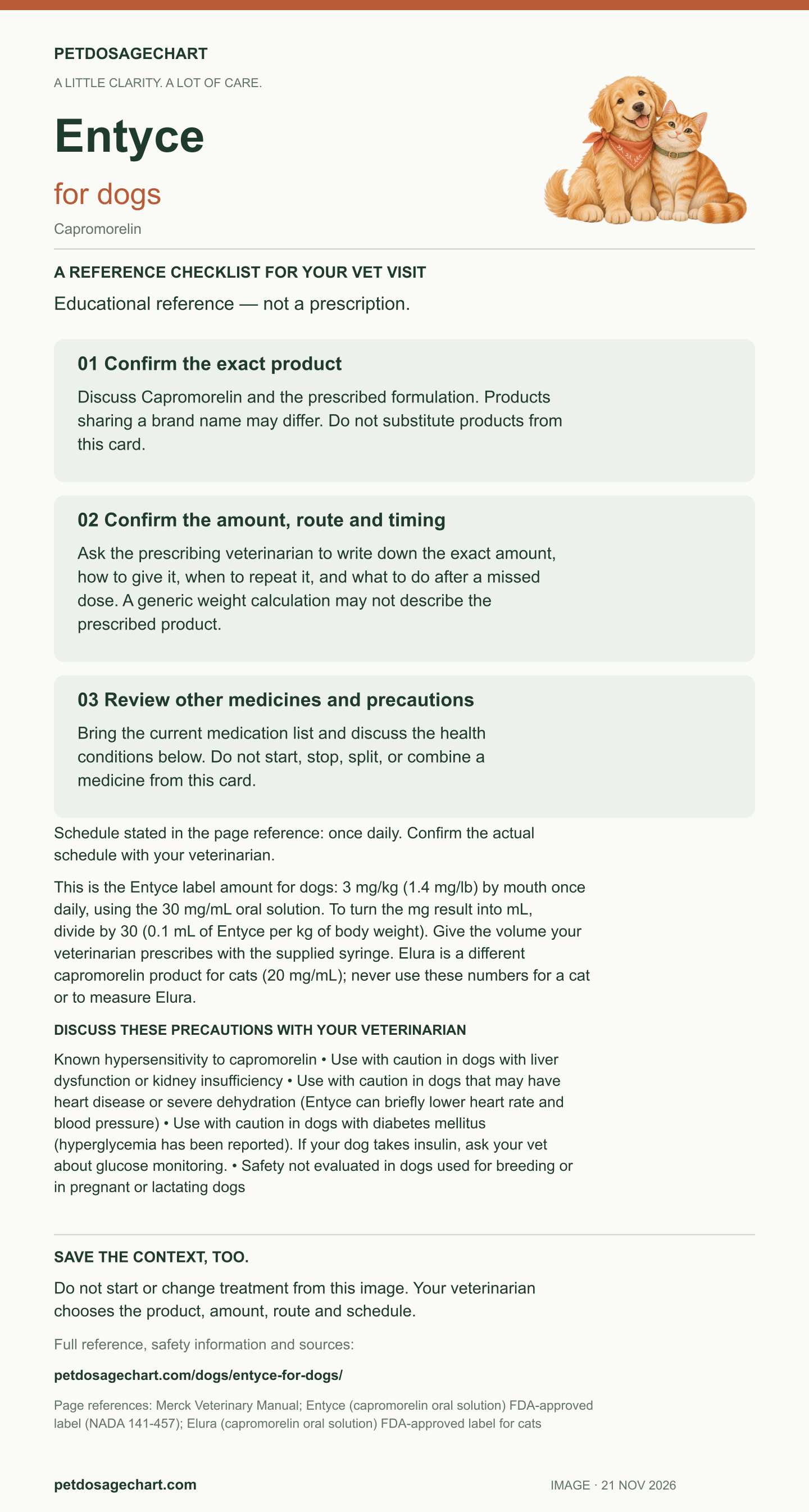
Keep a copy of the reference checklist
Educational reference, not a prescription. Your veterinarian sets the actual dose, product and schedule.
How to Give Entyce to Your Dog
The Entyce label describes four steps:
- Gently shake the bottle.
- Remove the cap and push the supplied dosing syringe firmly into the bottle opening.
- Turn the bottle upside down and draw up the prescribed volume. Turn the bottle upright before removing the syringe, then replace the cap.
- Squirt the solution from the syringe into your dog’s mouth.
Rinse the syringe and plunger with water between doses and leave them apart to dry. Wash your hands right after each dose, because the drug may be absorbed through skin. Keep the bottle and used syringes out of reach of children, dogs, cats and other animals, and store Entyce at or below 86°F (30°C).
Give Entyce once a day, with or without food, exactly as prescribed. The label’s field study treated dogs for 4 days and did not evaluate effectiveness beyond that; the Merck Veterinary Manual says capromorelin has no treatment duration, age or weight restrictions. How long your dog takes it is your veterinarian’s call. Capromorelin is broken down in the liver, mainly by the enzymes CYP3A4 and CYP3A5, so drugs that block those enzymes, such as ketoconazole and itraconazole, may change how it is cleared. Tell your vet if your dog receives insulin so they can advise on blood glucose monitoring. Tell your veterinarian about every medicine and supplement your dog takes.
Entyce and Anti-Vomiting Medicines
Entyce is labeled for appetite stimulation, not for vomiting or nausea, and vomiting is one of its reported side effects. A poor appetite has many possible causes: dogs in the label’s field study had conditions such as arthritis, gastrointestinal disease, allergies, dental disease, heart disease and kidney disease, and the Merck Veterinary Manual notes that loss of appetite is a common sign of many illnesses. Your veterinarian looks for the cause before choosing a treatment.
The Merck Veterinary Manual lists maropitant (Cerenia), ondansetron and metoclopramide among antiemetic (anti-vomiting) drugs. They are different drugs from Entyce, with their own doses and cautions, described on these pages: the Cerenia (maropitant) dosage reference for dogs, the ondansetron dosage reference for dogs and the metoclopramide dosage reference for dogs. These links are not a suggestion to swap, add or combine medicines; ask your veterinarian what fits your dog.
Entyce vs Elura (Capromorelin for Cats)
Capromorelin is also sold for cats as Elura. Elura is a 20 mg/mL solution labeled for oral use in cats only, for managing weight loss in cats with chronic kidney disease, and it has its own cat dose. Entyce is a 30 mg/mL solution labeled for oral use in dogs only. Never give a dog’s Entyce to a cat, and never measure Elura from the chart on this page.
This site does not have an Elura page. For a cat that is losing weight or not eating, the mirtazapine dosage reference for cats covers another medicine that the Merck Veterinary Manual describes as an appetite stimulant and anti-nausea drug for cats with chronic kidney disease. Your veterinarian decides which option, if any, suits your cat.
Side Effects and Safety
In the label’s 4-day field study, the most common reactions in dogs given Entyce were diarrhea (7.0%, vs 6.8% on a placebo solution), vomiting (6.4% vs 5.5%), increased thirst (4.1% vs 1.4%) and drooling (2.3% vs 0%). Some dogs also had a higher blood urea nitrogen (BUN) result. Reports since approval also include lethargy, weakness, high blood sugar, wobbliness, disorientation, loss of consciousness, panting, difficulty breathing, a slow heart rate and low blood pressure. These reports cannot show how often an effect happens or prove that Entyce caused it.
Entyce should not be used in dogs with a known hypersensitivity to capromorelin. The label advises caution in dogs with liver dysfunction or kidney insufficiency, in dogs that may have heart disease or severe dehydration (Entyce can briefly lower heart rate and blood pressure after a dose), and in dogs with diabetes, because high blood sugar has been reported. Its safety has not been evaluated in dogs used for breeding or in pregnant or lactating dogs.
When Entyce should be used with caution or avoided
Some dogs should not take Entyce, or need a different dose and closer monitoring. Tell your veterinarian about your pet's full health history and every other medication or supplement they take before giving Entyce.
- Known hypersensitivity to capromorelin
- Use with caution in dogs with liver dysfunction or kidney insufficiency
- Use with caution in dogs that may have heart disease or severe dehydration (Entyce can briefly lower heart rate and blood pressure)
- Use with caution in dogs with diabetes mellitus (hyperglycemia has been reported). If your dog takes insulin, ask your vet about glucose monitoring.
- Safety not evaluated in dogs used for breeding or in pregnant or lactating dogs
Entyce drug interactions
Entyce can interact with other drugs. This list is not complete — always give your veterinarian a full list of your dog's medications and supplements.
When not to use this calculator
This calculator gives a general educational estimate for a healthy adult dog at a known weight. Do not rely on it in these situations — talk to your veterinarian instead:
- In an emergency, or after accidental ingestion or a suspected overdose
- For pregnant or nursing pets
- For very young or very old dogs
- For pets with liver disease, kidney disease, or another chronic illness
- For pets taking several medications at once
- When you are not sure of your dog's current, accurate weight
- For combination products that contain additional active ingredients
Suspected overdose: what to do
If you think your dog had too much Entyce, or swallowed any medication by accident, act right away. Do not wait for symptoms to appear.
- Call your veterinarian or the nearest emergency animal hospital.
- ASPCA Animal Poison Control Center: (888) 426-4435
- Pet Poison Helpline: (855) 764-7661
A consultation fee may apply to the poison hotlines. Have the medication packaging ready, and note how much your pet may have taken and when. Do not try to make your pet vomit unless a veterinarian tells you to.
When to Call the Vet
If your dog experiences any of the following, contact your veterinarian or an emergency clinic immediately:
- Weakness, collapse or loss of consciousness after a dose
- Difficulty breathing or heavy panting
- Wobbliness, disorientation or unusual sleepiness
- Vomiting or diarrhea that continues
- In a dog with diabetes, any change in blood sugar control (the label reports high blood sugar after Entyce)
- Your dog still is not eating, got into the bottle, or received an extra dose
Frequently Asked Questions
Questions about this medication
What is the Entyce dosage for dogs?
How many mL of Entyce should I give my dog?
How long does it take for Entyce to work?
How long can a dog stay on Entyce?
What are the side effects of Entyce in dogs?
Is Entyce safe for dogs with kidney, liver or heart disease, or diabetes?
Is Entyce an anti-nausea medicine?
Is Entyce the same as Elura? Can I give Entyce to my cat?
What if my dog gets too much Entyce?
What weight alone cannot tell you
The calculator performs one narrow job: it multiplies your dog's weight by the lower, standard, and upper mg/kg values recorded for Entyce. It cannot decide whether this drug, indication, formulation, or schedule is appropriate for an individual animal.
Context in this medication record
- Commonly listed uses
- Appetite stimulation in dogs with a reduced or absent appetite
- Recorded forms
- Oral solution, 30 mg/mL (flavored; 10, 15 and 30 mL bottles with a measuring syringe)
- Reference timing
- once daily; onset Not stated on the label; appetite was rated on day 3 (±1) of daily dosing; duration Not stated on the label; given once daily
Individual checks a calculator cannot perform
- Confirm the diagnosis and the reason this medication is being considered.
- Match the exact product, concentration, route, and whether a tablet may be split.
- Account for age, pregnancy, organ function, genetics, allergies, and prior reactions.
- Review every prescription, over-the-counter product, and supplement your pet takes.
Recorded cautions
Known hypersensitivity to capromorelin; Use with caution in dogs with liver dysfunction or kidney insufficiency; Use with caution in dogs that may have heart disease or severe dehydration (Entyce can briefly lower heart rate and blood pressure); Use with caution in dogs with diabetes mellitus (hyperglycemia has been reported). If your dog takes insulin, ask your vet about glucose monitoring.; Safety not evaluated in dogs used for breeding or in pregnant or lactating dogs.
Recorded interactions
Drugs that inhibit the liver enzymes CYP3A4 and CYP3A5, such as ketoconazole or itraconazole (may change how capromorelin is broken down).
These lists reproduce the structured record used by this page and may not be exhaustive. Show your veterinarian the product label and your dog's complete medication list before acting on a number.
About this reference
- Onset
- Not stated on the label; appetite was rated on day 3 (±1) of daily dosing
- Duration
- Not stated on the label; given once daily
- Class
- Appetite stimulant (ghrelin receptor agonist)
Sources & references
The structured medication record behind this page names the references below. The links open the publisher or official resource; they do not turn this page into a prescription for an individual animal.
- Entyce (capromorelin oral solution) FDA-approved label, NADA 141-457 (revised August 2025)
Indication; Dosage and Administration; Contraindications; Warnings; Precautions; Storage; How Supplied. Supports the specific claim described above; it is not a review of the entire page.
- Entyce label: adverse reactions, post-approval reports, pharmacology and effectiveness
Adverse Reactions (Table 1); Post-Approval Experience (2025); Clinical Pharmacology; Effectiveness; Target Animal Safety. Supports the specific claim described above; it is not a review of the entire page.
- Merck Veterinary Manual: Drugs That Affect Appetite in Monogastric Animals
Appetite Stimulation in Monogastric Animals; table “Drugs Used to Stimulate Appetite”. Supports the specific claim described above; it is not a review of the entire page.
- Merck Veterinary Manual: Antiemetic Drugs (table)
Table “Antiemetic Drugs” (Drugs Used to Control or Stimulate Vomiting in Monogastric Animals). Supports the specific claim described above; it is not a review of the entire page.
- Elura (capromorelin oral solution) FDA-approved label for cats
Indication; Dosage and Administration; product heading. Supports the specific claim described above; it is not a review of the entire page.
- VCA Animal Hospitals: Capromorelin
Drug interactions. Supports the specific claim described above; it is not a review of the entire page.
- JAM Veterinary Services: Entyce
Administration. Supports the specific claim described above; it is not a review of the entire page.
- Merck Veterinary Manual — listed in this medication's source record.
- Entyce (capromorelin oral solution) FDA-approved label (NADA 141-457) — listed in this medication's source record.
- Elura (capromorelin oral solution) FDA-approved label for cats — listed in this medication's source record.
- DailyMed label search for Capromorelin — check current product and formulation labels; some veterinary uses may be off-label.
Specific citations above support the identified claims. Other source names remain record-level references; further claim review is still needed. Read our methodology and limitations.
How this page was made
This page's structured medication record lists the source names below. PetDosageChart applies the record's mg/kg values to the entered weight and presents the arithmetic result. A source record is not the same as an individualized prescription or an independent clinical review.
- Sources cited
-
- Merck Veterinary Manual
- Entyce (capromorelin oral solution) FDA-approved label (NADA 141-457)
- Elura (capromorelin oral solution) FDA-approved label for cats
- Calculator formula
- Doses scale linearly from a standard basis of 3 mg per kg (1.36 mg per lb) of body weight, given once daily. The calculator multiplies that basis by your dog's weight and shows an arithmetic comparison with recorded tablet sizes. That comparison does not determine whether a tablet is scored, splittable, or appropriate for your pet.
- Editorial owner
- Prepared and maintained by the PetDosageChart editorial team, a software-led publisher and not a veterinary practice.
- DVM review status
- Not independently DVM-reviewed. A named reviewer and review date appear here only after a confirmed review.
More on our methodology and editorial process — how we source, calculate, and review dogs dosage data.
More resources
- Pet Medication Safety Hub — What's safe, what's dangerous, and emergency signs
- How we calculate dosages — Our sources, math, and review process
- Printable emergency checklist — One-page reference for your fridge or first aid kit
More tools: common weights and embed code
By Weight
Entyce reference by dog weight
Choose a common weight to open its optional reference page. Use the main medication calculator for a different exact weight.
Common-weight pages are convenience views of the same educational reference, not separate medical recommendations.
Embed this calculator on your site
Get a free Entyce dosage widget
Get embed code
Embed this calculator on your site
Get a free Entyce dosage widget
Free forever. Works in any blog post or article. Adds a small "Powered by petdosagechart.com" credit and a one-line text link below the widget.