Interceptor Plus dosage reference for dogs (Milbemycin oxime / praziquantel)
This product is presented with its label's weight-band table instead of a weight-based calculator. Confirm the current weight, exact product strength and schedule with your veterinarian.
This information is for educational purposes only. Always consult your veterinarian before giving medication to your pet. Do not use this reference for emergencies, overdoses, pregnancy, very young animals, very old animals, pets with liver/kidney disease, or pets taking multiple medications.
Sources and review process
Each medication page lists the references recorded for its data. The reference content and editorial presentation are maintained by PetDosageChart; a page is independently DVM-reviewed only when a named reviewer byline appears. See our methodology and limitations.
Interceptor Plus is an FDA-approved prescription chew for dogs. Milbemycin oxime and praziquantel prevent heartworm disease and treat specified intestinal worms. The chart lists the amount of each ingredient in one chew.
Interceptor Plus dosage chart by weight
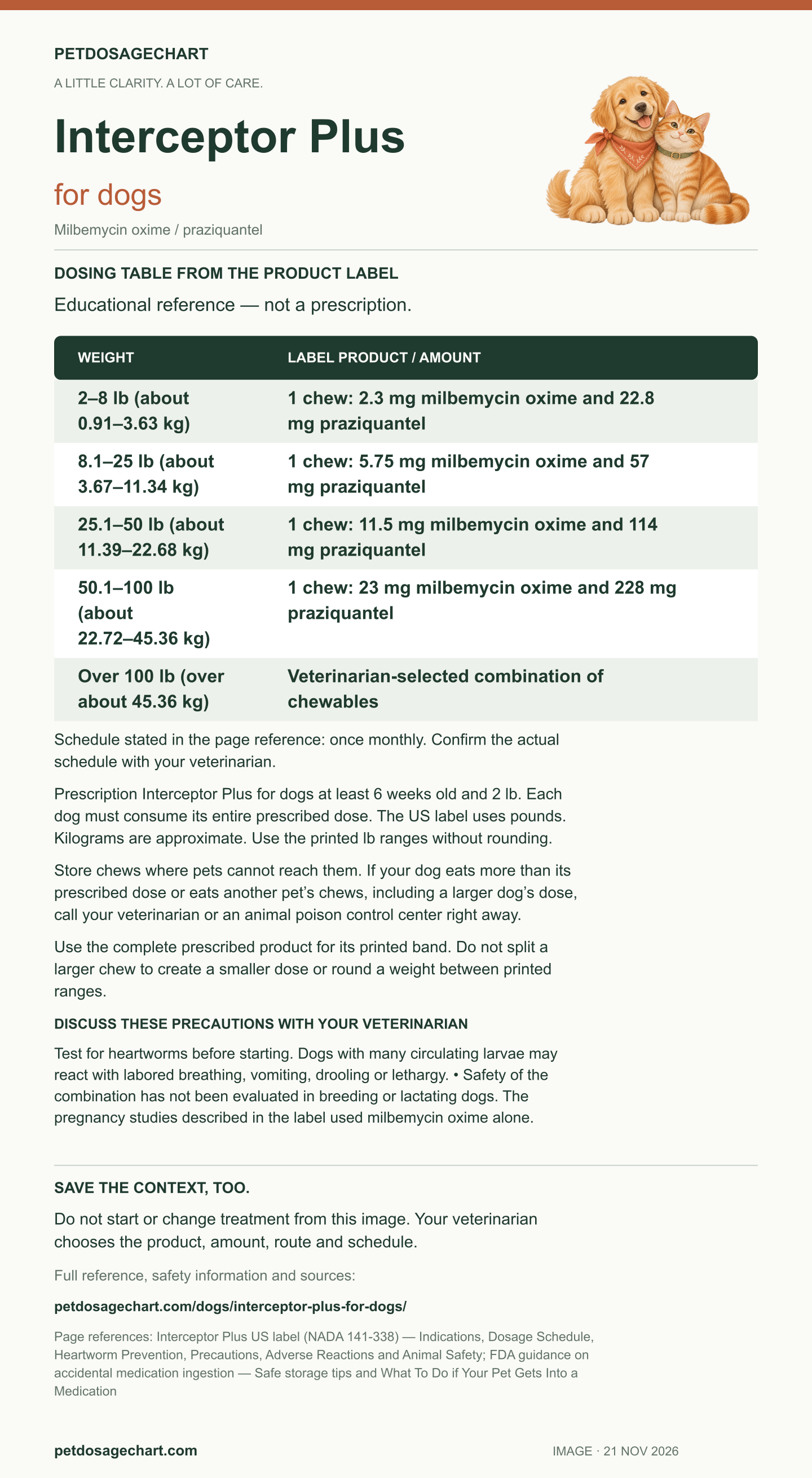
Prescription Interceptor Plus for dogs at least 6 weeks old and 2 lb. Each dog must consume its entire prescribed dose. The US label uses pounds. Kilograms are approximate. Use the printed lb ranges without rounding.
| Dog weight | Label dose (once monthly) |
|---|---|
| 2–8 lb (about 0.91–3.63 kg) | 1 chew: 2.3 mg milbemycin oxime and 22.8 mg praziquantel |
| 8.1–25 lb (about 3.67–11.34 kg) | 1 chew: 5.75 mg milbemycin oxime and 57 mg praziquantel |
| 25.1–50 lb (about 11.39–22.68 kg) | 1 chew: 11.5 mg milbemycin oxime and 114 mg praziquantel |
| 50.1–100 lb (about 22.72–45.36 kg) | 1 chew: 23 mg milbemycin oxime and 228 mg praziquantel |
| Over 100 lb (over about 45.36 kg) | Veterinarian-selected combination of chewables |
Source: Interceptor Plus US label (NADA 141-338) — Indications, Dosage Schedule, Heartworm Prevention, Precautions, Adverse Reactions and Animal Safety.
Store chews where pets cannot reach them. If your dog eats more than its prescribed dose or eats another pet’s chews, including a larger dog’s dose, call your veterinarian or an animal poison control center right away. FDA guidance on accidental medication ingestion
Use the complete dose prescribed for the labeled weight band. Do not divide a larger chew to create a smaller dose or combine strengths without your veterinarian's instructions. Confirm the product and schedule with your veterinarian.
Keep a copy of the reference chart
Educational reference, not a prescription. Your veterinarian sets the actual dose, product and schedule.
What parasites does Interceptor Plus cover?
The label covers heartworm disease prevention (Dirofilaria immitis) and treatment and control of adult roundworms (Toxocara canis and Toxascaris leonina), hookworms (Ancylostoma caninum), whipworms (Trichuris vulpis) and tapeworms (Taenia pisiformis, Echinococcus multilocularis, E. granulosus and Dipylidium caninum).
Dogs exposed to E. multilocularis can become reinfected and shed eggs between monthly treatments. Discuss ongoing exposure with your veterinarian. Fleas and ticks are outside this product’s indications. US Interceptor Plus label
How to give Interceptor Plus to your dog
Offer the chew by hand or in a small amount of food. For a dog that gulps treats, the label allows breaking the prescribed chew into pieces. Feed every piece to the same dog and watch for any that fall out. The label recommends redosing if any of the dose was lost. Store unused chews out of pets’ reach.Test for heartworms before starting. Interceptor Plus does not kill adult heartworms. The label permits year-round monthly use. For seasonal prevention, start within one month of the first mosquito exposure and continue monthly for at least six months after the last exposure. If a month was missed, call the prescribing clinic with the last dose date. Its instructions for a lost piece of chew apply at the time of administration. US Interceptor Plus label
Side effects and safety
The label reports vomiting, diarrhea, lethargy and convulsions after use of milbemycin oxime or praziquantel. Dogs with many circulating heartworm larvae can develop labored breathing, vomiting, drooling or lethargy after milbemycin oxime. Seek veterinary help promptly for breathing problems. US Interceptor Plus label
When Interceptor Plus should be used with caution or avoided
Some dogs should not take Interceptor Plus, or need a different dose and closer monitoring. Tell your veterinarian about your pet's full health history and every other medication or supplement they take before giving Interceptor Plus.
- Test for heartworms before starting. Dogs with many circulating larvae may react with labored breathing, vomiting, drooling or lethargy.
- Safety of the combination has not been evaluated in breeding or lactating dogs. The pregnancy studies described in the label used milbemycin oxime alone.
When this reference is not enough
A reference table cannot decide whether a product or treatment is appropriate for an individual animal. Do not rely on it in these situations — talk to your veterinarian instead:
- In an emergency, or after accidental ingestion or a suspected overdose
- For pregnant or nursing pets
- For very young or very old dogs
- For pets with liver disease, kidney disease, or another chronic illness
- For pets taking several medications at once
- When you are not sure of your dog's current, accurate weight
- For combination products that contain additional active ingredients
Suspected overdose: what to do
If you think your dog had too much Interceptor Plus, or swallowed any medication by accident, act right away. Do not wait for symptoms to appear.
- Call your veterinarian or the nearest emergency animal hospital.
- ASPCA Animal Poison Control Center: (888) 426-4435
- Pet Poison Helpline: (855) 764-7661
A consultation fee may apply to the poison hotlines. Have the medication packaging ready, and note how much your pet may have taken and when. Do not try to make your pet vomit unless a veterinarian tells you to.
What the source establishes
Four monthly milbemycin oxime and praziquantel strengths start at 2 lb and 6 weeks. The label lists an appropriate combination above 100 lb, pre-treatment heartworm testing, at least six monthly doses after last mosquito exposure, the adult worm species and the option to break a chew while giving the whole dose. It identifies reactions in dogs with circulating larvae and limits the reproductive evidence to studies of milbemycin oxime alone.
The insert addresses loss of a chew at dosing but gives no catch-up schedule for a missed month.
Interceptor Plus US label (NADA 141-338) — Indications, Dosage Schedule, Heartworm Prevention, Precautions, Adverse Reactions and Animal Safety.
Store chews where pets cannot reach them. If your dog eats more than its prescribed dose or eats another pet’s chews, including a larger dog’s dose, call your veterinarian or an animal poison control center right away.
General guidance for accidental ingestion. The product label gives the prescribed amount for each weight band.
FDA guidance on accidental medication ingestion — Safe storage tips and What To Do if Your Pet Gets Into a Medication.
The Drontal Plus Taste Tabs chart covers a different praziquantel combination. For products with a tick indication as well as heartworm prevention, see the separate NexGard PLUS and Credelio Quattro guides.
Frequently asked questions
Questions about this medication
What if a monthly Interceptor Plus dose was missed?
Does Interceptor Plus treat adult heartworms?
About this reference
- Onset
- The label gives a monthly schedule rather than a single onset time
- Duration
- Monthly heartworm prevention and intestinal worm control
- Class
- Antiparasitic combination
Related medications for dogs
These references share a recorded drug class. They are not interchangeable treatments or instructions to combine medications.
- Antiparasitic combination NexGard PLUS Recorded class: Antiparasitic combination
- Antiparasitic combination Ivermectin / Pyrantel Recorded class: Antiparasitic combination
- Antiparasitic combination Credelio Quattro Recorded class: Antiparasitic combination
- Antiparasitic combination Drontal Plus Taste Tabs Recorded class: Antiparasitic combination
Sources & references
The structured medication record behind this page names the references below. The links open the publisher or official resource; they do not turn this page into a prescription for an individual animal.
- Interceptor Plus US label (NADA 141-338)
Indications, Dosage Schedule, Heartworm Prevention, Precautions, Adverse Reactions and Animal Safety. Supports the specific claim described above; it is not a review of the entire page.
- FDA guidance on accidental medication ingestion
Safe storage tips and What To Do if Your Pet Gets Into a Medication. Supports the specific claim described above; it is not a review of the entire page.
- Interceptor Plus US product label (DailyMed) — listed in this medication's source record.
- DailyMed label search for Milbemycin oxime / praziquantel — check current product and formulation labels; some veterinary uses may be off-label.
Specific citations above support the identified claims. Other source names remain record-level references; further claim review is still needed. Read our methodology and limitations.
How this page was made
This page's structured medication record lists the source names below. This product is presented with its label's weight-band table instead of a weight-based calculator. A source record is not the same as an individualized prescription or an independent clinical review.
- Sources cited
-
- Interceptor Plus US product label (DailyMed)
- Calculator formula
- No weight-based calculator is shown because this product is dosed by the weight bands on its label. When a row specifies the strength and count, it lists one complete dose for every weight in that band. If a combination is needed, confirm the strengths and count with your veterinarian.
- Editorial owner
- Prepared and maintained by the PetDosageChart editorial team, a software-led publisher and not a veterinary practice.
- DVM review status
- Not independently DVM-reviewed. A named reviewer and review date appear here only after a confirmed review.
More on our methodology and editorial process — how we source, calculate, and review dogs dosage data.
More resources
- Pet Medication Safety Hub — What's safe, what's dangerous, and emergency signs
- How we calculate dosages — Our sources, math, and review process
- Printable emergency checklist — One-page reference for your fridge or first aid kit
More tools: common weights and embed code
By Weight
Interceptor Plus reference by dog weight
Choose a common weight to open its optional reference page. Return to the main guide for the product's labeled weight-band limits.
Common-weight pages are convenience views of the same educational reference, not separate medical recommendations.