Convenia dosage reference for cats (Cefovecin)
This medication is given by a veterinarian, so the page shows the label's dosing table instead of a weight-based calculator. Ask your veterinarian which dose your cat received.
This information is for educational purposes only. Always consult your veterinarian before giving medication to your pet. Do not use this reference for emergencies, overdoses, pregnancy, very young animals, very old animals, pets with liver/kidney disease, or pets taking multiple medications.
Sources and review process
Each medication page lists the references recorded for its data. The reference content and editorial presentation are maintained by PetDosageChart; a page is independently DVM-reviewed only when a named reviewer byline appears. See our methodology and limitations.
Convenia (cefovecin) is a long-acting cephalosporin antibiotic that a veterinarian gives as an injection under the skin. Its FDA-approved label for cats covers skin infections, wounds and abscesses, caused by Pasteurella multocida. Because one injection keeps working for about a week, it can replace a course of antibiotic pills or liquid for those infections, which helps with cats that are hard to medicate.
Given by your veterinarian, not at home: Convenia is measured and injected by the veterinary team, so this page has no dose calculator. It explains what to expect, how long the injection lasts, and the side effects to watch for.
What the source establishes
For cats, Convenia is a single, one-time injection under the skin of 3.6 mg/lb (8 mg/kg), 0.045 mL/lb of the 80 mg/mL solution: the table lists 0.23 mL at 5 lb, 0.45 mL at 10 lb, 0.67 mL at 15 lb and 0.90 mL at 20 lb. It is labeled for skin infections (wounds and abscesses) caused by Pasteurella multocida; effective levels last about 7 days, peak blood level comes about 2 hours after injection, and about 65 days are needed to eliminate 97% of a dose. In the US cat field study (147 treated cats) it was non-inferior to 14 days of an oral antibiotic, with vomiting (10), diarrhea (7), decreased appetite (6), lethargy (6), hyper or strange behavior (1) and inappropriate urination (1) reported. Foreign-market reports, contraindications (beta-lactam allergy), safety limits (under 4 months, breeding or nursing) and protein-binding interactions (carprofen, furosemide, doxycycline, ketoconazole, NSAIDs, propofol, cardiac, anticonvulsant and behavioral drugs) are listed. Free levels do not reach the E. coli MIC90, and it is not active against Pseudomonas or enterococci.
One US product label. The dose is measured and given by the veterinarian; the printed table shows example weights only.
Convenia (cefovecin sodium) FDA-approved label (Zoetis, DailyMed) — Indications; Dosage and Administration (dosing table); Contraindications; Precautions; Adverse Reactions; Clinical Pharmacology; Effectiveness (NADA 141-285).
Classes cefovecin as a third-generation cephalosporin approved for dogs and cats, sustained-release because of its long elimination half-life (6.9 days in cats, with 99% protein binding), and lists 8 mg/kg under the skin every 14 days for dogs and cats.
A veterinary reference overview. Whether a cat receives a second injection is a veterinary decision.
Merck Veterinary Manual: Cephalosporins and Cephamycins Use in Animals — Third- and Fourth-Generation Cephalosporins; Absorption; Distribution; Table: Dosages of Cephalosporins.
What to Expect When Your Cat Gets Convenia
Your veterinarian weighs your cat and gives a single injection under the skin, usually during the visit. The label recommends taking a sample of the wound or abscess for culture before starting antibiotics, so your vet may swab or drain it first. For cats, the US label describes a single, one-time injection; there are no antibiotic doses to give at home for that infection unless your vet prescribes other medicines.
At home, keep an eye on your cat’s appetite, litter box and the injection site. The label says that if there is no improvement within 3 to 4 days, the diagnosis should be re-evaluated, so call your veterinarian if the wound or abscess is not getting better by then.
How Long Does Convenia Last?
Blood levels peak about 2 hours after the injection. According to the label, levels that are effective against Pasteurella multocida last about 7 days in cats. The drug itself leaves the body very slowly: cefovecin’s elimination half-life in cats is about 7 days (6.9 days in the Merck Veterinary Manual), and about 65 days are needed to clear 97% of a dose. That long tail has two practical consequences:
- If your cat has a reaction, it may need monitoring, and sometimes treatment, for weeks rather than days.
- Tell any veterinarian who treats your cat in the next 65 days (about two months) that it had Convenia. The label notes that the effect of remaining cefovecin on later antibiotic treatment has not been determined.
Convenia Label Dose Table for Cats
The label dose is 3.6 mg per pound (8 mg/kg), injected once under the skin. These are the volumes the label prints for cat-sized example weights:
US label for cats: one injection under the skin of 3.6 mg per lb (8 mg/kg), which is 0.045 mL per lb of the mixed 80 mg per mL solution. The label prints these example weights; your veterinarian works out the volume from your cat’s weight measured at the clinic.
| Cat weight | Label dose (as a single injection under the skin, given by your veterinarian) |
|---|---|
| 5 lb | 0.23 mL |
| 10 lb | 0.45 mL |
| 15 lb | 0.67 mL |
| 20 lb | 0.90 mL |
Source: Convenia (cefovecin sodium) FDA-approved label (Zoetis, DailyMed) — Indications; Dosage and Administration (dosing table); Contraindications; Precautions; Adverse Reactions; Clinical Pharmacology; Effectiveness (NADA 141-285).
The veterinary team measures and gives this medication at the clinic; there is nothing to measure or give at home.
Keep a copy of the reference chart
Educational reference, not a prescription. Your veterinarian sets the actual dose, product and schedule.
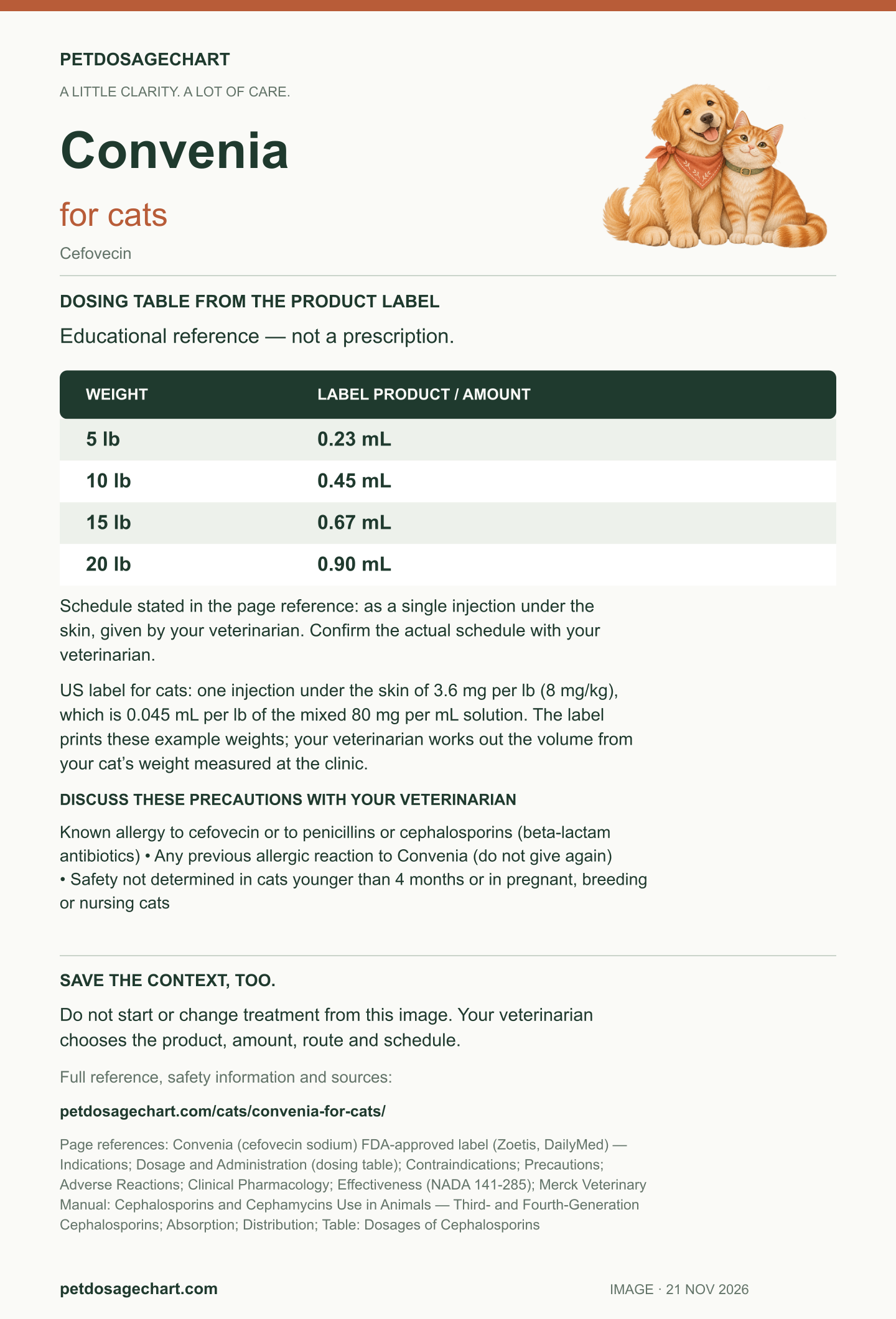
The Merck Veterinary Manual’s dosing table lists 8 mg/kg under the skin every 14 days for dogs and cats. Whether your cat needs a second injection is your veterinarian’s decision; the US label for cats describes one injection.
Convenia as the No-Pill Option
In the US field study behind the label, cats with infected wounds or abscesses were treated with either one Convenia injection or an oral antibiotic given once daily for 14 days. Convenia was found to be no less effective (clinical success in 96.6% vs 90.9% of evaluated cats). If giving pills or liquid is the obstacle, ask your veterinarian whether Convenia suits your cat’s infection. Our guide on how to give a cat medication safely covers pilling and liquid technique when an oral antibiotic is the better fit.
Convenia is not right for every infection. The US label for cats covers only skin infections caused by Pasteurella multocida. Because cefovecin is so tightly bound to blood proteins, the label notes that free drug levels in the body do not reach the concentration that inhibits 90% of E. coli strains, and it is not active against Pseudomonas or enterococci. Other antibiotic references on this site, all given by mouth, are Clavamox, cephalexin (another cephalosporin) and clindamycin. They are different medicines and are not interchangeable with Convenia; your veterinarian chooses the drug for the infection.
Side Effects and Safety
In the US field study of 147 cats given Convenia, the reported reactions were vomiting (10 cats), diarrhea (7), decreased appetite (6), lethargy (6), acting hyper or strange (1) and inappropriate urination (1). Cats given the comparison oral antibiotic had similar or higher counts, for example 14 with vomiting and 26 with diarrhea out of 144. Some cats had raised liver (ALT) and kidney (BUN, creatinine) values after treatment, mild to moderate, without signs of illness, and one cat in a separate field study had diarrhea for 42 days. Voluntary reports from other countries, in dogs and cats, also include vomiting, diarrhea, lethargy, drooling, itching, injection-site reactions (hair loss, scabs, redness, tissue death), facial swelling, fluid in the lungs, anaphylaxis, hemolytic anemia, tremors, loss of coordination, seizures and death.
Convenia should not be given to cats allergic to cefovecin or to penicillins or cephalosporins (beta-lactam antibiotics), and a cat that has had an allergic reaction to it should not receive it again. Its safety has not been determined in cats younger than 4 months or in pregnant, breeding or nursing cats. Cefovecin is highly bound to blood proteins and, in a laboratory test, raised the free levels of carprofen, furosemide, doxycycline and ketoconazole; the label cautions about other highly protein-bound drugs too, such as NSAIDs, propofol, and heart, seizure and behavior medications. Cephalosporins can also skew some lab tests, including urine glucose, urine protein, albumin and the Coombs test, so mention the injection before blood or urine tests.
When Convenia should be used with caution or avoided
Some cats should not take Convenia, or need a different dose and closer monitoring. Tell your veterinarian about your pet's full health history and every other medication or supplement they take before your cat receives Convenia.
- Known allergy to cefovecin or to penicillins or cephalosporins (beta-lactam antibiotics)
- Any previous allergic reaction to Convenia (do not give again)
- Safety not determined in cats younger than 4 months or in pregnant, breeding or nursing cats
Convenia drug interactions
Convenia can interact with other drugs. This list is not complete — always give your veterinarian a full list of your cat's medications and supplements.
When this reference is not enough
A reference table cannot decide whether a product or treatment is appropriate for an individual animal. Do not rely on it in these situations — talk to your veterinarian instead:
- In an emergency, or after accidental ingestion or a suspected overdose
- For pregnant or nursing pets
- For very young or very old cats
- For pets with liver disease, kidney disease, or another chronic illness
- For pets taking several medications at once
- When you are not sure of your cat's current, accurate weight
- For combination products that contain additional active ingredients
Suspected reaction: what to do
If you think your cat reacted to the injection, call your veterinarian or an emergency clinic.
When to Call the Vet
If your cat experiences any of the following, contact your veterinarian or an emergency clinic immediately:
- Facial swelling, hives, trouble breathing, collapse or sudden vomiting after the injection (possible allergic reaction)
- Seizures, tremors or wobbliness
- Not eating, or vomiting or diarrhea that does not settle
- Swelling, hair loss, scabs or a sore at the injection site
- The wound or abscess is not improving within 3 to 4 days
Frequently Asked Questions
Questions about this medication
How long does Convenia last in cats?
Is Convenia an alternative to giving my cat antibiotic pills?
How much Convenia does a cat get?
What are the side effects of Convenia in cats?
Can my cat get a second Convenia shot?
Does Convenia treat urinary tract infections in cats?
About this reference
- Onset
- Peak blood level about 2 hours after the injection
- Duration
- About 7 days of effective levels; up to 65 days to leave the body
- Class
- Cephalosporin antibiotic (third generation)
Sources & references
The structured medication record behind this page names the references below. The links open the publisher or official resource; they do not turn this page into a prescription for an individual animal.
- Convenia (cefovecin sodium) FDA-approved label (Zoetis, DailyMed)
Indications; Dosage and Administration (dosing table); Contraindications; Precautions; Adverse Reactions; Clinical Pharmacology; Effectiveness (NADA 141-285). Supports the specific claim described above; it is not a review of the entire page.
- Merck Veterinary Manual: Cephalosporins and Cephamycins Use in Animals
Third- and Fourth-Generation Cephalosporins; Absorption; Distribution; Table: Dosages of Cephalosporins. Supports the specific claim described above; it is not a review of the entire page.
- Convenia (cefovecin sodium) FDA-approved label (NADA 141-285) — listed in this medication's source record.
- Merck Veterinary Manual — listed in this medication's source record.
- DailyMed label search for Cefovecin — check current product and formulation labels; some veterinary uses may be off-label.
Specific citations above support the identified claims. Other source names remain record-level references; further claim review is still needed. Read our methodology and limitations.
How this page was made
This page's structured medication record lists the source names below. This medication is given by a veterinarian, so the page shows the label's dosing table instead of a weight-based calculator. A source record is not the same as an individualized prescription or an independent clinical review.
- Sources cited
-
- Convenia (cefovecin sodium) FDA-approved label (NADA 141-285)
- Merck Veterinary Manual
- Calculator formula
- No weight-based calculator is shown because the veterinary team gives this medication, working out the dose from the animal's measured weight at the clinic. The table reproduces the weight entries printed on the label.
- Editorial owner
- Prepared and maintained by the PetDosageChart editorial team, a software-led publisher and not a veterinary practice.
- DVM review status
- Not independently DVM-reviewed. A named reviewer and review date appear here only after a confirmed review.
More on our methodology and editorial process — how we source, calculate, and review cats dosage data.
More resources
- Pet Medication Safety Hub — What's safe, what's dangerous, and emergency signs
- How we calculate dosages — Our sources, math, and review process
- Printable emergency checklist — One-page reference for your fridge or first aid kit