Clavamox dosage reference for cats (Amoxicillin-Clavulanate)
The product label gives an amount per cat. For kittens and very small cats, confirm the prescribed amount and liquid volume with your veterinarian.
This information is for educational purposes only. Always consult your veterinarian before giving medication to your pet. Do not use this reference for emergencies, overdoses, pregnancy, very young animals, very old animals, pets with liver/kidney disease, or pets taking multiple medications.
Sources and review process
Each medication page lists the references recorded for its data. The reference content and editorial presentation are maintained by PetDosageChart; a page is independently DVM-reviewed only when a named reviewer byline appears. See our methodology and limitations.
Clavamox is a prescription antibiotic that combines amoxicillin with clavulanate (clavulanic acid). Its FDA-approved label for cats covers skin and soft tissue infections, such as wounds, abscesses and cellulitis/dermatitis, and urinary tract infections (cystitis) caused by E. coli. Cats can take it as a 62.5 mg chewable tablet or as a liquid, Clavamox Drops.
No weight-based calculator on this page: The Clavamox labels give cats a fixed amount, 62.5 mg twice a day, rather than a dose per pound. For kittens and very small cats, confirm the individual dose and liquid volume with the prescribing veterinarian before giving it. Give exactly what is on your cat’s prescription.
What the source establishes
For cats the label dose is 62.5 mg twice a day. Skin and soft tissue infections are treated for 5–7 days or 48 hours after signs subside, not over 30 days, and re-evaluated if there is no response after 3 days; urinary tract infections may need 10–14 days or longer. The 62.5 mg tablet (50 mg amoxicillin, 12.5 mg clavulanic acid) is for dogs and cats; the 125, 250 and 375 mg tablets are for dogs only. It is contraindicated after an allergic reaction to a penicillin or cephalosporin, and post-approval reports list anorexia, lethargy, vomiting and diarrhea.
One US product label. It gives a per-cat amount, not a weight-based dose, and does not replace the prescription for an individual cat.
Clavamox Chewable (amoxicillin and clavulanate potassium tablets) FDA-approved label (Zoetis, DailyMed) — Indications; Dosage and Administration: Cats; Contraindications; Adverse Reactions; Storage; How Supplied (NADA 055-099).
For cats the dose is 62.5 mg (1 mL) twice a day. Once mixed, each mL holds 50 mg amoxicillin and 12.5 mg clavulanic acid, the suspension must be refrigerated, and any unused portion is discarded after 10 days. Absorption is not significantly influenced by gastric or intestinal contents.
One US product label for the liquid form. It does not cover compounded or human amoxicillin-clavulanate products.
Clavamox Drops (amoxicillin and clavulanate potassium for oral suspension) FDA-approved label (Zoetis, DailyMed) — Dosage and Administration: Cats; Reconstitution instructions; Clinical Pharmacology (NADA 055-101).
Lists amoxicillin-clavulanate for cats at 62.5 mg per cat by mouth every 12 hours, or 10–20 mg/kg every 8 hours, and amoxicillin with or without clavulanic acid among first-choice drugs for feline urinary tract infections. Notes that gut-active penicillins can strengthen anticoagulants and that salicylates, phenylbutazone and sulfonamides delay penicillin excretion.
A veterinary reference table of general dosages. The dose for an individual cat is set by the prescribing veterinarian.
Merck Veterinary Manual: Penicillins Use in Animals — Table: Dosages of Penicillins (amoxicillin-clavulanate); Interactions With Penicillins.
Lists an allergic reaction among rare reactions that call for contacting the veterinarian immediately, with signs such as irregular breathing, rash, fever, and puffiness and swelling around the face, and says to watch for signs of an allergic reaction over the entire course of treatment.
An owner-facing hospital handout on amoxicillin-clavulanic acid in general, not a Clavamox product label.
VCA Animal Hospitals: Amoxicillin-Clavulanic Acid — Are there any potential side effects from amoxicillin-clavulanic acid?.
Human formulations list amoxicillin and clavulanate separately and have differing proportions. A matching amoxicillin number does not identify an equivalent Clavamox product.
Product identification and handling only.
AUGMENTIN human prescribing information — Dosage forms and strengths; noninterchangeable presentations.
Shake the liquid well before measuring each dose.
Product identification and handling only.
VCA Animal Hospitals: Amoxicillin-Clavulanic Acid — Administration.
Clavamox Dosage for Cats
FDA labels for Clavamox Chewable and Clavamox Drops: 62.5 mg per cat twice a day. For kittens and very small cats, confirm the individual dose and liquid volume with the prescribing veterinarian before giving it. The 62.5 mg tablet is the only strength labeled for cats; the 125, 250 and 375 mg tablets are for dogs only. Do not substitute human Augmentin. Shake the drops and verify 62.5 mg/mL before measuring.
| Cat weight | Label dose (every 12 hours) |
|---|---|
| Feline label (no minimum weight specified) | 62.5 mg (one 62.5 mg chewable tablet or 1 mL of mixed Clavamox Drops) |
Source: Clavamox Chewable (amoxicillin and clavulanate potassium tablets) FDA-approved label (Zoetis, DailyMed) — Indications; Dosage and Administration: Cats; Contraindications; Adverse Reactions; Storage; How Supplied (NADA 055-099).
Use the complete dose listed for the labeled weight band, as prescribed. Do not divide a product or combine strengths beyond what the label lists for that band without your veterinarian's instructions. Confirm the product and schedule with your veterinarian.
Keep a copy of the reference chart
Educational reference, not a prescription. Your veterinarian sets the actual dose, product and schedule.
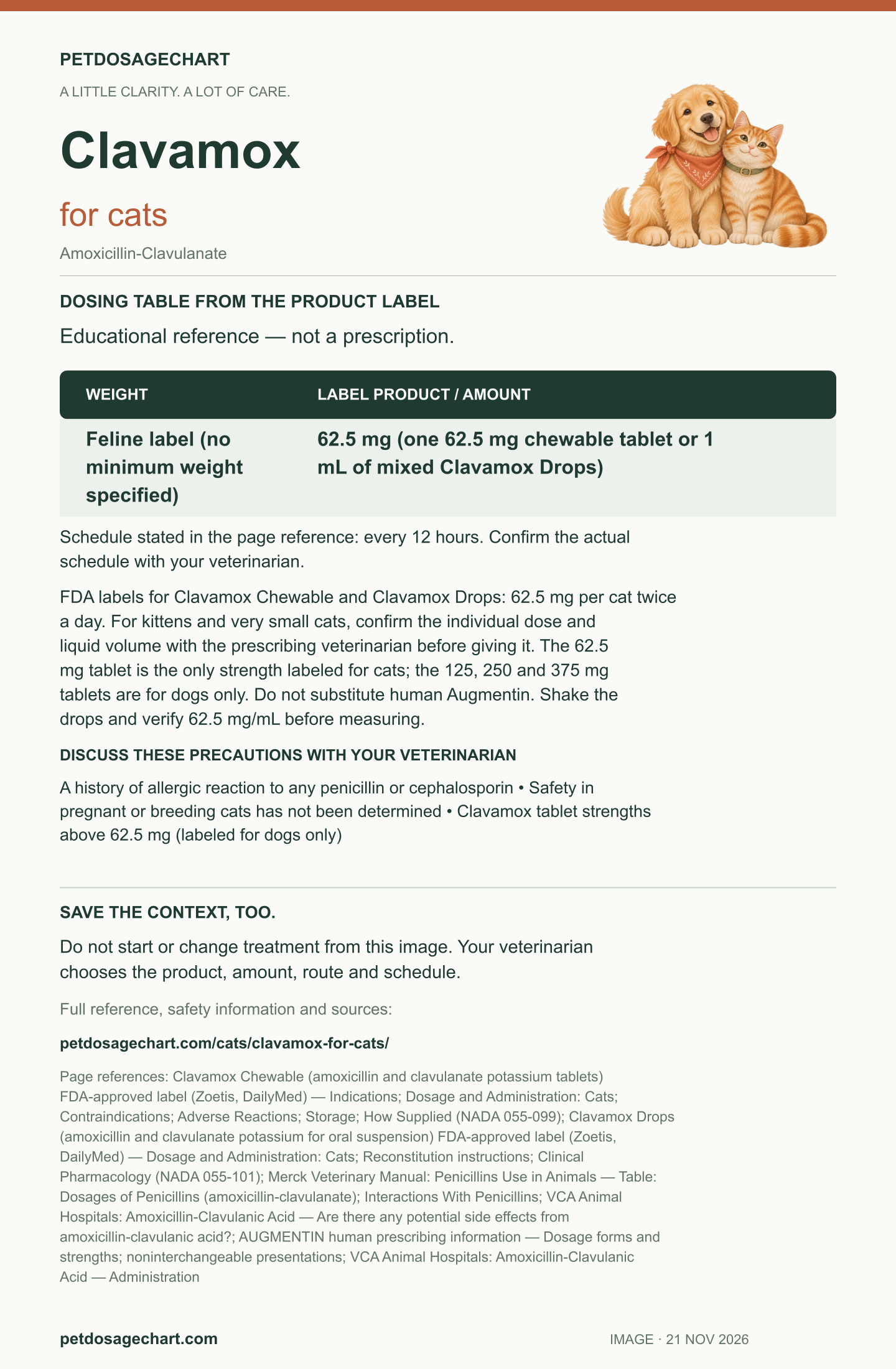
The 62.5 mg strength is 50 mg of amoxicillin plus 12.5 mg of clavulanic acid, and 1 mL of mixed drops holds the same amount. The Merck Veterinary Manual also lists a weight-based schedule for cats, 10–20 mg/kg every 8 hours, which a veterinarian may choose instead. Follow the dose and schedule on your cat’s label rather than either reference.
Clavamox Versus Plain Amoxicillin for Cats
Plain amoxicillin for cats is broken down by beta-lactamases, enzymes some bacteria make. Clavulanate blocks those enzymes, so Clavamox also works against many of those bacteria. The two are not interchangeable: the strength on a Clavamox product counts both ingredients, and the label dose for cats is set for Clavamox specifically. Never give a cat a dog’s 125, 250 or 375 mg Clavamox tablets: only the 62.5 mg strength is labeled for cats.
How to Give Clavamox to Your Cat
Do not substitute human amoxicillin-clavulanate (Augmentin). Clavamox strengths count both drugs together. Human labels list the components separately and the proportions can differ.
Give the prescribed amount by mouth every 12 hours and finish the course. The Clavamox Drops label says absorption is not significantly affected by food, so it can be given with or without a meal. Keep tablets in their foil strip until you give them, stored somewhere dry and cool, no warmer than 77°F (25°C). Do not split and save part of a tablet. If it breaks, give the full prescribed tablet.
Clavamox Drops must be refrigerated. Once the powder is mixed with water, the label requires the liquid to be kept in the refrigerator, and any unused portion must be thrown away after 10 days. Shake mixed Clavamox Drops well before every dose. Check the bottle for 62.5 mg/mL before using these volumes. Measure each dose with the device your clinic or pharmacy provides and give it slowly. Do not keep leftover drops for a later illness.
The label treats skin and soft tissue infections for 5–7 days or for 48 hours after all signs have gone, and urinary tract infections for 10–14 days or longer, with a maximum of 30 days. If your cat is not responding after 3 days, call your veterinarian: the label says treatment should then be stopped and the case re-evaluated.
Our guide on how to give a cat medication safely covers pilling and liquid technique step by step. If twice-daily dosing is not working for your cat, ask your veterinarian whether a different option suits the infection. For skin wounds and abscesses, one choice is Convenia, an antibiotic your vet gives as a single injection.
Side Effects and Safety
Penicillins can cause allergic reactions in people who are sensitive to them. The chewable label advises anyone handling Clavamox to avoid direct contact with skin and mucous membranes.
Post-approval reports for Clavamox in dogs and cats list, from most to least often reported, loss of appetite, lethargy, vomiting and diarrhea. Amoxicillin is a penicillin, so allergic reactions can happen. Clavamox should not be given to a cat that has had an allergic reaction to any penicillin or cephalosporin, and its safety in pregnant or breeding cats has not been determined. The Merck Veterinary Manual notes that penicillins given by mouth can strengthen anticoagulants, and that aspirin and other salicylates, phenylbutazone and sulfonamides slow penicillin excretion.
When Clavamox should be used with caution or avoided
Some cats should not take Clavamox, or need a different dose and closer monitoring. Tell your veterinarian about your pet's full health history and every other medication or supplement they take before giving Clavamox.
- A history of allergic reaction to any penicillin or cephalosporin
- Safety in pregnant or breeding cats has not been determined
- Clavamox tablet strengths above 62.5 mg (labeled for dogs only)
Clavamox drug interactions
Clavamox can interact with other drugs. This list is not complete — always give your veterinarian a full list of your cat's medications and supplements.
When this reference is not enough
A reference table cannot decide whether a product or treatment is appropriate for an individual animal. Do not rely on it in these situations — talk to your veterinarian instead:
- In an emergency, or after accidental ingestion or a suspected overdose
- For pregnant or nursing pets
- For very young or very old cats
- For pets with liver disease, kidney disease, or another chronic illness
- For pets taking several medications at once
- When you are not sure of your cat's current, accurate weight
- For combination products that contain additional active ingredients
Suspected overdose: what to do
If you think your cat had too much Clavamox, or swallowed any medication by accident, act right away. Do not wait for symptoms to appear.
- Call your veterinarian or the nearest emergency animal hospital.
- ASPCA Animal Poison Control Center: (888) 426-4435
- Pet Poison Helpline: (855) 764-7661
A consultation fee may apply to the poison hotlines. Have the medication packaging ready, and note how much your pet may have taken and when. Do not try to make your pet vomit unless a veterinarian tells you to.
When to Call the Vet
If your cat experiences any of the following, contact your veterinarian or an emergency clinic immediately:
- Hives, facial swelling, trouble breathing or collapse (possible allergic reaction)
- Vomiting, diarrhea or refusal to eat that does not settle
- No improvement after 3 days of treatment
- Your cat cannot be given the doses, or you have missed several
Other Antibiotic References for Cats
These pages cover different antibiotics; they are not substitutes for Clavamox, and your veterinarian chooses the drug for the infection: cephalexin for cats, clindamycin for cats, doxycycline for cats and metronidazole for cats.
Frequently Asked Questions
Questions about this medication
How much Clavamox should I give my cat?
Do Clavamox drops for cats need to be refrigerated?
How long does a cat take Clavamox?
Can I give my cat my dog’s Clavamox tablets?
What are the side effects of Clavamox in cats?
About this reference
- Onset
- Response expected within 3 days (label re-check point)
- Duration
- 12 hours (given twice a day)
- Class
- Antibiotic (Penicillin)
For Dogs
Looking for Clavamox dosage for dogs?
View the Clavamox dosage chart and calculator for dogs.
Related medications for cats
These references share a recorded drug class. They are not interchangeable treatments or instructions to combine medications.
Sources & references
The structured medication record behind this page names the references below. The links open the publisher or official resource; they do not turn this page into a prescription for an individual animal.
- Clavamox Chewable (amoxicillin and clavulanate potassium tablets) FDA-approved label (Zoetis, DailyMed)
Indications; Dosage and Administration: Cats; Contraindications; Adverse Reactions; Storage; How Supplied (NADA 055-099). Supports the specific claim described above; it is not a review of the entire page.
- Clavamox Drops (amoxicillin and clavulanate potassium for oral suspension) FDA-approved label (Zoetis, DailyMed)
Dosage and Administration: Cats; Reconstitution instructions; Clinical Pharmacology (NADA 055-101). Supports the specific claim described above; it is not a review of the entire page.
- Merck Veterinary Manual: Penicillins Use in Animals
Table: Dosages of Penicillins (amoxicillin-clavulanate); Interactions With Penicillins. Supports the specific claim described above; it is not a review of the entire page.
- VCA Animal Hospitals: Amoxicillin-Clavulanic Acid
Are there any potential side effects from amoxicillin-clavulanic acid?. Supports the specific claim described above; it is not a review of the entire page.
- AUGMENTIN human prescribing information
Dosage forms and strengths; noninterchangeable presentations. Supports the specific claim described above; it is not a review of the entire page.
- VCA Animal Hospitals: Amoxicillin-Clavulanic Acid
Administration. Supports the specific claim described above; it is not a review of the entire page.
- Clavamox Chewable tablets FDA-approved label (NADA 055-099) — listed in this medication's source record.
- Clavamox Drops FDA-approved label (NADA 055-101) — listed in this medication's source record.
- Merck Veterinary Manual — listed in this medication's source record.
- VCA Animal Hospitals: Amoxicillin-Clavulanic Acid — listed in this medication's source record.
- DailyMed label search for Amoxicillin-Clavulanate — check current product and formulation labels; some veterinary uses may be off-label.
Specific citations above support the identified claims. Other source names remain record-level references; further claim review is still needed. Read our methodology and limitations.
How this page was made
This page's structured medication record lists the source names below. This product is presented with its label's weight-band table instead of a weight-based calculator. A source record is not the same as an individualized prescription or an independent clinical review.
- Sources cited
-
- Clavamox Chewable tablets FDA-approved label (NADA 055-099)
- Clavamox Drops FDA-approved label (NADA 055-101)
- Merck Veterinary Manual
- VCA Animal Hospitals: Amoxicillin-Clavulanic Acid
- Calculator formula
- No weight-based calculator is shown because this product is dosed by the weight bands on its label. When a row specifies the strength and count, it lists one complete dose for every weight in that band. If a combination is needed, confirm the strengths and count with your veterinarian.
- Editorial owner
- Prepared and maintained by the PetDosageChart editorial team, a software-led publisher and not a veterinary practice.
- DVM review status
- Not independently DVM-reviewed. A named reviewer and review date appear here only after a confirmed review.
More on our methodology and editorial process — how we source, calculate, and review cats dosage data.
More resources
- Pet Medication Safety Hub — What's safe, what's dangerous, and emergency signs
- How we calculate dosages — Our sources, math, and review process
- Printable emergency checklist — One-page reference for your fridge or first aid kit
More tools: common weights and embed code
By Weight
Clavamox reference by cat weight
Choose a common weight to open its optional reference page. Return to the main guide for the product's labeled weight-band limits.
Common-weight pages are convenience views of the same educational reference, not separate medical recommendations.