Clindamycin dosage reference for cats (Antirobe Aquadrops)
This page's standard weight-based reference is 11.025 mg per kg (5.00 mg per lb), with once every 24 hours recorded as the reference frequency. Use the calculator to see the arithmetic for your cat's weight, then confirm the indication, product, and actual dose with a veterinarian.
This information is for educational purposes only. Always consult your veterinarian before giving medication to your pet. Do not use this calculator for emergencies, overdoses, pregnancy, very young animals, very old animals, pets with liver/kidney disease, or pets taking multiple medications.
Sources and review process
Each medication page lists the references recorded for its data. The calculator math and editorial presentation are maintained by PetDosageChart; a page is independently DVM-reviewed only when a named reviewer byline appears. See our methodology and limitations.
Clindamycin is a prescription lincosamide antibiotic. For cats, the FDA-approved form is the liquid Antirobe Aquadrops (25 mg per mL), labeled for infected wounds, abscesses and dental infections. Antirobe capsules are labeled for dogs only; if your veterinarian prescribes a capsule or tablet for your cat, that is extra-label use. Veterinarians also use clindamycin to treat cats with signs of toxoplasmosis.
The label dose for cats is 5–15 mg per pound once every 24 hours (about 11–33 mg/kg a day), depending on how severe the infection is. With the 25 mg per mL liquid, 1 mL per 5 lb gives the low end and 3 mL per 5 lb the high end. The Merck Veterinary Manual lists 10–15 mg/kg every 12–24 hours.
Pill safety for cats: Always follow a clindamycin capsule or tablet with a little water from a syringe or with food. The Merck Veterinary Manual reports that clindamycin given to cats without food or water has caused esophagitis, esophageal ulcers and esophageal strictures (scar tissue that narrows the swallowing tube).
Calculator Warning: Use this only as an educational estimate. Your veterinarian may prescribe a different dose based on your pet’s condition, age, weight, other medications, and medical history. Clindamycin is prescription-only; give the amount on your cat’s label.
What the source establishes
For cats the label dose is 5–15 mg/lb once every 24 hours (11–33 mg/kg a day) for infected wounds, abscesses and dental infections: 1 mL per 5 lb of the 25 mg/mL liquid gives 5 mg/lb and 3 mL per 5 lb gives 15 mg/lb. Treatment may continue up to 14 days, but not beyond 3–4 days without a response. Capsules are for dogs only. Peak blood level is about 1 hour after a dose. Side effects are vomiting and diarrhea; in the cat safety study vomiting occurred at 3 times the minimum dose or more. Periodic liver and kidney tests and blood counts are advised for therapy of a month or longer. It is contraindicated with clindamycin or lincomycin allergy and must not be given to rabbits, hamsters, guinea pigs, horses, chinchillas or ruminants.
One US product label for the liquid. Capsule use and twice-daily schedules in cats are vet-directed and extra-label.
Antirobe Aquadrops (clindamycin hydrochloride oral solution) FDA-approved label (Zoetis, DailyMed) — Description; Indications; Dosage and Administration: Cats; Animal Safety Summary: Cat Data; Contraindications; Precautions (NADA 135-940).
Lists clindamycin for dogs and cats at 10–15 mg/kg every 12–24 hours (extra-label). States that clindamycin given without food or water has caused esophagitis, esophageal ulceration and stricture in cats, and that lincosamides should not be used in neonates because of their limited ability to metabolize drugs. Lincosamides add to the neuromuscular effects of anesthetics and muscle relaxants, kaolin-pectin blocks their absorption, they should not be combined with bactericidal agents or macrolides, and dose reduction should be considered with liver insufficiency.
A veterinary reference overview. It does not set the dose for an individual cat.
Merck Veterinary Manual: Lincosamides Use in Animals — Table: Dosages of Lincosamides; Adverse Effects and Toxicity; Interactions With Lincosamides.
Cats with clinical signs of toxoplasmosis are generally treated with clindamycin hydrochloride at 10–12.5 mg/kg by mouth every 12 hours for 4 weeks, or a trimethoprim-sulfonamide; these drugs help in the acute stage but usually do not eradicate infection.
Treatment of a diagnosed infection under veterinary care. Subclinical infection is not treated, and the schedule differs from the once-daily label.
Merck Veterinary Manual: Toxoplasmosis in Animals — Treatment.
Lists exposure to certain drugs, such as doxycycline or clindamycin, among causes of esophageal stricture, with signs that include regurgitation, ptyalism (drooling), dysphagia (trouble swallowing) and pain.
A disease overview. It does not quantify how often clindamycin causes strictures.
Merck Veterinary Manual: Esophageal Strictures in Small Animals — Opening section (causes and clinical signs).
Clindamycin Dosage Calculator for Cats
Enter your cat’s weight to see the arithmetic for one daily dose. The lower reference is the label’s 5 mg per lb and the upper reference its 15 mg per lb, given once every 24 hours. Your veterinarian may prescribe a different schedule, such as twice daily for toxoplasmosis.
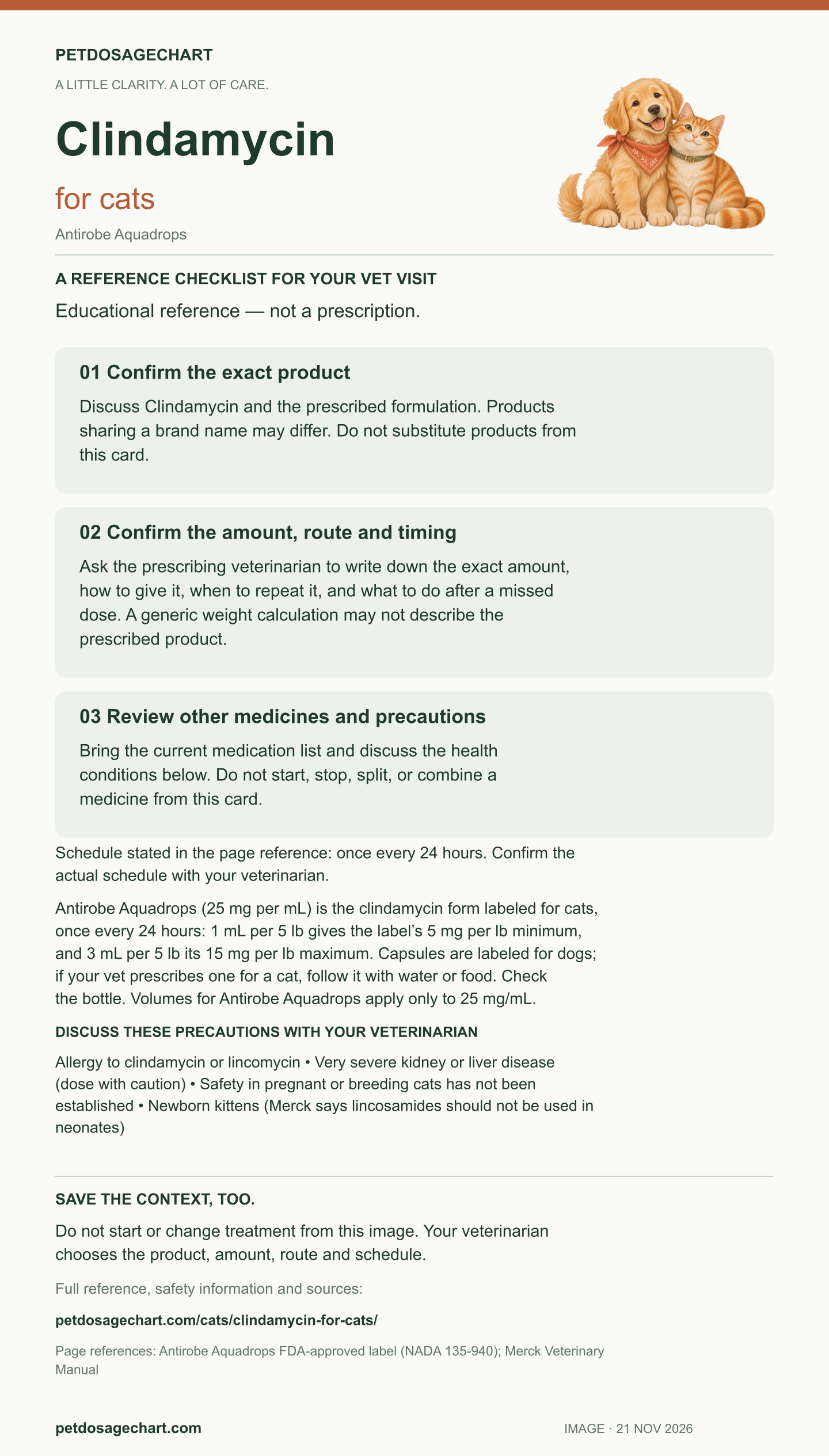
Which product this applies to: Antirobe Aquadrops (25 mg per mL) is the clindamycin form labeled for cats, once every 24 hours: 1 mL per 5 lb gives the label’s 5 mg per lb minimum, and 3 mL per 5 lb its 15 mg per lb maximum. Capsules are labeled for dogs; if your vet prescribes one for a cat, follow it with water or food. Check the bottle. Volumes for Antirobe Aquadrops apply only to 25 mg/mL.
Clindamycin Dosage Chart by Weight
Clindamycin amounts per daily dose for common cat weights, for quick reference:
Which product this applies to: Antirobe Aquadrops (25 mg per mL) is the clindamycin form labeled for cats, once every 24 hours: 1 mL per 5 lb gives the label’s 5 mg per lb minimum, and 3 mL per 5 lb its 15 mg per lb maximum. Capsules are labeled for dogs; if your vet prescribes one for a cat, follow it with water or food. Check the bottle. Volumes for Antirobe Aquadrops apply only to 25 mg/mL.
Both units describe the same weight. Switching the display does not change the amounts. For an exact weight, use the calculator.
Scroll sideways to compare references. The weight column stays visible.
| Weight | Lower Reference | Standard Reference | Upper Reference | Frequency |
|---|---|---|---|---|
| 3 lbs (1.4 kg) | 15.0 mg | 15.0 mg | 45.0 mg | once every 24 hours |
| 4 lbs (1.8 kg) | 20.0 mg | 20.0 mg | 60.0 mg | once every 24 hours |
| 5 lbs (2.3 kg) | 25.0 mg | 25.0 mg | 75.0 mg | once every 24 hours |
| 6 lbs (2.7 kg) | 30.0 mg | 30.0 mg | 90.0 mg | once every 24 hours |
| 7 lbs (3.2 kg) | 35.0 mg | 35.0 mg | 105.0 mg | once every 24 hours |
| 8 lbs (3.6 kg) | 40.0 mg | 40.0 mg | 120.0 mg | once every 24 hours |
| 9 lbs (4.1 kg) | 45.0 mg | 45.0 mg | 135.0 mg | once every 24 hours |
| 10 lbs (4.5 kg) | 50.0 mg | 50.0 mg | 150.0 mg | once every 24 hours |
| 12 lbs (5.4 kg) | 60.0 mg | 60.0 mg | 180.0 mg | once every 24 hours |
| 14 lbs (6.3 kg) | 70.0 mg | 70.0 mg | 210.0 mg | once every 24 hours |
| 16 lbs (7.3 kg) | 80.0 mg | 80.0 mg | 240.0 mg | once every 24 hours |
| 18 lbs (8.2 kg) | 90.0 mg | 90.0 mg | 270.0 mg | once every 24 hours |
| 20 lbs (9.1 kg) | 100.0 mg | 100.0 mg | 300.0 mg | once every 24 hours |
| 25 lbs (11.3 kg) | 125.0 mg | 125.0 mg | 375.0 mg | once every 24 hours |
Parenthetical tablet amounts are arithmetic comparisons only. They do not account for scoring, release type, concentration, product labeling, or whether this medication is appropriate for an individual animal.
Keep a copy of the reference checklist
Educational reference, not a prescription. Your veterinarian sets the actual dose, product and schedule.
Clindamycin for Toxoplasmosis in Cats
The Merck Veterinary Manual says cats with clinical signs of toxoplasmosis are generally treated with clindamycin at 10–12.5 mg/kg by mouth every 12 hours for 4 weeks, or with a trimethoprim-sulfonamide. These drugs help while the parasite is actively multiplying but usually do not eradicate the infection, and treatment is not recommended for cats without signs. This twice-daily, 4-week schedule differs from the once-daily wound and dental label, so follow your veterinarian’s instructions exactly. During therapy of a month or longer, the label recommends periodic liver and kidney tests and blood counts.
How to Give Clindamycin to Your Cat
Check the bottle before measuring: these mL amounts apply only to Antirobe Aquadrops at 25 mg/mL. If the strength differs, ask the clinic for the correct volume.
Give clindamycin by mouth exactly as prescribed and finish the course. Measure Aquadrops with the calibrated dropper supplied and give it slowly. The liquid is stored at room temperature, 68–77°F (20–25°C).
If your cat is prescribed a capsule or tablet, follow it right away with a small amount of water from a syringe or with a little food. Clindamycin is one of the drugs, along with doxycycline, that the Merck Veterinary Manual lists as a cause of esophageal strictures. Our guide on how to give a cat medication safely shows how to pill a cat and follow with water.
For wounds, abscesses and dental infections, the label allows treatment up to 14 days if your veterinarian judges it necessary, but an acute infection that has not responded in 3 or 4 days should not be continued as is, so call your vet. Keep clindamycin away from any rabbits, guinea pigs, hamsters or chinchillas in the home: the label warns it can cause serious gut problems in those species.
Side Effects and Safety
Vomiting and diarrhea are the side effects the label reports. In the label’s cat safety study, soft stool and diarrhea occurred in both treated and untreated cats, and vomiting appeared at 3 or more times the minimum dose. Clindamycin can let organisms it does not kill, such as clostridia and yeasts, overgrow, so call your vet about severe or bloody diarrhea. It should not be used in a cat allergic to clindamycin or lincomycin, and cats with very severe kidney or liver disease need cautious dosing. Clindamycin adds to the effect of neuromuscular blocking drugs, anesthetics and muscle relaxants, so tell your vet before any surgery or sedation. Kaolin-pectin anti-diarrhea products block its absorption, and Merck advises against combining it with bactericidal antibiotics, such as amoxicillin, or with macrolide antibiotics. Safety in pregnant or breeding cats has not been established. The Merck Veterinary Manual says lincosamides such as clindamycin should not be used in newborn kittens, because neonates have a limited ability to break down drugs.
When Antirobe Aquadrops should be used with caution or avoided
Some cats should not take Antirobe Aquadrops, or need a different dose and closer monitoring. Tell your veterinarian about your pet's full health history and every other medication or supplement they take before giving Antirobe Aquadrops.
- Allergy to clindamycin or lincomycin
- Very severe kidney or liver disease (dose with caution)
- Safety in pregnant or breeding cats has not been established
- Newborn kittens (Merck says lincosamides should not be used in neonates)
Antirobe Aquadrops drug interactions
Antirobe Aquadrops can interact with other drugs. This list is not complete — always give your veterinarian a full list of your cat's medications and supplements.
When not to use this calculator
This calculator gives a general educational estimate for a healthy adult cat at a known weight. Do not rely on it in these situations — talk to your veterinarian instead:
- In an emergency, or after accidental ingestion or a suspected overdose
- For pregnant or nursing pets
- For very young or very old cats
- For pets with liver disease, kidney disease, or another chronic illness
- For pets taking several medications at once
- When you are not sure of your cat's current, accurate weight
- For combination products that contain additional active ingredients
Suspected overdose: what to do
If you think your cat had too much Antirobe Aquadrops, or swallowed any medication by accident, act right away. Do not wait for symptoms to appear.
- Call your veterinarian or the nearest emergency animal hospital.
- ASPCA Animal Poison Control Center: (888) 426-4435
- Pet Poison Helpline: (855) 764-7661
A consultation fee may apply to the poison hotlines. Have the medication packaging ready, and note how much your pet may have taken and when. Do not try to make your pet vomit unless a veterinarian tells you to.
When to Call the Vet
If your cat experiences any of the following, contact your veterinarian or an emergency clinic immediately:
- Drooling, regurgitation, trouble swallowing or pain when swallowing (possible esophageal injury)
- Severe, watery or bloody diarrhea
- Repeated vomiting
- No improvement after 3 to 4 days of treatment
- Hives, facial swelling or trouble breathing (possible allergic reaction)
Other Antibiotic References for Cats
These pages cover different antibiotics; they are not substitutes for clindamycin, and your veterinarian chooses the drug for the infection: Clavamox, amoxicillin, cephalexin, metronidazole and Convenia, an antibiotic your vet gives as a single injection.
Frequently Asked Questions
Questions about this medication
How much clindamycin do I give my cat?
Why must clindamycin pills be followed by water or food in cats?
Is clindamycin used for toxoplasmosis in cats?
How long can a cat take clindamycin?
What are the side effects of clindamycin in cats?
What weight alone cannot tell you
The calculator performs one narrow job: it multiplies your cat's weight by the lower, standard, and upper mg/kg values recorded for Antirobe Aquadrops. It cannot decide whether this drug, indication, formulation, or schedule is appropriate for an individual animal.
Context in this medication record
- Commonly listed uses
- Infected wounds and abscesses, Dental infections, Toxoplasmosis with clinical signs (veterinarian-directed)
- Recorded forms
- oral liquid (Antirobe Aquadrops, 25 mg per mL; labeled for cats), capsule (labeled for dogs; extra-label in cats, vet-directed only)
- Reference timing
- once every 24 hours; onset Peak blood level about 1 hour after a dose; duration 24 hours (given once a day on the label)
Individual checks a calculator cannot perform
- Confirm the diagnosis and the reason this medication is being considered.
- Match the exact product, concentration, route, and whether a tablet may be split.
- Account for age, pregnancy, organ function, genetics, allergies, and prior reactions.
- Review every prescription, over-the-counter product, and supplement your pet takes.
Recorded cautions
Allergy to clindamycin or lincomycin; Very severe kidney or liver disease (dose with caution); Safety in pregnant or breeding cats has not been established; Newborn kittens (Merck says lincosamides should not be used in neonates).
Recorded interactions
Anesthetics and neuromuscular blocking agents or muscle relaxants (added muscle-blocking effect); Kaolin-pectin antidiarrheals (block absorption); Bactericidal antibiotics such as amoxicillin, and macrolide antibiotics (Merck advises against combining them).
These lists reproduce the structured record used by this page and may not be exhaustive. Show your veterinarian the product label and your cat's complete medication list before acting on a number.
About this reference
- Onset
- Peak blood level about 1 hour after a dose
- Duration
- 24 hours (given once a day on the label)
- Class
- Lincosamide antibiotic
For Dogs
Looking for Clindamycin dosage for dogs?
View the Clindamycin dosage chart and calculator for dogs.
Sources & references
The structured medication record behind this page names the references below. The links open the publisher or official resource; they do not turn this page into a prescription for an individual animal.
- Antirobe Aquadrops (clindamycin hydrochloride oral solution) FDA-approved label (Zoetis, DailyMed)
Description; Indications; Dosage and Administration: Cats; Animal Safety Summary: Cat Data; Contraindications; Precautions (NADA 135-940). Supports the specific claim described above; it is not a review of the entire page.
- Merck Veterinary Manual: Lincosamides Use in Animals
Table: Dosages of Lincosamides; Adverse Effects and Toxicity; Interactions With Lincosamides. Supports the specific claim described above; it is not a review of the entire page.
- Merck Veterinary Manual: Toxoplasmosis in Animals
Treatment. Supports the specific claim described above; it is not a review of the entire page.
- Merck Veterinary Manual: Esophageal Strictures in Small Animals
Opening section (causes and clinical signs). Supports the specific claim described above; it is not a review of the entire page.
- Antirobe Aquadrops FDA-approved label (NADA 135-940) — listed in this medication's source record.
- Merck Veterinary Manual — listed in this medication's source record.
- DailyMed label search for Clindamycin — check current product and formulation labels; some veterinary uses may be off-label.
Specific citations above support the identified claims. Other source names remain record-level references; further claim review is still needed. Read our methodology and limitations.
How this page was made
This page's structured medication record lists the source names below. PetDosageChart applies the record's mg/kg values to the entered weight and presents the arithmetic result. A source record is not the same as an individualized prescription or an independent clinical review.
- Sources cited
-
- Antirobe Aquadrops FDA-approved label (NADA 135-940)
- Merck Veterinary Manual
- Calculator formula
- Doses scale linearly from a standard basis of 11.025 mg per kg (5.00 mg per lb) of body weight, given once every 24 hours. The calculator multiplies that basis by your cat's weight and shows an arithmetic comparison with recorded tablet sizes. That comparison does not determine whether a tablet is scored, splittable, or appropriate for your pet.
- Editorial owner
- Prepared and maintained by the PetDosageChart editorial team, a software-led publisher and not a veterinary practice.
- DVM review status
- Not independently DVM-reviewed. A named reviewer and review date appear here only after a confirmed review.
More on our methodology and editorial process — how we source, calculate, and review cats dosage data.
More resources
- Pet Medication Safety Hub — What's safe, what's dangerous, and emergency signs
- How we calculate dosages — Our sources, math, and review process
- Printable emergency checklist — One-page reference for your fridge or first aid kit
More tools: common weights and embed code
By Weight
Antirobe Aquadrops reference by cat weight
Choose a common weight to open its optional reference page. Use the main medication calculator for a different exact weight.
Common-weight pages are convenience views of the same educational reference, not separate medical recommendations.
Embed this calculator on your site
Get a free Clindamycin dosage widget
Get embed code
Embed this calculator on your site
Get a free Clindamycin dosage widget
Free forever. Works in any blog post or article. Adds a small "Powered by petdosagechart.com" credit and a one-line text link below the widget.