Fenbendazole dosage reference for dogs (Panacur C)
This product is presented with its label's weight-band table instead of a weight-based calculator. Confirm the current weight, exact product strength and schedule with your veterinarian.
This information is for educational purposes only. Always consult your veterinarian before giving medication to your pet. Do not use this reference for emergencies, overdoses, pregnancy, very young animals, very old animals, pets with liver/kidney disease, or pets taking multiple medications.
Sources and review process
Each medication page lists the references recorded for its data. The reference content and editorial presentation are maintained by PetDosageChart; a page is independently DVM-reviewed only when a named reviewer byline appears. See our methodology and limitations.
Fenbendazole (sold as Panacur C, Panacur and Safe-Guard Canine) is a dewormer for roundworms, hookworms, whipworms and one kind of tapeworm (Taenia) in dogs. The FDA-approved label dose is 50 mg/kg (22.7 mg per lb) once a day for 3 days in a row. Panacur C is sold over the counter as granules in 1-gram, 2-gram and 4-gram packets, and its label gives the packet size by dog weight. This page shows that label table instead of a mg calculator.
Product check: The table is for Panacur C granules (22.2%, or 222 mg of fenbendazole per gram). It does not apply to the 10% liquid, which is labeled for horses and cattle. Do not deworm a dog that is sick; the label says to see your veterinarian first.
Panacur C (Fenbendazole) Dosage Chart by Weight
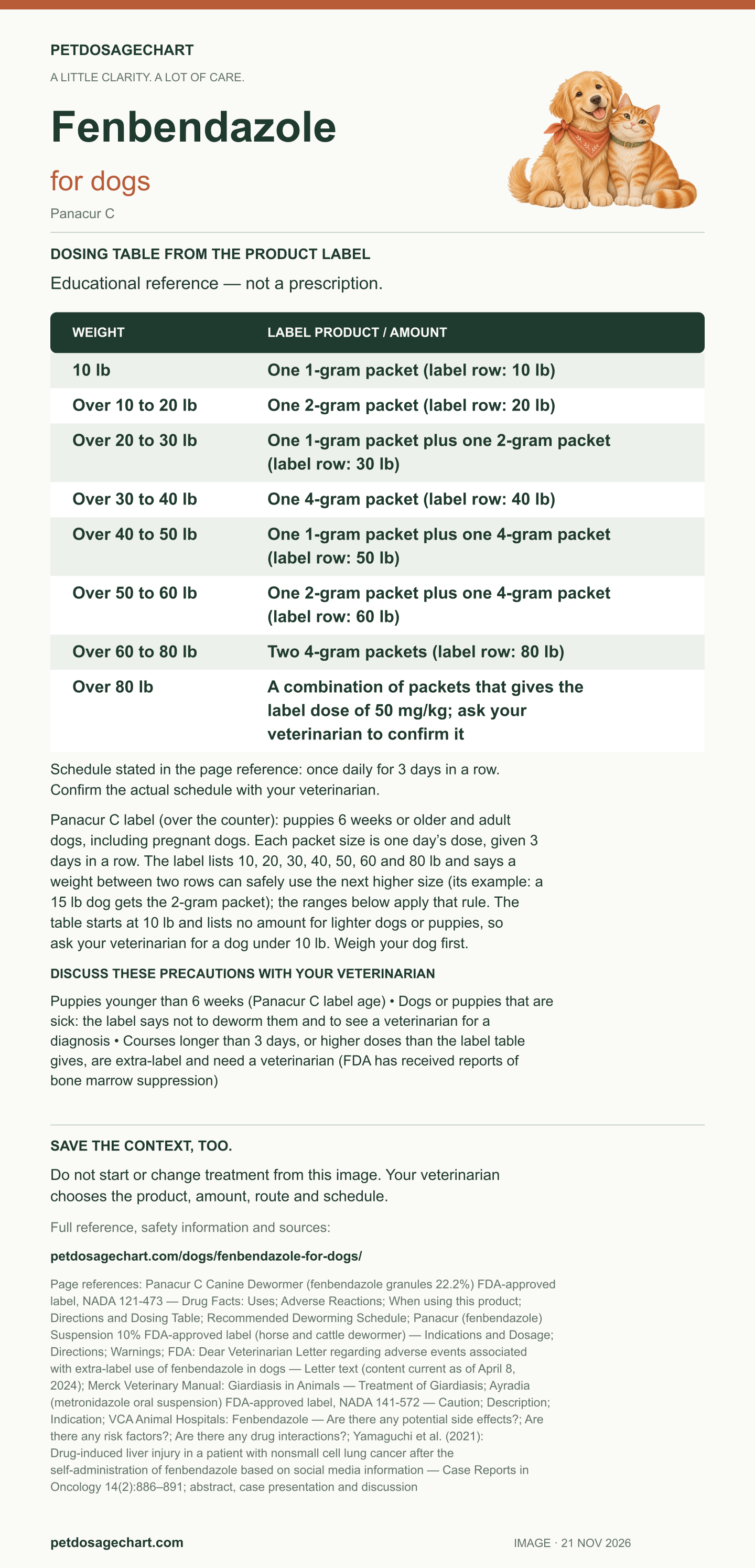
Find your dog’s weight below. Each packet size is one day’s dose, given once a day for 3 days in a row. The label’s table lists 10, 20, 30, 40, 50, 60 and 80 lb and says that a dog whose weight falls between two rows can safely use the next higher size, so a 15 lb dog gets the 2-gram packet. The table starts at 10 lb and lists no amount for lighter dogs, so ask your veterinarian how much to give a dog or puppy under 10 lb. Weigh your dog before you choose.
Panacur C label (over the counter): puppies 6 weeks or older and adult dogs, including pregnant dogs. Each packet size is one day’s dose, given 3 days in a row. The label lists 10, 20, 30, 40, 50, 60 and 80 lb and says a weight between two rows can safely use the next higher size (its example: a 15 lb dog gets the 2-gram packet); the ranges below apply that rule. The table starts at 10 lb and lists no amount for lighter dogs or puppies, so ask your veterinarian for a dog under 10 lb. Weigh your dog first.
| Dog weight | Label dose (once daily for 3 days in a row) |
|---|---|
| 10 lb | One 1-gram packet (label row: 10 lb) |
| Over 10 to 20 lb | One 2-gram packet (label row: 20 lb) |
| Over 20 to 30 lb | One 1-gram packet plus one 2-gram packet (label row: 30 lb) |
| Over 30 to 40 lb | One 4-gram packet (label row: 40 lb) |
| Over 40 to 50 lb | One 1-gram packet plus one 4-gram packet (label row: 50 lb) |
| Over 50 to 60 lb | One 2-gram packet plus one 4-gram packet (label row: 60 lb) |
| Over 60 to 80 lb | Two 4-gram packets (label row: 80 lb) |
| Over 80 lb | A combination of packets that gives the label dose of 50 mg/kg; ask your veterinarian to confirm it |
Source: Panacur C Canine Dewormer (fenbendazole granules 22.2%) FDA-approved label, NADA 121-473 — Drug Facts: Uses; Adverse Reactions; When using this product; Directions and Dosing Table; Recommended Deworming Schedule.
Use the complete dose listed for the labeled weight band, as prescribed. Do not divide a product or combine strengths beyond what the label lists for that band without your veterinarian's instructions. Confirm the product and schedule with your veterinarian.
Keep a copy of the reference chart
Educational reference, not a prescription. Your veterinarian sets the actual dose, product and schedule.
The 3-Day Course: How Long to Give Fenbendazole
The Panacur C label says the dog must get the daily dose for 3 days in a row, and that each deworming takes 3 daily treatments. One or two days is not a complete course.
Courses longer than 3 days, or higher doses than the label table gives, are extra-label. In a Dear Veterinarian letter, FDA reported 12 cases of bone marrow hypoplasia or pancytopenia (very low blood cell counts) in dogs given fenbendazole for 5 to 14 days. The dogs were treated for conditions such as Giardia, flukes, coccidia, lungworms and skin parasites. FDA states that fenbendazole is safe and effective at the labeled dose and duration and for the labeled indications. If your veterinarian prescribes a longer course, ask how your dog will be monitored.
What Fenbendazole Treats in Dogs
The US label covers:
- Roundworms (Toxocara canis, Toxascaris leonina)
- Hookworms (Ancylostoma caninum, Uncinaria stenocephala)
- Whipworms (Trichuris vulpis)
- Tapeworms of the species Taenia pisiformis only
Panacur C does not kill the common flea tapeworm, Dipylidium caninum. The label says to call your veterinarian if you still see tapeworm segments after treatment. That tapeworm is treated with praziquantel; see the praziquantel (Droncit) tapeworm dosage reference for dogs. For roundworms and hookworms only, the pyrantel pamoate dosage reference for dogs covers a single-dose liquid dewormer.
Fenbendazole is not labeled for heartworm prevention. Monthly heartworm preventives also control some intestinal worms; see the Heartgard Plus weight-range reference, the Sentinel (milbemycin and lufenuron) reference and the Simparica Trio weight-range guide for what each label covers. These links are not instructions to switch or combine products.
Puppy and Adult Deworming Schedule
The Panacur C label gives this general schedule, which can vary with climate and your dog’s activity:
- Newly weaned puppies: deworm at 6, 8, 10 and 12 weeks of age, and treat the mother at the same time.
- Dogs over 6 months: deworm at least twice a year.
- Every deworming is a full 3-day course.
Panacur C is labeled from 6 weeks of age, and its table starts at 10 lb. The pyrantel pamoate puppy deworming schedule on that product’s label starts at 2 weeks; ask your veterinarian which product and plan fit your litter.
Fenbendazole for Giardia in Dogs (Extra-Label)
Giardia is not on the US fenbendazole label. The Merck Veterinary Manual lists fenbendazole at 50 mg/kg once daily for 3 to 5 days as a first-line Giardia treatment. Fenbendazole is not FDA-approved for Giardia in dogs (in the US, a metronidazole oral suspension, Ayradia, is FDA-approved for Giardia in dogs), so this is an extra-label use that your veterinarian prescribes and supervises. Giardia was one of the conditions in the FDA reports of bone marrow suppression after courses of 5 to 14 days. Merck also describes metronidazole for dogs, alone or with fenbendazole, if signs continue.
Fenbendazole and Cancer: What FDA and the Evidence Say
If your dog receives chemotherapy, ask the veterinary oncologist before adding fenbendazole. FDA has received reports of bone marrow suppression with prolonged courses.
You may have seen fenbendazole promoted online as a cancer treatment for dogs or people. Here is what the sources on this page establish:
- No approved cancer use. The Panacur C label, and the labeled indications FDA lists for approved dog products, cover intestinal worms (roundworms, hookworms, whipworms and Taenia tapeworms) at 50 mg/kg for 3 days. Cancer is not among them.
- Longer use is extra-label, and FDA has safety reports. The FDA letter above describes 12 dogs with bone marrow hypoplasia or pancytopenia after 5 to 14 days of fenbendazole. The letter does not discuss cancer, but it applies to any course beyond the label.
- One human case report describes harm. A 2021 case report described liver injury in a woman with lung cancer who took fenbendazole marketed as a dog dewormer after reading claims on social media. Her liver tests recovered after she stopped, and her tumor did not shrink. The authors note that fenbendazole has not been clinically proven to treat human tumors. A single case report cannot show whether fenbendazole works against cancer in people or dogs. Animal fenbendazole products are not for people; the Panacur suspension label says “not for use in humans.”
If your dog has cancer, talk to your veterinarian or a veterinary oncologist before adding fenbendazole, and tell them about every supplement or product your dog gets.
What the source establishes
Gives 50 mg/kg (22.7 mg/lb) once daily for 3 days in a row, with daily packet sizes of 1 gram for 10 lb, 2 grams for 20 lb, 1 + 2 grams for 30 lb, 4 grams for 40 lb, 1 + 4 grams for 50 lb, 2 + 4 grams for 60 lb and two 4-gram packets for 80 lb, and says an in-between weight can safely use the next higher size; the table starts at 10 lb. Lists roundworms, hookworms, whipworms and Taenia pisiformis, says Panacur C kills only Taenia tapeworms, is safe from 6 weeks of age and in pregnant dogs, and should not be given to a sick dog. Suggests deworming pups at 6, 8, 10 and 12 weeks with the mother, and adults at least twice a year. Vomiting occurred in 3 of 240 dogs.
Over-the-counter label for one product. It does not cover Giardia, longer courses or any other extra-label use, and it does not replace a fecal diagnosis.
Panacur C Canine Dewormer (fenbendazole granules 22.2%) FDA-approved label, NADA 121-473 — Drug Facts: Uses; Adverse Reactions; When using this product; Directions and Dosing Table; Recommended Deworming Schedule.
The US 10% (100 mg/mL) suspension is labeled for horses and beef and dairy cattle only; the label gives no dog dose and warns it is not for use in humans.
Shows only that dog use of this suspension is extra-label. It does not give a dog dose or volume.
Panacur (fenbendazole) Suspension 10% FDA-approved label (horse and cattle dewormer) — Indications and Dosage; Directions; Warnings.
As of October 20, 2023, FDA had received 12 reports of bone marrow hypoplasia or pancytopenia in dogs given Panacur C, Safeguard Canine or Panacur Granules 22.2% for 5 to 14 days, longer than the labeled 50 mg/kg (22.7 mg/lb) for 3 consecutive days, for conditions including Giardia, flukes, coccidia, lungworms and skin parasites. It gives the approved dog indications as ascarids, hookworms, whipworms and Taenia pisiformis tapeworms, and states fenbendazole is safe and effective at the labeled dose and duration and for the labeled indications.
Spontaneous reports cannot show how often this happens. The letter does not discuss cancer; it concerns any use beyond the label dose, duration or indications.
FDA: Dear Veterinarian Letter regarding adverse events associated with extra-label use of fenbendazole in dogs — Letter text (content current as of April 8, 2024).
Lists fenbendazole at 50 mg/kg by mouth every 24 hours for 3 to 5 days as first-line treatment, notes that in the US a metronidazole oral suspension (Ayradia) is FDA-approved for dogs, and says metronidazole can be considered alone or with fenbendazole if clinical signs continue.
A veterinary reference for a condition that is not on the US fenbendazole label: fenbendazole is not FDA-approved for Giardia in dogs, so this use is extra-label. The 5-day course is longer than the label and needs a veterinarian.
Merck Veterinary Manual: Giardiasis in Animals — Treatment of Giardiasis.
Ayradia, a 125 mg/mL metronidazole oral suspension, is indicated for the treatment of Giardia duodenalis infection in dogs, and federal law restricts it to use by or on the order of a licensed veterinarian.
Prescription label for one metronidazole product. It shows that an FDA-approved Giardia treatment for dogs exists; it does not cover fenbendazole.
Ayradia (metronidazole oral suspension) FDA-approved label, NADA 141-572 — Caution; Description; Indication.
Lists drooling, vomiting and diarrhea as side effects, rare pancytopenia with longer-than-recommended use, and allergic reactions to substances released by dying parasites (facial swelling, itching, hives, seizures, shock), more likely at higher-than-regular doses. Says not to use it in puppies under 6 weeks or sick animals unless a veterinarian directs, and that there are no known drug interactions.
Owner-facing hospital handout. It does not set a dose for an individual dog.
VCA Animal Hospitals: Fenbendazole — Are there any potential side effects?; Are there any risk factors?; Are there any drug interactions?.
Describes a woman with non-small cell lung cancer who took fenbendazole marketed as a dog dewormer after reading social media claims. Her liver injury resolved after she stopped, her tumor did not shrink, and the authors note fenbendazole had not been clinically proven to treat human tumors.
A single human case report. It does not measure how often harm occurs and says nothing about dosing in dogs.
Yamaguchi et al. (2021): Drug-induced liver injury in a patient with nonsmall cell lung cancer after the self-administration of fenbendazole based on social media information — Case Reports in Oncology 14(2):886–891; abstract, case presentation and discussion.
How to Give Fenbendazole to Your Dog
Weigh your dog, then mix one day’s dose of granules with a small amount of your dog’s usual food and make sure all of the medicated food is eaten. Moisten dry food if needed to help the granules mix. Repeat the same dose for 3 days in a row. For a weight between label rows, use the next higher packet size; for a dog under 10 lb, ask your veterinarian.
The prescription Panacur Granules 22.2% and the 10% liquid (labeled for horses and cattle in the US) are not measured in Panacur C packets. Use either one for a dog only with the amount your veterinarian calculates.
Side Effects and Safety
Side effects are uncommon at the label dose. In US label studies, 3 of 240 dogs (about 1%) vomited. VCA also lists drooling and diarrhea. Substances released by dying parasites can sometimes cause an allergic reaction, with facial swelling, itching or hives; VCA says this is more likely at higher-than-regular doses. Rarely, very low blood cell counts have occurred when fenbendazole was given for longer than recommended.
The Panacur C label says it is safe for puppies 6 weeks or older and adult dogs, including pregnant dogs. Do not use it in puppies younger than 6 weeks, or in a sick dog unless your veterinarian directs it. VCA reports no known drug interactions, but tell your veterinarian about every medication and supplement your dog takes.
When Panacur C should be used with caution or avoided
Some dogs should not take Panacur C, or need a different dose and closer monitoring. Tell your veterinarian about your pet's full health history and every other medication or supplement they take before giving Panacur C.
- Puppies younger than 6 weeks (Panacur C label age)
- Dogs or puppies that are sick: the label says not to deworm them and to see a veterinarian for a diagnosis
- Courses longer than 3 days, or higher doses than the label table gives, are extra-label and need a veterinarian (FDA has received reports of bone marrow suppression)
Panacur C drug interactions
Panacur C can interact with other drugs. This list is not complete — always give your veterinarian a full list of your dog's medications and supplements.
When this reference is not enough
A reference table cannot decide whether a product or treatment is appropriate for an individual animal. Do not rely on it in these situations — talk to your veterinarian instead:
- In an emergency, or after accidental ingestion or a suspected overdose
- For pregnant or nursing pets
- For very young or very old dogs
- For pets with liver disease, kidney disease, or another chronic illness
- For pets taking several medications at once
- When you are not sure of your dog's current, accurate weight
- For combination products that contain additional active ingredients
Suspected overdose: what to do
If you think your dog had too much Panacur C, or swallowed any medication by accident, act right away. Do not wait for symptoms to appear.
- Call your veterinarian or the nearest emergency animal hospital.
- ASPCA Animal Poison Control Center: (888) 426-4435
- Pet Poison Helpline: (855) 764-7661
A consultation fee may apply to the poison hotlines. Have the medication packaging ready, and note how much your pet may have taken and when. Do not try to make your pet vomit unless a veterinarian tells you to.
When to Call the Vet
Contact your veterinarian, or an emergency clinic for severe signs, if:
- Your dog is sick before you deworm (the label says to see a veterinarian first)
- Your dog vomits after a dose or did not eat all of the medicated food
- You still see tapeworm segments in the stool after treatment
- You see facial swelling, hives, itching, collapse or seizures after a dose (possible allergic reaction)
- Your dog seems weak or unwell during a course longer than 3 days
If your dog’s prescription says sulfadimethoxine after a coccidiosis diagnosis, see the Albon guide for the US indication and the separate first-day and following-day doses.
Frequently Asked Questions
Questions about this medication
What is the fenbendazole (Panacur) dosage for dogs?
How many days do you give Panacur to a dog?
What worms does fenbendazole kill in dogs?
When should puppies be dewormed with Panacur C?
Can fenbendazole treat Giardia in dogs?
Does fenbendazole cure cancer in dogs?
Can I give my dog Panacur 10% liquid?
Is Panacur safe for pregnant dogs?
About this reference
- Onset
- Needs all 3 daily doses
- Duration
- One 3-day course per deworming
- Class
- Antiparasitic
Related medications for dogs
These references share a recorded drug class. They are not interchangeable treatments or instructions to combine medications.
Sources & references
The structured medication record behind this page names the references below. The links open the publisher or official resource; they do not turn this page into a prescription for an individual animal.
- Panacur C Canine Dewormer (fenbendazole granules 22.2%) FDA-approved label, NADA 121-473
Drug Facts: Uses; Adverse Reactions; When using this product; Directions and Dosing Table; Recommended Deworming Schedule. Supports the specific claim described above; it is not a review of the entire page.
- Panacur (fenbendazole) Suspension 10% FDA-approved label (horse and cattle dewormer)
Indications and Dosage; Directions; Warnings. Supports the specific claim described above; it is not a review of the entire page.
- FDA: Dear Veterinarian Letter regarding adverse events associated with extra-label use of fenbendazole in dogs
Letter text (content current as of April 8, 2024). Supports the specific claim described above; it is not a review of the entire page.
- Merck Veterinary Manual: Giardiasis in Animals
Treatment of Giardiasis. Supports the specific claim described above; it is not a review of the entire page.
- Ayradia (metronidazole oral suspension) FDA-approved label, NADA 141-572
Caution; Description; Indication. Supports the specific claim described above; it is not a review of the entire page.
- VCA Animal Hospitals: Fenbendazole
Are there any potential side effects?; Are there any risk factors?; Are there any drug interactions?. Supports the specific claim described above; it is not a review of the entire page.
- Yamaguchi et al. (2021): Drug-induced liver injury in a patient with nonsmall cell lung cancer after the self-administration of fenbendazole based on social media information
Case Reports in Oncology 14(2):886–891; abstract, case presentation and discussion. Supports the specific claim described above; it is not a review of the entire page.
- Merck Veterinary Manual — listed in this medication's source record.
- Panacur C Canine Dewormer FDA-approved label (NADA 121-473) — listed in this medication's source record.
- Panacur Suspension 10% FDA-approved label (horses and cattle) — listed in this medication's source record.
- FDA Dear Veterinarian Letter: extra-label use of fenbendazole in dogs — listed in this medication's source record.
- VCA Animal Hospitals: Fenbendazole — listed in this medication's source record.
- Yamaguchi et al. (2021), Case Reports in Oncology — listed in this medication's source record.
- DailyMed label search for Fenbendazole — check current product and formulation labels; some veterinary uses may be off-label.
Specific citations above support the identified claims. Other source names remain record-level references; further claim review is still needed. Read our methodology and limitations.
How this page was made
This page's structured medication record lists the source names below. This product is presented with its label's weight-band table instead of a weight-based calculator. A source record is not the same as an individualized prescription or an independent clinical review.
- Sources cited
-
- Merck Veterinary Manual
- Panacur C Canine Dewormer FDA-approved label (NADA 121-473)
- Panacur Suspension 10% FDA-approved label (horses and cattle)
- FDA Dear Veterinarian Letter: extra-label use of fenbendazole in dogs
- VCA Animal Hospitals: Fenbendazole
- Yamaguchi et al. (2021), Case Reports in Oncology
- Calculator formula
- No weight-based calculator is shown because this product is dosed by the weight bands on its label. When a row specifies the strength and count, it lists one complete dose for every weight in that band. If a combination is needed, confirm the strengths and count with your veterinarian.
- Editorial owner
- Prepared and maintained by the PetDosageChart editorial team, a software-led publisher and not a veterinary practice.
- DVM review status
- Not independently DVM-reviewed. A named reviewer and review date appear here only after a confirmed review.
More on our methodology and editorial process — how we source, calculate, and review dogs dosage data.
More resources
- Pet Medication Safety Hub — What's safe, what's dangerous, and emergency signs
- How we calculate dosages — Our sources, math, and review process
- Printable emergency checklist — One-page reference for your fridge or first aid kit
More tools: common weights and embed code
By Weight
Panacur C reference by dog weight
Choose a common weight to open its optional reference page. Return to the main guide for the product's labeled weight-band limits.
Common-weight pages are convenience views of the same educational reference, not separate medical recommendations.