Melatonin dosage reference for dogs
This medication is presented with its per-animal reference amount instead of a weight-based calculator. Confirm the current weight, exact product strength and schedule with your veterinarian.
This information is for educational purposes only. Always consult your veterinarian before giving medication to your pet. Do not use this reference for emergencies, overdoses, pregnancy, very young animals, very old animals, pets with liver/kidney disease, or pets taking multiple medications.
Sources and review process
Each medication page lists the references recorded for its data. The reference content and editorial presentation are maintained by PetDosageChart; a page is independently DVM-reviewed only when a named reviewer byline appears. See our methodology and limitations.
Melatonin is a hormone made by the pineal gland that helps regulate sleep cycles, and it is sold over the counter as a supplement for people. Veterinarians use it in dogs for sleep problems, as an add-on for fear and anxiety alongside behavior training, for non-allergic hair loss such as alopecia X, and for immune-mediated thrombocytopenia. There is no FDA-approved oral melatonin product for dogs: in the United States, the only FDA-approved use of melatonin in animals is an implant for mink. That makes melatonin for dogs an off-label use, so the product and amount should come from your veterinarian.
Xylitol warning: Do not give your dog a melatonin gummy, chewable, fast-dissolve tablet or liquid made for people until you have read every ingredient. Many human melatonin products contain other ingredients that can harm dogs, including xylitol, a sweetener that can cause signs of low blood sugar within 30 minutes and, in larger amounts, liver failure. Xylitol may be listed as birch sugar or wood sugar. If your dog ate a melatonin gummy or any product that might contain xylitol, call your veterinarian or a pet poison hotline now, even if your dog seems fine.
Melatonin is one of many products made for people. See 7 human medications that are dangerous for dogs for why any human product needs a veterinarian’s check first.
Melatonin Dosage for Dogs by Weight
No veterinary label sets a melatonin dose for dogs, and a 2025 veterinary study notes that there is no universally agreed standard dose. The table shows the only weight-split amounts in the sources cited on this page, from a 28-day study of 40 healthy dogs in which no side effects or sedation were noted; 15 kg is about 33 lb. The study abstract does not report the dogs’ weight range, so very small and very large dogs may be outside what was studied. Your veterinarian may choose a different amount or schedule, such as a single dose before a stressful event.
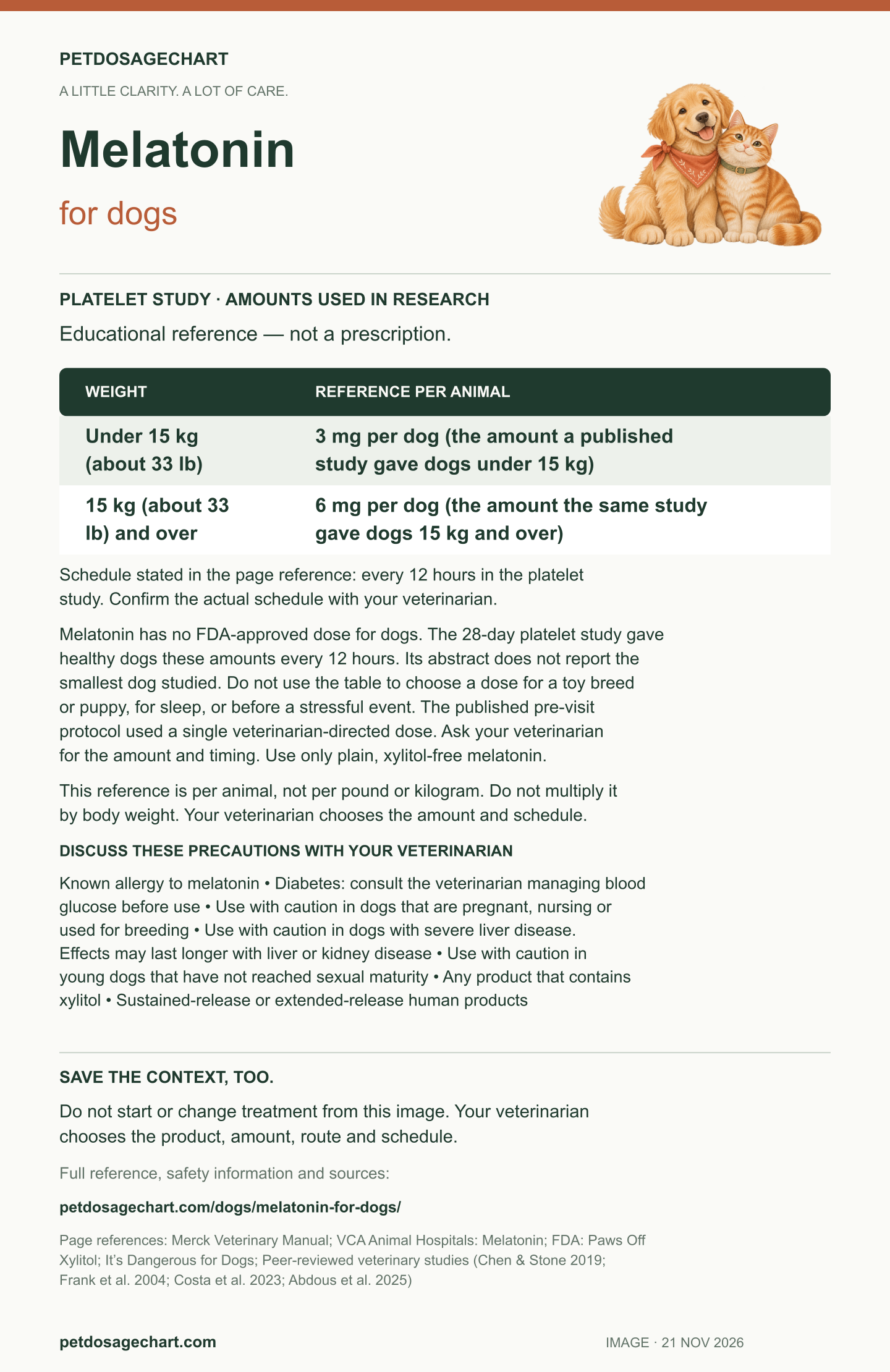
Melatonin has no FDA-approved dose for dogs. The 28-day platelet study gave healthy dogs these amounts every 12 hours. Its abstract does not report the smallest dog studied. Do not use the table to choose a dose for a toy breed or puppy, for sleep, or before a stressful event. The published pre-visit protocol used a single veterinarian-directed dose. Ask your veterinarian for the amount and timing. Use only plain, xylitol-free melatonin.
| Dog weight | Reference amount (every 12 hours in the platelet study) |
|---|---|
| Under 15 kg (about 33 lb) | 3 mg per dog (the amount a published study gave dogs under 15 kg) |
| 15 kg (about 33 lb) and over | 6 mg per dog (the amount the same study gave dogs 15 kg and over) |
The cited source reports amounts per dog. Give only the amount and schedule your veterinarian prescribes.
Keep a copy of the reference chart
Educational reference, not a prescription. Your veterinarian sets the actual dose, product and schedule.
Because the amount is fixed within each range, a small dog gets more per pound than a large one: 3 mg is about 1.3 mg per kg for a 5 lb dog but about 0.2 mg per kg for a 30 lb dog. Doses figured per kilogram, such as the 0.1 to 0.3 mg/kg range described for promoting sleep or starting alopecia treatment, work out to much less for a small dog. Ask your veterinarian before giving melatonin to a toy breed or a puppy.
What Published Sources Used
Published amounts vary with the dog, the condition and the goal. These rows are not interchangeable, and none of them is an FDA-approved dose.
| Use or setting | Amount given | Schedule | Source |
|---|---|---|---|
| Healthy dogs in a 28-day platelet study | 3 mg per dog under 15 kg; 6 mg per dog 15 kg and over | Every 12 hours | Chen & Stone, 2019 |
| Hair cycle arrest (alopecia X) | Started at 3 to 6 mg per dog | Every 12 hours | Frank et al., 2004 |
| Before vet visits, combined with gabapentin and acepromazine | 3 to 5 mg per dog | Once, 90 to 120 minutes before the visit | Costa et al., 2023 |
| Background range stated in a 2025 study | 0.1 to 1.7 mg/kg overall; 0.1 to 0.3 mg/kg for promoting sleep or starting alopecia treatment | Varies by condition | Abdous et al., 2025 |
In the alopecia X study, the authors reported partial to complete hair regrowth in 62% of 29 dogs, but raising the dose helped only one of eight dogs. A separate placebo-controlled study found no clear benefit from an 18 mg melatonin implant for keeping seasonal flank alopecia from coming back. The vet-visit protocol lowered stress scores and raised sedation scores, but it tested three medicines together, not melatonin alone.
Human Melatonin Products: Xylitol, Gummies and Combination Ingredients
Most melatonin is sold for people, so the product matters as much as the amount. Before your dog gets any, check these points with your veterinarian:
- Xylitol. Xylitol is found in many vitamins and supplements, including chewables, and the FDA lists dietary supplements, chewable vitamins and over-the-counter medicines among products that may contain it. In dogs, more than about 100 mg/kg of xylitol has been linked to low blood sugar, with vomiting, weakness, staggering, collapse or seizures, and more than 500 mg/kg to liver failure. Signs of liver injury may not appear for 24 to 48 hours. Whatever the form, read the inactive ingredients.
- Gummies. Besides the xylitol risk, gummy formulations of melatonin can upset a dog’s electrolytes. Keep gummies where your dog cannot reach them.
- Combination products. Some human sleep products add other active ingredients. The Merck Veterinary Manual singles out 5-HTP, which can cause serotonin syndrome. Avoid products with 5-HTP, particularly if your dog takes selegiline, tramadol or another serotonin-affecting drug. Use a product that contains melatonin as its only active ingredient unless your veterinarian says otherwise.
- Sustained-release forms. Sustained-release or extended-release oral products should not be used off label in pets.
- Label strength. In a study of 31 melatonin supplements, measured melatonin ranged from 83% below to 478% above the labeled amount, so the label number is not always what your dog gets.
Melatonin With Trazodone, Gabapentin, Fluoxetine or Hydroxyzine
Owners often look at melatonin alongside prescription calming medicines. These are different products with different cautions, and the pages below are references, not substitutes or instructions to combine them:
- Trazodone for dogs: trazodone acts on serotonin, so melatonin products that add 5-HTP are a particular concern for a dog already taking it.
- Gabapentin for dogs: gabapentin was part of the vet-visit protocol above, in which veterinarians combined gabapentin, melatonin and acepromazine and the dogs were measurably more sedated.
- Fluoxetine for dogs: fluoxetine is an SSRI, so ask your veterinarian before adding any melatonin product and avoid products with 5-HTP.
- Hydroxyzine for dogs: its page lists its own side effects and interactions.
Melatonin itself can cause sleepiness, and each of these pages lists the side effects and interactions of its own medicine. Do not combine any of them with melatonin unless your veterinarian has chosen each dose, and give your vet a full list of everything your dog takes, including supplements.
How to Give Melatonin to Your Dog
Use only a plain melatonin product your veterinarian has approved, and check every ingredient, including inactive ingredients, for xylitol (also listed as birch sugar or wood sugar) and for added ingredients such as 5-HTP. Do not use sustained-release or extended-release products. Melatonin can be given with or without food; if your dog vomits after a dose on an empty stomach, give the next one with a meal or treat. Give it at the same time each day, or as far ahead of a stressful event as your vet advises. If you miss a dose, give it when you remember unless the next dose is nearly due, and never give two doses at once. Wash your hands after handling it.
Melatonin usually takes effect within 1 to 2 hours and wears off within 24 hours, although the effect can last longer in dogs with liver or kidney disease. Use it cautiously with amlodipine, benzodiazepines such as diazepam, cimetidine, ciprofloxacin, estrogens, fluvoxamine, mexiletine, propofol, succinylcholine and warfarin. Tell your veterinarian about every medicine and supplement your dog takes, and mention melatonin before any anesthetic or sedation.
Side Effects and Safety
Melatonin generally has a wide margin of safety in dogs. Reported side effects include sleepiness, weight gain and changes in fertility. Too much melatonin can cause vomiting, lethargy, sedation and wobbliness. In the 28-day study of healthy dogs given 3 or 6 mg every 12 hours, no side effects or sedation were noted.
Do not give melatonin to a dog that has had an allergic reaction to it. Use it with caution in dogs that are pregnant, nursing or used for breeding, in young dogs that have not reached sexual maturity, and in dogs with severe liver disease. If your dog has diabetes or takes insulin, ask your veterinarian about glucose monitoring before use. High doses can reduce insulin sensitivity. The Merck Veterinary Manual’s main warnings about human melatonin products concern other ingredients, such as xylitol and 5-HTP.
When Melatonin should be used with caution or avoided
Some dogs should not take Melatonin, or need a different dose and closer monitoring. Tell your veterinarian about your pet's full health history and every other medication or supplement they take before giving Melatonin.
- Known allergy to melatonin
- Diabetes: consult the veterinarian managing blood glucose before use
- Use with caution in dogs that are pregnant, nursing or used for breeding
- Use with caution in dogs with severe liver disease. Effects may last longer with liver or kidney disease
- Use with caution in young dogs that have not reached sexual maturity
- Any product that contains xylitol
- Sustained-release or extended-release human products
Melatonin drug interactions
Melatonin can interact with other drugs. This list is not complete — always give your veterinarian a full list of your dog's medications and supplements.
When this reference is not enough
A reference table cannot decide whether a product or treatment is appropriate for an individual animal. Do not rely on it in these situations — talk to your veterinarian instead:
- In an emergency, or after accidental ingestion or a suspected overdose
- For pregnant or nursing pets
- For very young or very old dogs
- For pets with liver disease, kidney disease, or another chronic illness
- For pets taking several medications at once
- When you are not sure of your dog's current, accurate weight
- For combination products that contain additional active ingredients
Suspected overdose: what to do
If you think your dog had too much Melatonin, or swallowed any medication by accident, act right away. Do not wait for symptoms to appear.
- Call your veterinarian or the nearest emergency animal hospital.
- ASPCA Animal Poison Control Center: (888) 426-4435
- Pet Poison Helpline: (855) 764-7661
A consultation fee may apply to the poison hotlines. Have the medication packaging ready, and note how much your pet may have taken and when. Do not try to make your pet vomit unless a veterinarian tells you to.
When to Call the Vet
If your dog experiences any of the following, contact your veterinarian or an emergency clinic immediately:
- Your dog ate melatonin gummies or any product that might contain xylitol — call even if your dog seems fine
- Weakness, staggering, collapse or seizures (possible low blood sugar from xylitol)
- Vomiting, heavy sleepiness or wobbliness after a dose
- Agitation, tremors, wobbliness or fever after a product with 5-HTP, especially in a dog taking trazodone, fluoxetine, selegiline or tramadol
- Hives, facial swelling or other signs of an allergic reaction
What the source establishes
Dogs in the treatment group were given melatonin at 3 mg by mouth every 12 hours if they weighed under 15 kg and 6 mg every 12 hours if they weighed 15 kg or more, for 28 days. No adverse effects or sedation were noted in any dog, and melatonin did not appear to raise platelet counts in healthy dogs.
These are the amounts used in one study of healthy dogs, not an FDA-approved label dose or a treatment recommendation for a particular condition. The study measured platelets, not sleep, anxiety or hair regrowth, and the abstract does not report the dogs’ weight range.
Chen M, Stone R. Lack of Effect of Oral Melatonin on Platelet Parameters in Normal Healthy Dogs. J Am Anim Hosp Assoc 2019;55(5):226-230 — Abstract (randomized, blinded, placebo-controlled study of 40 healthy dogs).
Twenty-nine neutered dogs with normal thyroid and cortisol tests were started on melatonin at 3-6 mg every 12 hours. The authors report partial to complete hair regrowth in 62% of dogs; raising the melatonin dose in eight dogs improved regrowth in only one.
A study of hair cycle arrest (alopecia X), mostly in Pomeranians. It does not set a dose for sleep or anxiety.
Owners gave melatonin at 3 to 5 mg per dog by mouth 90 to 120 minutes before the appointment, together with gabapentin (20 to 25 mg/kg the evening before and again before the visit) and oral-transmucosal acepromazine (0.05 mg/kg). Stress scores fell and sedation scores rose compared with the dogs’ baseline visit.
A veterinarian-prescribed three-drug protocol in 45 dogs; the effect of melatonin alone was not measured. It is not a home recipe for combining medicines.
Costa RS, et al. Gabapentin, melatonin, and acepromazine combination prior to hospital visits decreased stress scores in aggressive and anxious dogs in a prospective clinical trial. J Am Vet Med Assoc 2023;261(11):1660-1665 — Abstract (Methods; Results).
The introduction states that there is no universally agreed-upon standard dose of melatonin for dogs, that clinical use generally ranges from 0.1 to 1.7 mg/kg depending on the condition, and that lower doses of 0.1 to 0.3 mg/kg are commonly used for promoting sleep or starting alopecia treatment. The study itself gave 0.1, 0.3 or 0.5 mg/kg twice daily for 45 days.
The per-kilogram range is a background statement in the introduction, not a dose the study tested for sleep. The study enrolled 16 intact male Pomeranians and measured reproductive parameters.
Abdous A, et al. Dose-Response Effects of Oral Melatonin on Reproductive Parameters in Intact Male Pomeranian Dogs With Alopecia X: A Controlled Study. Vet Med Sci 2025;11(3):e70410 — Introduction; Methods (Melatonin Administration).
Describes veterinary use of melatonin for canine alopecia, sleep disorders and immune-mediated thrombocytopenia, and a generally wide margin of safety. Warns that many human melatonin products contain 5-HTP (a serotonin syndrome risk) or xylitol (a hypoglycemia and liver failure risk), that gummy formulations can cause electrolyte disturbances, and that melatonin can cause vomiting, lethargy, sedation and ataxia. Lists fluoxetine among the SSRIs, describes trazodone as inhibiting serotonin reuptake, says serotonin syndrome often follows repeated use or overdose of substances that increase serotonin, and lists agitation, tremors, incoordination and fever among its signs.
A toxicology overview for accidental exposures. It does not give a therapeutic dose.
Merck Veterinary Manual: Toxicoses in Animals From Human Antidepressants, Anxiolytics, and Sleep Aids — Sleep Aid Toxicoses in Animals: Melatonin Toxicosis (full review May 2025); Antidepressant Toxicoses: antidepressants table and Serotonin Syndrome.
Lists melatonin among adjunctive therapies that, in reported studies, have shown potential to calm and decrease underlying fear and anxiety, and notes that changing fear responses requires concurrent behavior modification.
Names melatonin as a possible adjunct only. It gives no melatonin dose and does not rank it against prescription anxiety medications.
Merck Veterinary Manual: Treatment of Behavior Problems in Animals — Medication for Behavior Problems in Animals (full review Sept 2024).
States that the only FDA-approved use of melatonin in animals in the US is an implant for mink, so oral use in dogs is off label, for sleep and behavior disorders and non-allergic hair loss. Melatonin can be given with or without food, usually takes effect in 1-2 hours and stops working within 24 hours (longer with liver or kidney disease). Lists sleepiness, weight gain and fertility changes as side effects; caution in pregnant, nursing, breeding or sexually immature pets and severe liver disease; interactions with amlodipine, benzodiazepines, cimetidine, ciprofloxacin, estrogens, fluvoxamine, mexiletine, propofol, succinylcholine and warfarin. Warns that human products may contain xylitol and that sustained-release products should not be used in pets.
Owner-facing hospital handout. It gives no dose and is not a complete interaction list.
VCA Animal Hospitals: Melatonin — Uses; How do I give my pet melatonin?; Side effects; Risk factors; Drug interactions (updated Jan 2026).
Xylitol is present in numerous vitamins and nutritional supplements, including chewable products. Doses above about 100 mg/kg have been associated with hypoglycemia in dogs and doses above 500 mg/kg with liver failure. Signs of hypoglycemia (vomiting, weakness, ataxia, lethargy, seizures, coma) can begin within 30 minutes; signs of liver injury may not appear for 24-48 hours.
Describes xylitol exposure in general; it does not say how much xylitol any particular melatonin product contains.
Merck Veterinary Manual: Xylitol Toxicosis in Dogs — Introduction; Pathogenesis; Clinical Findings (full review Sept 2024).
Lists dietary supplements, chewable vitamins and over-the-counter medicines among products that may contain xylitol, says it may appear on labels as birch sugar or wood sugar, and describes a rapid drop in blood sugar within 10 to 60 minutes with vomiting, weakness, staggering, collapse and seizures.
General owner guidance on xylitol. It does not name specific melatonin products.
FDA: Paws Off Xylitol; It’s Dangerous for Dogs — Consumer update (content current as of 12/17/2025).
In 31 commercial melatonin supplements, measured melatonin ranged from 83% below to 478% above the labeled amount, and more than 71% were not within 10% of the label claim.
A study of human supplements; it shows label amounts can be unreliable but does not test any product made for dogs.
Erland LA, Saxena PK. Melatonin Natural Health Products and Supplements: Presence of Serotonin and Significant Variability of Melatonin Content. J Clin Sleep Med 2017;13(2):275-281 — Abstract (Results; Conclusions).
In a double-blind, randomized, placebo-controlled study, an 18 mg melatonin implant given about 2 months before expected onset did not show a statistically significant benefit over placebo in preventing recurrence of seasonal flank alopecia; it was well tolerated.
A small study of implants, not oral melatonin, for one type of seasonal hair loss.
Verschuuren MUMY, et al. The efficacy of subcutaneous slow-release melatonin implants in the prevention of canine flank alopecia recurrence is uncertain. Vet Dermatol 2022;33(6):553-558 — Abstract (Results; Conclusions).
Advises caution in diabetic dogs because high melatonin doses can cause insulin resistance.
A disease-specific precaution. It does not set an insulin adjustment or a sleep dose.
Blackwell’s Five-Minute Veterinary Consult: Alopecia X — Alopecia X, medications and precautions.
Tramadol affects serotonin uptake. The chapter also identifies selegiline as an MAO inhibitor and warns about serotonergic drug combinations.
Supports the warning about added 5-HTP in human supplements; it does not identify plain melatonin as the cause.
Merck Veterinary Manual: Analgesics Used in Animals — Tramadol, serotonergic effects and interactions.
Frequently Asked Questions
Questions about this medication
How much melatonin can I give my dog by weight?
Can I give my dog human melatonin?
My dog ate melatonin gummies. What should I do?
How long does melatonin take to work in dogs?
Can I give melatonin with trazodone, gabapentin or fluoxetine?
Does melatonin help hair loss (alopecia X) in dogs?
Is melatonin FDA-approved for dogs?
About this reference
- Onset
- 1-2 hours
- Duration
- Usually wears off within 24 hours; can last longer with liver or kidney disease
- Class
- Hormone supplement
Sources & references
The structured medication record behind this page names the references below. The links open the publisher or official resource; they do not turn this page into a prescription for an individual animal.
- Chen M, Stone R. Lack of Effect of Oral Melatonin on Platelet Parameters in Normal Healthy Dogs. J Am Anim Hosp Assoc 2019;55(5):226-230
Abstract (randomized, blinded, placebo-controlled study of 40 healthy dogs). Supports the specific claim described above; it is not a review of the entire page.
- Frank LA, Hnilica KA, Oliver JW. Adrenal steroid hormone concentrations in dogs with hair cycle arrest (Alopecia X) before and during treatment with melatonin and mitotane. Vet Dermatol 2004;15(5):278-284
Abstract. Supports the specific claim described above; it is not a review of the entire page.
- Costa RS, et al. Gabapentin, melatonin, and acepromazine combination prior to hospital visits decreased stress scores in aggressive and anxious dogs in a prospective clinical trial. J Am Vet Med Assoc 2023;261(11):1660-1665
Abstract (Methods; Results). Supports the specific claim described above; it is not a review of the entire page.
- Abdous A, et al. Dose-Response Effects of Oral Melatonin on Reproductive Parameters in Intact Male Pomeranian Dogs With Alopecia X: A Controlled Study. Vet Med Sci 2025;11(3):e70410
Introduction; Methods (Melatonin Administration). Supports the specific claim described above; it is not a review of the entire page.
- Merck Veterinary Manual: Toxicoses in Animals From Human Antidepressants, Anxiolytics, and Sleep Aids
Sleep Aid Toxicoses in Animals: Melatonin Toxicosis (full review May 2025); Antidepressant Toxicoses: antidepressants table and Serotonin Syndrome. Supports the specific claim described above; it is not a review of the entire page.
- Merck Veterinary Manual: Treatment of Behavior Problems in Animals
Medication for Behavior Problems in Animals (full review Sept 2024). Supports the specific claim described above; it is not a review of the entire page.
- VCA Animal Hospitals: Melatonin
Uses; How do I give my pet melatonin?; Side effects; Risk factors; Drug interactions (updated Jan 2026). Supports the specific claim described above; it is not a review of the entire page.
- Merck Veterinary Manual: Xylitol Toxicosis in Dogs
Introduction; Pathogenesis; Clinical Findings (full review Sept 2024). Supports the specific claim described above; it is not a review of the entire page.
- FDA: Paws Off Xylitol; It’s Dangerous for Dogs
Consumer update (content current as of 12/17/2025). Supports the specific claim described above; it is not a review of the entire page.
- Erland LA, Saxena PK. Melatonin Natural Health Products and Supplements: Presence of Serotonin and Significant Variability of Melatonin Content. J Clin Sleep Med 2017;13(2):275-281
Abstract (Results; Conclusions). Supports the specific claim described above; it is not a review of the entire page.
- Verschuuren MUMY, et al. The efficacy of subcutaneous slow-release melatonin implants in the prevention of canine flank alopecia recurrence is uncertain. Vet Dermatol 2022;33(6):553-558
Abstract (Results; Conclusions). Supports the specific claim described above; it is not a review of the entire page.
- Blackwell’s Five-Minute Veterinary Consult: Alopecia X
Alopecia X, medications and precautions. Supports the specific claim described above; it is not a review of the entire page.
- Merck Veterinary Manual: Analgesics Used in Animals
Tramadol, serotonergic effects and interactions. Supports the specific claim described above; it is not a review of the entire page.
- Merck Veterinary Manual — listed in this medication's source record.
- VCA Animal Hospitals: Melatonin — listed in this medication's source record.
- FDA: Paws Off Xylitol; It’s Dangerous for Dogs — listed in this medication's source record.
- Peer-reviewed veterinary studies (Chen & Stone 2019; Frank et al. 2004; Costa et al. 2023; Abdous et al. 2025) — listed in this medication's source record.
- DailyMed label search for Melatonin — check current product and formulation labels; some veterinary uses may be off-label.
Specific citations above support the identified claims. Other source names remain record-level references; further claim review is still needed. Read our methodology and limitations.
How this page was made
This page's structured medication record lists the source names below. This medication is presented with its per-animal reference amount instead of a weight-based calculator. A source record is not the same as an individualized prescription or an independent clinical review.
- Sources cited
-
- Merck Veterinary Manual
- VCA Animal Hospitals: Melatonin
- FDA: Paws Off Xylitol; It’s Dangerous for Dogs
- Peer-reviewed veterinary studies (Chen & Stone 2019; Frank et al. 2004; Costa et al. 2023; Abdous et al. 2025)
- Calculator formula
- No weight-based calculator is shown because the source reports amounts per animal rather than per kilogram. Use the exact amount directed by the veterinarian.
- Editorial owner
- Prepared and maintained by the PetDosageChart editorial team, a software-led publisher and not a veterinary practice.
- DVM review status
- Not independently DVM-reviewed. A named reviewer and review date appear here only after a confirmed review.
More on our methodology and editorial process — how we source, calculate, and review dogs dosage data.
More resources
- Pet Medication Safety Hub — What's safe, what's dangerous, and emergency signs
- How we calculate dosages — Our sources, math, and review process
- Printable emergency checklist — One-page reference for your fridge or first aid kit
More tools: common weights and embed code
By Weight
Melatonin reference by dog weight
Choose a common weight to open its optional reference page. Return to the main guide for the per-dog reference amount.
Common-weight pages are convenience views of the same educational reference, not separate medical recommendations.