Ursodiol dosage reference for dogs (Actigall)
This page's standard weight-based reference is 15 mg per kg (6.80 mg per lb), with Once daily recorded as the reference frequency. Use the calculator to see the arithmetic for your dog's weight, then confirm the indication, product, and actual dose with a veterinarian.
This information is for educational purposes only. Always consult your veterinarian before giving medication to your pet. Do not use this calculator for emergencies, overdoses, pregnancy, very young animals, very old animals, pets with liver/kidney disease, or pets taking multiple medications.
Sources and review process
Each medication page lists the references recorded for its data. The calculator math and editorial presentation are maintained by PetDosageChart; a page is independently DVM-reviewed only when a named reviewer byline appears. See our methodology and limitations.
Ursodiol (ursodeoxycholic acid, sold for people as Actigall, Urso 250 and Urso Forte) is a bile acid that increases bile flow. It is a human medicine, and veterinarians prescribe it off-label for dogs with some liver and gallbladder conditions. Understanding how ursodiol is dosed, given and monitored helps you follow your veterinarian’s plan safely.
A typical ursodiol dose for dogs is 15 mg/kg by mouth once a day, given with food. That is the amount in the ACVIM consensus statement on chronic hepatitis in dogs and in the Merck Veterinary Manual’s pharmacology chapter. The calculator and chart show total amounts for one day. The standard reference is 15 mg/kg. A study in dogs with early gallbladder disease used 10–15 mg/kg once daily, which supplies the lower reference. Merck also describes condition-specific schedules that the calculator does not show: 10–15 mg/kg a day split into two doses 12 hours apart for inflamed bile ducts and liver (cholangiohepatitis), and 15–25 mg/kg a day split into two doses 12 hours apart for a gallbladder mucocele without leakage or obstruction. If your veterinarian splits the daily amount into two doses, each dose is half of it. Why the same drug can be dosed differently by condition is explained in how vets calculate medication dosages.
Calculator Warning: Use this only as an educational estimate. Your veterinarian may prescribe a different dose based on your pet’s condition, age, weight, other medications, and medical history.
Ursodiol Dosage Calculator for Dogs
Enter your dog’s weight below to estimate the daily ursodiol total at 10–15 mg/kg. The result is the total for one day; if your vet prescribes twice-daily dosing, each dose is half that amount. Your veterinarian sets the actual dose for your dog’s diagnosis, so treat the result as an educational estimate, not a prescription.

Which product this applies to: These references (10–15 mg/kg) show the total amount of oral ursodiol for one day, given with food. The chronic hepatitis consensus uses 15 mg/kg once daily. If your vet splits it into two doses 12 hours apart, each dose is half. Only the scored 500 mg tablet is labeled to be broken in half, so ask your vet or pharmacist before splitting other tablets or opening capsules, or about a xylitol-free compounded liquid for a small dog.
Quick Dosage Chart
Typical once-daily ursodiol totals for common dog weights, for quick reference:
Which product this applies to: These references (10–15 mg/kg) show the total amount of oral ursodiol for one day, given with food. The chronic hepatitis consensus uses 15 mg/kg once daily. If your vet splits it into two doses 12 hours apart, each dose is half. Only the scored 500 mg tablet is labeled to be broken in half, so ask your vet or pharmacist before splitting other tablets or opening capsules, or about a xylitol-free compounded liquid for a small dog.
Both units describe the same weight. Switching the display does not change the amounts. For an exact weight, use the calculator.
Scroll sideways to compare references. The weight column stays visible.
| Weight | Lower Reference | Standard Reference | Upper Reference | Frequency |
|---|---|---|---|---|
| 5 lbs (2.3 kg) | 22.7 mg | 34.0 mg | 34.0 mg | Once daily |
| 10 lbs (4.5 kg) | 45.4 mg | 68.0 mg | 68.0 mg | Once daily |
| 15 lbs (6.8 kg) | 68.0 mg | 102.0 mg | 102.0 mg | Once daily |
| 20 lbs (9.1 kg) | 90.7 mg | 136.1 mg | 136.1 mg | Once daily |
| 25 lbs (11.3 kg) | 113.4 mg | 170.1 mg | 170.1 mg | Once daily |
| 30 lbs (13.6 kg) | 136.1 mg | 204.1 mg | 204.1 mg | Once daily |
| 40 lbs (18.1 kg) | 181.4 mg | 272.1 mg | 272.1 mg | Once daily |
| 50 lbs (22.7 kg) | 226.8 mg | 340.1 mg | 340.1 mg | Once daily |
| 60 lbs (27.2 kg) | 272.1 mg | 408.2 mg | 408.2 mg | Once daily |
| 70 lbs (31.7 kg) | 317.5 mg | 476.2 mg | 476.2 mg | Once daily |
| 80 lbs (36.3 kg) | 362.8 mg | 544.2 mg | 544.2 mg | Once daily |
| 90 lbs (40.8 kg) | 408.2 mg | 612.2 mg | 612.2 mg | Once daily |
| 100 lbs (45.4 kg) | 453.5 mg | 680.3 mg | 680.3 mg | Once daily |
| 120 lbs (54.4 kg) | 544.2 mg | 816.3 mg | 816.3 mg | Once daily |
| 150 lbs (68 kg) | 680.3 mg | 1020.4 mg | 1020.4 mg | Once daily |
Parenthetical tablet amounts are arithmetic comparisons only. They do not account for scoring, release type, concentration, product labeling, or whether this medication is appropriate for an individual animal.
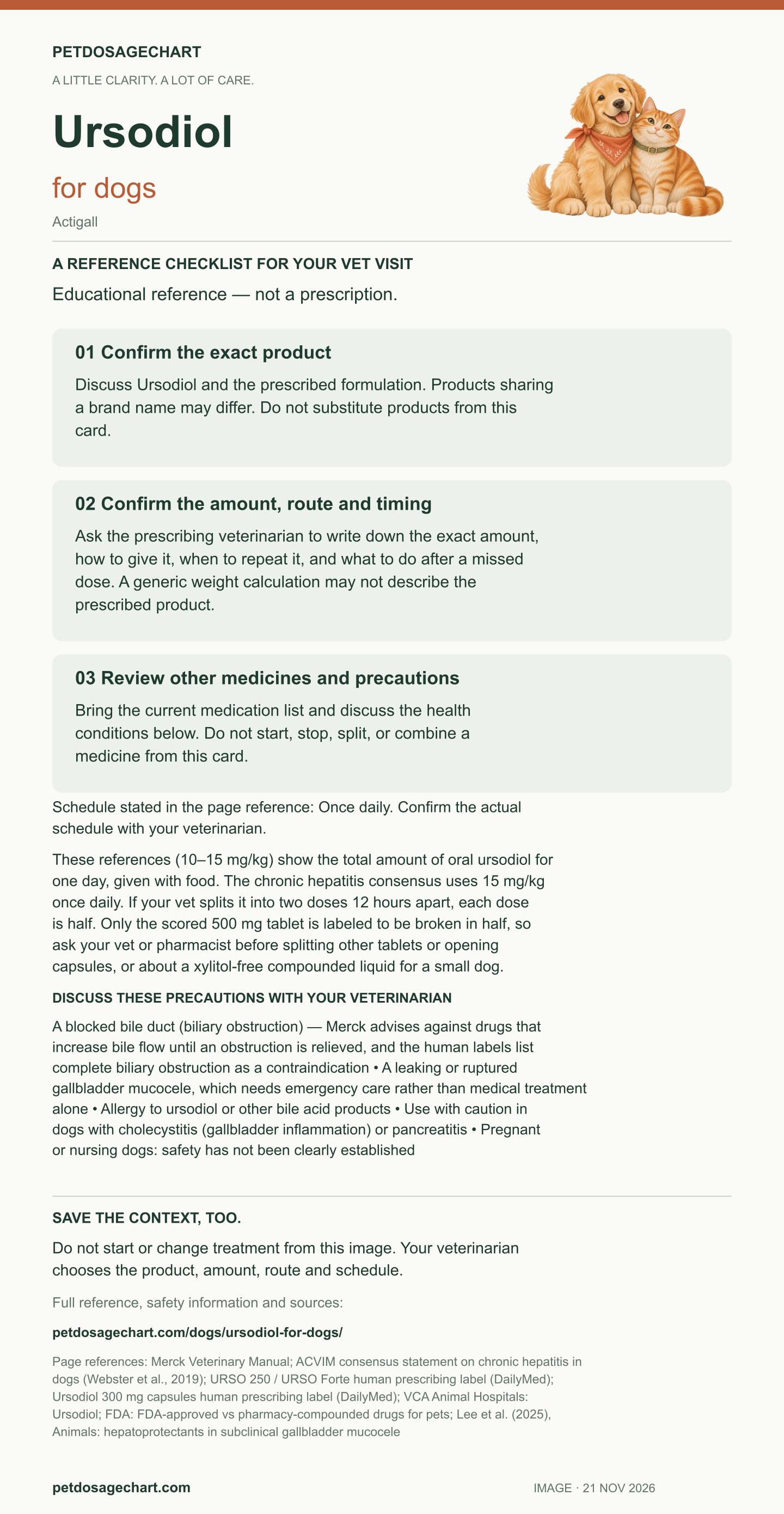
Keep a copy of the reference checklist
Educational reference, not a prescription. Your veterinarian sets the actual dose, product and schedule.
What the source establishes
Describes ursodiol as a naturally occurring bile acid that increases bile flow and suppresses the liver’s synthesis and secretion of cholesterol. In small animals it may be useful for cholesterol-containing gallstones, idiopathic hepatic lipidosis and chronic active hepatitis, and “the dosage in dogs and cats is 15 mg/kg, PO, every 24 hours.”
A pharmacology overview. It does not choose the dose for a particular liver or gallbladder condition or for an individual dog or cat.
Merck Veterinary Manual: Drugs That Affect Digestive Functions in Monogastric Animals — Ursodiol paragraph (full review May 2023, updated Sept 2024).
Lists ursodeoxycholate (ursodiol) at 15 mg/kg by mouth once a day, given with food to increase bioavailability, and encourages generic 250 mg tablets and 300 mg capsules. It is indicated for dogs with chronic hepatitis that show cholestasis, bile-ductule inflammation or suspected bile-borne infection. Adverse effects are rare nausea and diarrhea, with a mild effect on serum bile acid levels.
Expert consensus for chronic hepatitis. The panel notes there is little veterinary evidence that hepatoprotectants such as ursodiol work; it is adjunctive treatment chosen by a veterinarian.
Webster et al. (2019): ACVIM consensus statement on the diagnosis and treatment of chronic hepatitis in dogs — J Vet Intern Med 33:1173–1200; section 7.4 and Table 19 (hepatoprotective medications).
Gives ursodeoxycholic acid at 10–15 mg/kg divided every 12 hours, with food to increase bioavailability, and states that choleretics “should not be used until EHBDO is decompressed” (extrahepatic bile duct obstruction).
Applies to inflammatory disease of the bile ducts and liver. It is not a dose for gallbladder mucocele or for an individual dog.
Merck Veterinary Manual: Canine Cholangiohepatitis — Treatment: Choleretics (full review Aug 2023, updated Sept 2024).
For dogs without signs of mucocele leakage or biliary obstruction at diagnosis, suggests ursodeoxycholic acid at 15–25 mg/kg by mouth, divided every 12 hours and given with food, with blood tests and ultrasound every 6 weeks. An evolving mucocele rarely resolves with medical treatment, and worsening calls for surgery. Dogs progressing to rupture usually show abdominal pain, jaundice, a fast heart rate, fast breathing and fever. Hyperadrenocorticism, hypothyroidism and diabetes mellitus are listed as predisposing conditions.
The 15–25 mg/kg daily total is specific to managing a mucocele without leakage or obstruction. This divided regimen is not used in the once-daily calculator. Removing the gallbladder is the best treatment for most dogs with signs of inflammation, obstruction or rupture.
Merck Veterinary Manual: Canine Gallbladder Mucocele — Clinical findings; Treatment of Canine Gallbladder Mucocele (full review Aug 2023, updated Sept 2024).
Describes dark, gritty, sludged bile as most common in dogs with gallbladder dysmotility before a mucocele develops, and canine mucocele as reflecting gallbladder dysmotility.
Explains why sludge and mucoceles are discussed together. It gives no drug dose and does not say every dog with sludge needs treatment.
Merck Veterinary Manual: Pathological Changes in Bile in Small Animals — Sludged or inspissated bile; gallbladder mucocele (full review Aug 2023, updated Nov 2024).
Sixty dogs with immobile gallbladder sludge or an early mucocele, no clinical signs and no evidence of obstruction or rupture were assigned to three treatments for a year. The 20 dogs given ursodiol alone (10–15 mg/kg once daily, the range shown in this guide’s calculator) showed only mild improvement in sludge and liver enzymes, and no treatment-related complications were recorded.
A small study from one referral hospital without histologic confirmation; the authors call for larger randomized studies. It does not show that ursodiol dissolves sludge or avoids surgery.
Lee et al. (2025): Evaluation of hepatoprotectants in the management of subclinical gallbladder mucocele in dogs — Animals 15(20):3002; methods, results and limitations.
Human tablets come as URSO 250 (250 mg) and URSO Forte (a 500 mg scored tablet that can be broken in halves). The bitter halves keep for up to 28 days in the original bottle at 20–25°C, separated from whole tablets. Ursodiol recirculates through the gut and liver and is mainly excreted in feces. The label contraindicates use with complete biliary obstruction, asks prescribers to maintain bile flow and monitor liver tests, and says bile acid sequestrants (cholestyramine, colestipol) and aluminum-based antacids may interfere with absorption, while estrogens may counteract the drug.
A human label for primary biliary cholangitis. It supports product handling, human pharmacokinetics and label cautions; it does not set a dose for dogs.
URSO 250 / URSO Forte (ursodiol tablets) human prescribing label (Allergan, DailyMed) — Sections 2.2, 3, 4, 5.1, 7, 12.3 and 16 (human label).
The capsule strength is 300 mg, and the warnings refer to the product as Actigall. Human uses are dissolving certain gallstones and preventing gallstones during rapid weight loss. Patients with compelling reasons for gallbladder removal, including biliary obstruction and cholangitis, are among those who should not take it.
A human label cited only for the capsule strength, brand name and human-label cautions. Its human doses do not apply to dogs.
Ursodiol capsules USP, 300 mg, human prescribing label (Actavis/Teva, DailyMed) — Indications and Usage; Contraindications; Warnings; How Supplied (human label).
Says use in dogs and cats is off label, that ursodiol comes as a capsule, tablet or liquid suspension and should be given with food and not with antacids that contain aluminum, and that a missed dose should be skipped rather than doubled. VCA describes onset within 1 to 2 days. A canine washout time is not established by this handout. Lists diarrhea and mild discomfort as possible side effects, and says to stop giving ursodiol and contact the veterinarian immediately for vomiting, lack of appetite, tiredness or yellowing of the skin, eyes or gums. Advises caution with biliary obstruction, cholecystitis or pancreatitis and with aluminum-containing antacids, cholestyramine and taurine, notes falsely raised bile acid results, and recommends a liver panel before starting, at 1 and 3 months, then every 6 months.
An owner-facing hospital handout. It gives no dose and is not a complete interaction list.
VCA Animal Hospitals: Ursodiol (Forsythe and Gollakner, updated April 2025) — How is it given; missed dose; side effects; risk factors; interactions; monitoring; storage.
Explains that compounded animal drugs are not FDA-approved and that FDA does not verify their safety, effectiveness or quality, that compounding can turn tablets into a liquid or make a different strength, that veterinarians can prescribe FDA-approved human drugs for pets, and that owners can ask whether an approved drug with the same active ingredient could be used.
General agency guidance on compounding. It does not address ursodiol specifically.
FDA: Medicines for Your Pet — What's the Difference Between FDA-approved and Pharmacy-compounded Drugs? — Consumer update (content current as of 08/30/2024).
Separate sucralfate from other oral medications by at least two hours to avoid impaired absorption.
General spacing advice; the prescribing veterinarian sets the schedule.
VCA Animal Hospitals: Sucralfate — Administration.
Some liquid medications contain xylitol, which can cause hypoglycemia and liver injury in dogs.
Verify ingredients with the compounding pharmacy.
Merck Veterinary Manual: Xylitol Toxicosis in Dogs — Sources of exposure.
What Ursodiol Is Used For in Dogs
Ursodiol increases bile flow and makes bile salts less damaging to the liver. Veterinary references describe these uses in dogs:
- Chronic hepatitis with reduced bile flow. The ACVIM consensus statement recommends ursodiol for dogs with chronic hepatitis that show cholestasis (reduced bile flow), inflamed bile ductules or a suspected bile-borne infection. The same panel notes that there is little veterinary research proving how well it works, so it is one part of a wider treatment plan.
- Gallbladder sludge and mucocele. Thick, gritty “sludged” bile is most common in dogs whose gallbladder does not empty well, before a mucocele develops. For dogs with a mucocele but no sign of leakage or bile duct blockage, the Merck Veterinary Manual suggests ursodiol with blood tests and an ultrasound about every 6 weeks. A mucocele only rarely resolves with medicine, and removing the gallbladder is the best treatment for most dogs with signs of inflammation, blockage or rupture.
- Gallstones and inflamed bile ducts. Merck lists cholesterol-containing gallstones and cholangiohepatitis among the conditions where ursodiol may be used.
In a 2025 study of 60 dogs with sludge or an early mucocele but no symptoms, the dogs given ursodiol alone showed only mild improvement over a year. That is why your vet rechecks bloodwork and ultrasound to judge whether ursodiol is helping your dog.
Merck lists hyperadrenocorticism (Cushing’s disease), hypothyroidism and diabetes as conditions that make mucoceles more likely. If your dog has one of them, the trilostane (Vetoryl) reference for Cushing’s disease and the levothyroxine reference for hypothyroid dogs cover those treatments. They treat the underlying condition and are not gallbladder medicines.
Ursodiol Tablets, Capsules and Compounded Liquids
Ursodiol products are human medicines. The human labels list 250 mg tablets (Urso 250), 500 mg scored tablets that can be broken in half (Urso Forte), and 300 mg capsules (the Actigall strength). The ACVIM consensus statement encourages generic versions. The human labels’ doses are for human diseases, so never give your dog ursodiol that was prescribed for a person.
A small dog’s dose may not match any tablet or capsule, so your vet may ask a pharmacy to compound a liquid or a different strength. The FDA notes that compounded drugs are not FDA-approved, and that FDA does not check their safety, effectiveness or quality. Ask your vet whether an approved human product could work, and have the pharmacist confirm any liquid is xylitol-free before measuring it. Xylitol is toxic to dogs.
How to Give Ursodiol to Your Dog
Give ursodiol by mouth with food, which increases how much is absorbed, at the same time each day. If your vet prescribes it twice daily, give half of the daily amount every 12 hours with a meal. If you miss a dose, VCA Animal Hospitals advises skipping it and continuing the usual schedule; never give two doses at once. Only the scored 500 mg tablet is labeled to be broken in half, so ask your vet or pharmacist before splitting other tablets or opening capsules. The URSO Forte label says its bitter half-tablets can be kept for up to 28 days in the original bottle at 20–25°C, separate from whole tablets. Protect the medicine from moisture and light.
VCA Animal Hospitals says not to give ursodiol with antacids that contain aluminum. The human labels say aluminum-based antacids and bile acid binders such as cholestyramine may reduce how much ursodiol is absorbed, and VCA also advises caution with taurine supplements. Ursodiol is not a stomach-acid reducer like omeprazole for dogs or a stomach-lining protectant like sucralfate for dogs. They are different medicines, not substitutes for each other. If your dog also takes sucralfate or an antacid, give sucralfate at least 2 hours apart from ursodiol and ask your vet to schedule any antacid, and tell your vet about every medication and supplement your dog takes.
Duration of clinical effect in dogs is uncertain. The human label describes recirculation through the liver and intestine and mainly fecal excretion. Use the veterinary dosing schedule rather than assuming the drug has cleared after a day. VCA recommends a liver panel before starting ursodiol, then at one month, three months and every six months. For a gallbladder mucocele, Merck suggests blood tests and an ultrasound about every 6 weeks. Ursodiol can falsely raise serum bile acid test results, so remind the clinic that your dog takes it before a bile acid test.
Side Effects and Safety
The ACVIM consensus statement describes nausea and diarrhea as rare, and VCA lists diarrhea and mild stomach discomfort as possible side effects. VCA advises that if your dog develops vomiting, loss of appetite, unusual tiredness, or yellowing of the skin, eyes or gums, you stop giving ursodiol and contact your veterinarian immediately.
Ursodiol should not be used while a bile duct is blocked. The Merck Veterinary Manual says drugs that increase bile flow should not be used until a bile duct obstruction is relieved, and the human labels list complete biliary obstruction as a contraindication. A mucocele that is leaking or has ruptured needs emergency care. VCA also advises caution in pets with gallbladder inflammation (cholecystitis) or pancreatitis, and notes that safety in pregnant or nursing animals has not been clearly established.
When Actigall should be used with caution or avoided
Some dogs should not take Actigall, or need a different dose and closer monitoring. Tell your veterinarian about your pet's full health history and every other medication or supplement they take before giving Actigall.
- A blocked bile duct (biliary obstruction) — Merck advises against drugs that increase bile flow until an obstruction is relieved, and the human labels list complete biliary obstruction as a contraindication
- A leaking or ruptured gallbladder mucocele, which needs emergency care rather than medical treatment alone
- Allergy to ursodiol or other bile acid products
- Use with caution in dogs with cholecystitis (gallbladder inflammation) or pancreatitis
- Pregnant or nursing dogs: safety has not been clearly established
Actigall drug interactions
Actigall can interact with other drugs. This list is not complete — always give your veterinarian a full list of your dog's medications and supplements.
When not to use this calculator
This calculator gives a general educational estimate for a healthy adult dog at a known weight. Do not rely on it in these situations — talk to your veterinarian instead:
- In an emergency, or after accidental ingestion or a suspected overdose
- For pregnant or nursing pets
- For very young or very old dogs
- For pets with liver disease, kidney disease, or another chronic illness
- For pets taking several medications at once
- When you are not sure of your dog's current, accurate weight
- For combination products that contain additional active ingredients
Suspected overdose: what to do
If you think your dog had too much Actigall, or swallowed any medication by accident, act right away. Do not wait for symptoms to appear.
- Call your veterinarian or the nearest emergency animal hospital.
- ASPCA Animal Poison Control Center: (888) 426-4435
- Pet Poison Helpline: (855) 764-7661
A consultation fee may apply to the poison hotlines. Have the medication packaging ready, and note how much your pet may have taken and when. Do not try to make your pet vomit unless a veterinarian tells you to.
When to Call the Vet
If your dog shows any of the following, contact your veterinarian or an emergency clinic immediately:
- Vomiting, refusing food, unusual tiredness, or yellowing of the gums, eyes or skin (jaundice): stop giving ursodiol and call your vet right away
- Belly pain, a swollen belly, fever or fast breathing (possible gallbladder rupture or bile duct blockage — an emergency)
- Your dog ate extra tablets or capsules or got into the bottle
Ursodiol for Cats
Ursodiol is also prescribed off-label for some cats with liver disease. The Merck Veterinary Manual lists idiopathic hepatic lipidosis (fatty liver) among its small-animal uses and gives the same 15 mg/kg once-daily amount for cats as for dogs. This site has no cat ursodiol calculator, and a cat’s dose and monitoring plan must come from its own veterinarian.
Frequently Asked Questions
Questions about this medication
What is the usual ursodiol dosage for dogs?
Should ursodiol be given with food?
What is ursodiol used for in dogs?
Will ursodiol dissolve my dog’s gallbladder sludge or mucocele?
When should a dog not take ursodiol?
Can my dog take human ursodiol, and is there a liquid?
How will my vet monitor a dog on ursodiol?
What weight alone cannot tell you
The calculator performs one narrow job: it multiplies your dog's weight by the lower, standard, and upper mg/kg values recorded for Actigall. It cannot decide whether this drug, indication, formulation, or schedule is appropriate for an individual animal.
Context in this medication record
- Commonly listed uses
- Liver disease with reduced bile flow (cholestasis), Chronic hepatitis, Gallbladder mucocele or immobile sludge without blockage or leakage, Cholesterol-containing gallstones, Cholangiohepatitis (inflamed bile ducts and liver)
- Recorded forms
- Tablet (250 mg; 500 mg scored), Capsule (300 mg), Compounded oral liquid (pharmacy-prepared, not FDA-approved)
- Reference timing
- Once daily; onset 1-2 days (changes may only show on lab tests); duration Duration in dogs is uncertain; follow the prescribed schedule
Individual checks a calculator cannot perform
- Confirm the diagnosis and the reason this medication is being considered.
- Match the exact product, concentration, route, and whether a tablet may be split.
- Account for age, pregnancy, organ function, genetics, allergies, and prior reactions.
- Review every prescription, over-the-counter product, and supplement your pet takes.
Recorded cautions
A blocked bile duct (biliary obstruction) — Merck advises against drugs that increase bile flow until an obstruction is relieved, and the human labels list complete biliary obstruction as a contraindication; A leaking or ruptured gallbladder mucocele, which needs emergency care rather than medical treatment alone; Allergy to ursodiol or other bile acid products; Use with caution in dogs with cholecystitis (gallbladder inflammation) or pancreatitis; Pregnant or nursing dogs: safety has not been clearly established.
Recorded interactions
Aluminum-containing antacids (may bind ursodiol and reduce absorption); Cholestyramine and other bile acid binders; Taurine supplements; Estrogens (listed on the human label as counteracting ursodiol); Sucralfate can interfere with absorption. Give it at least 2 hours apart from ursodiol on the schedule your veterinarian sets..
These lists reproduce the structured record used by this page and may not be exhaustive. Show your veterinarian the product label and your dog's complete medication list before acting on a number.
About this reference
- Onset
- 1-2 days (changes may only show on lab tests)
- Duration
- Duration in dogs is uncertain; follow the prescribed schedule
- Class
- Bile acid (choleretic)
Sources & references
The structured medication record behind this page names the references below. The links open the publisher or official resource; they do not turn this page into a prescription for an individual animal.
- Merck Veterinary Manual: Drugs That Affect Digestive Functions in Monogastric Animals
Ursodiol paragraph (full review May 2023, updated Sept 2024). Supports the specific claim described above; it is not a review of the entire page.
- Webster et al. (2019): ACVIM consensus statement on the diagnosis and treatment of chronic hepatitis in dogs
J Vet Intern Med 33:1173–1200; section 7.4 and Table 19 (hepatoprotective medications). Supports the specific claim described above; it is not a review of the entire page.
- Merck Veterinary Manual: Canine Cholangiohepatitis
Treatment: Choleretics (full review Aug 2023, updated Sept 2024). Supports the specific claim described above; it is not a review of the entire page.
- Merck Veterinary Manual: Canine Gallbladder Mucocele
Clinical findings; Treatment of Canine Gallbladder Mucocele (full review Aug 2023, updated Sept 2024). Supports the specific claim described above; it is not a review of the entire page.
- Merck Veterinary Manual: Pathological Changes in Bile in Small Animals
Sludged or inspissated bile; gallbladder mucocele (full review Aug 2023, updated Nov 2024). Supports the specific claim described above; it is not a review of the entire page.
- Lee et al. (2025): Evaluation of hepatoprotectants in the management of subclinical gallbladder mucocele in dogs
Animals 15(20):3002; methods, results and limitations. Supports the specific claim described above; it is not a review of the entire page.
- URSO 250 / URSO Forte (ursodiol tablets) human prescribing label (Allergan, DailyMed)
Sections 2.2, 3, 4, 5.1, 7, 12.3 and 16 (human label). Supports the specific claim described above; it is not a review of the entire page.
- Ursodiol capsules USP, 300 mg, human prescribing label (Actavis/Teva, DailyMed)
Indications and Usage; Contraindications; Warnings; How Supplied (human label). Supports the specific claim described above; it is not a review of the entire page.
- VCA Animal Hospitals: Ursodiol (Forsythe and Gollakner, updated April 2025)
How is it given; missed dose; side effects; risk factors; interactions; monitoring; storage. Supports the specific claim described above; it is not a review of the entire page.
- FDA: Medicines for Your Pet — What's the Difference Between FDA-approved and Pharmacy-compounded Drugs?
Consumer update (content current as of 08/30/2024). Supports the specific claim described above; it is not a review of the entire page.
- VCA Animal Hospitals: Sucralfate
Administration. Supports the specific claim described above; it is not a review of the entire page.
- Merck Veterinary Manual: Xylitol Toxicosis in Dogs
Sources of exposure. Supports the specific claim described above; it is not a review of the entire page.
- Merck Veterinary Manual — listed in this medication's source record.
- ACVIM consensus statement on chronic hepatitis in dogs (Webster et al., 2019) — listed in this medication's source record.
- URSO 250 / URSO Forte human prescribing label (DailyMed) — listed in this medication's source record.
- Ursodiol 300 mg capsules human prescribing label (DailyMed) — listed in this medication's source record.
- VCA Animal Hospitals: Ursodiol — listed in this medication's source record.
- FDA: FDA-approved vs pharmacy-compounded drugs for pets — listed in this medication's source record.
- Lee et al. (2025), Animals: hepatoprotectants in subclinical gallbladder mucocele — listed in this medication's source record.
- DailyMed label search for Ursodiol — check current product and formulation labels; some veterinary uses may be off-label.
Specific citations above support the identified claims. Other source names remain record-level references; further claim review is still needed. Read our methodology and limitations.
How this page was made
This page's structured medication record lists the source names below. PetDosageChart applies the record's mg/kg values to the entered weight and presents the arithmetic result. A source record is not the same as an individualized prescription or an independent clinical review.
- Sources cited
-
- Merck Veterinary Manual
- ACVIM consensus statement on chronic hepatitis in dogs (Webster et al., 2019)
- URSO 250 / URSO Forte human prescribing label (DailyMed)
- Ursodiol 300 mg capsules human prescribing label (DailyMed)
- VCA Animal Hospitals: Ursodiol
- FDA: FDA-approved vs pharmacy-compounded drugs for pets
- Lee et al. (2025), Animals: hepatoprotectants in subclinical gallbladder mucocele
- Calculator formula
- Doses scale linearly from a standard basis of 15 mg per kg (6.80 mg per lb) of body weight, given Once daily. The calculator multiplies that basis by your dog's weight and shows an arithmetic comparison with recorded tablet sizes. That comparison does not determine whether a tablet is scored, splittable, or appropriate for your pet.
- Editorial owner
- Prepared and maintained by the PetDosageChart editorial team, a software-led publisher and not a veterinary practice.
- DVM review status
- Not independently DVM-reviewed. A named reviewer and review date appear here only after a confirmed review.
More on our methodology and editorial process — how we source, calculate, and review dogs dosage data.
More resources
- Pet Medication Safety Hub — What's safe, what's dangerous, and emergency signs
- How we calculate dosages — Our sources, math, and review process
- Printable emergency checklist — One-page reference for your fridge or first aid kit
More tools: common weights and embed code
By Weight
Actigall reference by dog weight
Choose a common weight to open its optional reference page. Use the main medication calculator for a different exact weight.
Common-weight pages are convenience views of the same educational reference, not separate medical recommendations.
Embed this calculator on your site
Get a free Ursodiol dosage widget
Get embed code
Embed this calculator on your site
Get a free Ursodiol dosage widget
Free forever. Works in any blog post or article. Adds a small "Powered by petdosagechart.com" credit and a one-line text link below the widget.